rotating globe
3 Apr 2026


Apple, Amazon reject 6 GHz proposal

Tech giants tell TRAI the band isn’t ready for mobile use and should remain with Wi-Fi until global studies conclude

Global technology companies including Apple, Amazon, Meta, Cisco and Intel have opposed Reliance Jio and Vodafone Idea’s push to allocate the 6 GHz band for mobile services, telling TRAI that the spectrum is not yet suitable for IMT use and should be kept for Wi-Fi in the near term.

These firms submitted a joint response to TRAI’s ongoing consultation, arguing that the upper 6 GHz range (6425–7125 MHz) is still under global study and lacks technical readiness for mobile networks. They said opening it for Wi-Fi would immediately support India’s rising dependence on high-capacity wireless broadband across homes, businesses and public spaces.

The group has recommended that India wait until after the 2027 World Radiocommunication Conference, when global norms for the band are expected to be finalised. Until then, they want the band preserved for unlicensed use, which they believe will expand affordable, high-speed Wi-Fi access.

India has already delicensed 500 MHz in the lower 6 GHz band, while around 400 MHz is expected to be put up for auction in the coming spectrum sale. Telecom operators, however, want more. Jio, in particular, has asked the government to release the entire 1,200 MHz of the band for mobile services, calling it essential for future 6G-ready networks.

The Cellular Operators Association of India (COAI), which represents Jio, Airtel and Vi, has warned against further delicensing, saying it could weaken mobile network capacity and reduce government revenues from auctions. COAI argues that mobile operators need access to large, contiguous blocks of mid-band spectrum to meet India’s growing data demand.

Chipmaker Qualcomm has sided with the global tech companies, emphasising that India should align with international studies before auctioning the upper 6 GHz band.

With telcos pushing for more spectrum and global tech giants urging caution, TRAI now faces the task of balancing long-term mobile network requirements with the immediate benefits of strengthening the country’s Wi-Fi ecosystem. A final decision is expected after the regulator reviews all stakeholder submissions.

Also Read: Justice Surya Kant becomes India’s 53rd Chief Justice

US–Ukraine advance revised peace plan talks

Stronger guarantees offered, but hard choices still await Ukraine

The US and Ukraine have taken a cautious step forward in reviving efforts to end the war with Russia, unveiling a revised peace framework after a long and intense round of talks in Geneva. The updated proposal, shaped from the Trump administration’s earlier 28-point plan, now carries what US officials say are firmer and more enforceable security guarantees for Ukraine.

For Washington, the latest discussions were a rare moment of optimism. US Secretary of State Marco Rubio described the Geneva meeting as the most constructive engagement since President Trump returned to office, calling the draft a “living document” that will continue to evolve with feedback from all sides.

But for Ukraine, the path ahead remains emotionally and politically difficult. The proposal still leaves unanswered questions on issues central to Ukraine’s future, possible territorial compromises, limits on its military strength, and how its sovereignty will be protected in the long term. These are the choices that President Volodymyr Zelenskyy has called “painful,” warning that Ukraine must guard its principles even as it leans on US support.

European leaders involved in the process have also pushed to ensure the plan does not tilt unfairly toward Russia. They want any territorial negotiations to start from current battle lines rather than assumptions that disadvantage Kyiv.

Russia, meanwhile, has responded with cautious approval. President Vladimir Putin has indicated the plan could serve as a base for a final settlement, although Moscow’s demands, including military restrictions on Ukraine, are still being negotiated.

More rounds of talks are expected, and both Washington and Kyiv say the true test will be whether the security guarantees offered on paper translate into protection Ukraine can rely on. For now, the revised framework signals movement but not certainty.

Also Read: Justice Surya Kant becomes India’s 53rd Chief Justice

Delhi marks Nov. 25 holiday for Guru Tegh Bahadur

The capital observes 350th Shaheedi Diwas with ceremonies and prayers

The Delhi government has announced that 25 November will be a public holiday, dedicated to the Shaheedi Diwas of Guru Tegh Bahadur, the ninth Sikh Guru whose martyrdom stands as one of the most powerful symbols of courage and freedom of faith in Indian history.

The declaration transforms what was earlier meant to be a restricted holiday into a full public holiday. The city will host a large gathering of devotees and community organisations observing the 350th Shaheedi Diwas. Events and prayers have been underway at prominent locations, including the Red Fort, where thousands have been paying homage over the past three days.

Chief Minister Rekha Gupta, while announcing the decision, said Guru Tegh Bahadur’s life continues to remind us of the value of standing up for others, even when it comes at a great personal cost. She added that this day is not only important for Sikh communities but is a moment of reflection for the nation as a whole.

With the new notification, all Delhi government offices, public schools, and departments will remain closed on Tuesday. Essential services, including emergency healthcare facilities, public transport, and utility services, will operate without interruption. The Delhi Metro and city buses will run on their regular schedules to ensure commuters are not inconvenienced. Banks, however, will remain open as they follow the RBI’s regional holiday calendar.

The holiday holds particular emotional weight for Sikh families in the national capital, home to many historical sites linked to the Guru’s legacy. Delhi’s Gurdwaras are preparing for large footfalls, and several langars, prayer services, and historical exhibitions have been planned through the day.

Guru Tegh Bahadur was executed in 1675 after refusing to renounce his faith and defending the right of others to practise theirs. His martyrdom is remembered as an act of immense spiritual and moral resolve. For many in Delhi, the holiday marks not just a day of remembrance but a chance to reconnect with values of tolerance, sacrifice and unity.

Also Read: Apple, Amazon, Meta reject Jio–Vi 6 GHz proposal

G20 backs declaration despite US boycott

Johannesburg summit adopts joint statement focused on climate, debt relief and global peace

South Africa announced that G20 leaders have approved a joint declaration at the Johannesburg summit, even though the United States chose to boycott the meeting. As the first G20 summit hosted in Africa, South Africa was determined to ensure that the event produced a united outcome.

The US stayed away from the summit because it disagreed with South Africa’s agenda, particularly the strong emphasis on climate action, clean energy, and financial support for developing nations. Washington had even urged South Africa not to issue a joint declaration without its participation, but South Africa rejected the request.

President Cyril Ramaphosa said there was broad support for the declaration and thanked participating leaders for working “in good faith.” South African officials also made it clear that the document is final and will not be reopened for changes.

The declaration focuses on several major issues, including the urgent need to tackle climate change, easing the heavy debt burden on poorer countries, encouraging nations with critical minerals to build value-added industries, and pushing for peace in ongoing conflict zones such as Sudan, Ukraine, and Palestine.

South Africa also dismissed the US offer to send only a lower-ranking diplomat for the G20 presidency handover, which Ramaphosa criticised as “empty chair diplomacy.” Despite the diplomatic tensions, South Africa says the adopted declaration reflects strong cooperation among member nations and highlights the priorities of the developing world.

Also Read: PM Modi in South Africa, calls for AI growth

RBI, ECB to link UPI with Europe’s TIPS

New digital payments corridor to simplify remittances and business transfers

Sending money from India to Europe could soon be as simple as a UPI transfer at home. The Reserve Bank of India (RBI) is partnering with the European Central Bank (ECB) to link India’s Unified Payments Interface (UPI) with Europe’s instant payment system, TARGET Instant Payment Settlement (TIPS). The move aims to make cross‑border payments faster, cheaper, and hassle‑free.

The project is being implemented through NPCI International Payments Ltd (NIPL), the global arm of India’s National Payments Corporation (NPCI). Once operational, the UPI‑TIPS connection will benefit Indian travellers, exporters, fintech companies, and businesses by simplifying international payments and lowering transaction costs.

This initiative is part of a wider global push, supported by the G20, to make cross‑border payments quicker, more transparent, and cost-effective. India has already extended UPI to countries like Singapore, and Europe is now the next frontier for its growing digital payments network.

Officials say technical integration, settlement mechanisms, and risk management frameworks are still being finalised. The rollout will be phased to ensure smooth operations while meeting regulatory, currency conversion, and cross-border compliance requirements.

The UPI‑TIPS link is expected to strengthen India’s global digital payments presence, offering individuals and businesses a faster, more efficient, and cost-friendly way to send money abroad.

Also Read: Four new labour codes to benefit 40 crore workers

Rupee slides past ₹89, sets new record low

Rising imports, US trade tensions, and a strong dollar weigh on India’s currency, hitting markets and corporate costs

The Indian rupee fell sharply on Friday, crossing the ₹89 mark against the US dollar — a record low. The fall was the steepest single-day drop since May, raising concerns about the currency’s stability.

Experts say several factors are weighing on the rupee. A strong US dollar, backed by solid economic data and reduced chances of a rate cut by the Federal Reserve, has made the rupee look weaker. Meanwhile, trade tensions with the US, including sanctions on some Indian firms involved in oil transactions with Iran, have added uncertainty.

Domestically, the trade deficit is widening as exports slow and imports, including gold, rise. Foreign investors have also pulled billions out of Indian markets this year, adding to the pressure on the rupee.

Analysts warn that the rupee could test ₹90 or more if these trends continue. The Reserve Bank of India (RBI) stepped in to support the currency after it breached ₹89, but its governor noted that there is no fixed target for the rupee’s value.

The rupee’s slide highlights India’s vulnerability to global market swings and domestic challenges. Without a shift in these factors, the currency may remain under pressure in the coming weeks, affecting markets and daily life alike.

For ordinary Indians, a weaker rupee can make foreign travel, education, and imported goods more expensive. For businesses, it raises the cost of imports while offering limited help to exporters facing slower global demand and tariffs.

Also Read: RBI, ECB to connect UPI with Europe’s instant payments

Amazon cuts 14,000 jobs, 40% are engineers


Amazon is undertaking its largest-ever workforce reduction, cutting around 14,000 corporate jobs globally. The biggest impact has been on engineering roles, which account for nearly 40% of the cuts in key states like New York, California, New Jersey, and Washington.

Within engineering, mid-level software development engineers (SDE II) were the most affected. These employees are crucial in building and delivering Amazon’s products, sitting between entry-level staff and senior technical leaders.

The layoffs are partly driven by strategic shifts, including pulling back from areas like gaming projects and certain visual‑search AI shopping initiatives. Amazon’s aim is to streamline operations, flatten management layers, and make teams more agile, in line with CEO Andy Jassy’s push for startup-style efficiency.

Despite heavy investments in cloud computing and AI, Amazon is focusing on reducing the number of roles while increasing ownership and responsibility per employee. The company emphasizes that this is not about replacing workers with AI, but about optimizing team structure for faster decision-making.

Impacted employees are being given 90 days to apply for internal roles, and those who do not find a new position will receive severance pay, job transition support, and continued health benefits.

Also Read: Four new labour codes to benefit 40 crore workers

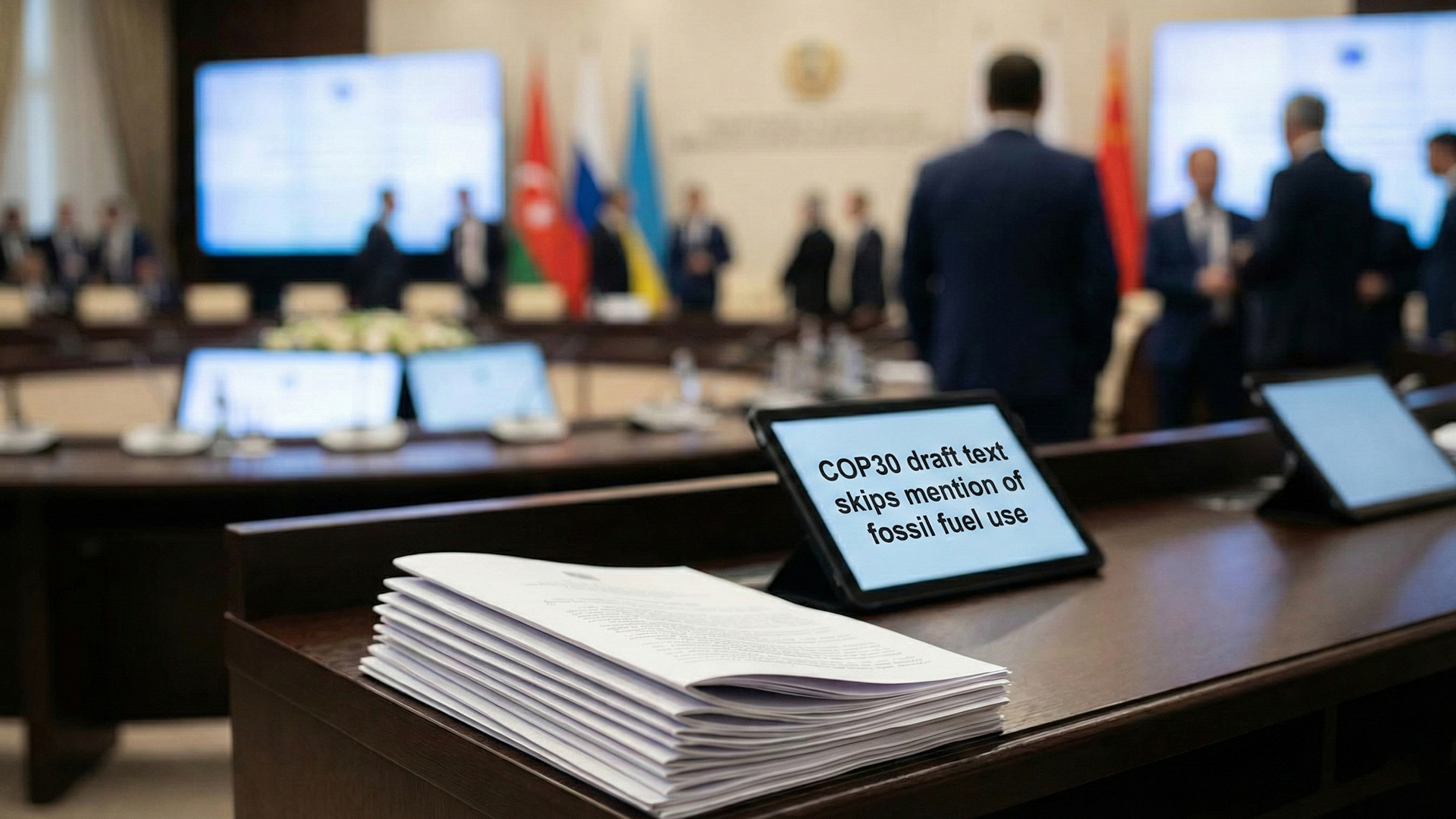
COP30 draft ignites tension over fossil fuels

Latest climate deal draft drops roadmap for phasing out oil, gas, and coal, sparking criticism from major nations

At the COP30 climate summit in Belém, Brazil, a new draft deal has stirred controversy by omitting any plan to phase out fossil fuels. Earlier versions had included a “roadmap” showing how countries could reduce dependence on coal, oil, and gas, but the latest text removed all such references.

Over 80 countries had pushed for a clear fossil fuel phase-out, citing its importance in meeting global climate targets. However, oil-producing nations argued that a phase-out could harm their economies, leading to a standoff in negotiations.

The European Union criticized the draft as too weak, insisting that a commitment to reduce fossil fuel use must be included. Meanwhile, a major issue remains financing climate adaptation. The draft proposes tripling funds for poorer nations by 2030, but details on who will provide the money, governments, banks, or private institutions, remain unclear.

Adding to the challenges, a fire broke out at the conference venue, forcing evacuations and delaying talks. Despite these disruptions, summit organizers urge countries to find common ground before the conference concludes.

Experts warn that leaving fossil fuels unaddressed could undermine global efforts to curb climate change. As one COP30 official noted, “Without a roadmap for phasing out oil, gas, and coal, the world risks falling short of the targets agreed in previous climate accords.”

The COP30 summit now faces pressure to reconcile the economic interests of oil-producing nations with the urgent need for climate action, while securing financial support for vulnerable countries. The outcome of these talks could shape global climate policy for years to come.

Also Read: Fátima Bosch of Mexico wins Miss Universe 2025