rotating globe
6 Apr 2026


IAF battles forest fires in Lohit valley, Arunachal

Helicopters drop 12,000 litres of water to contain blaze in Lohit Valley, protect forests and nearby villages

The Indian Air Force (IAF) mounted a challenging aerial firefighting operation to control a forest fire raging in Arunachal Pradesh’s remote Lohit Valley, dropping nearly 12,000 litres of water over the affected area. The operation was carried out using Mi-17V5 helicopters, flying at an altitude of around 9,500 feet in difficult Himalayan conditions.

The fire broke out in dense forested slopes where ground access is extremely limited due to steep terrain and lack of roads. Dry vegetation and seasonal winds helped the flames spread quickly, raising concerns for nearby villages and wildlife habitats. With ground teams struggling to reach the core fire zone, aerial intervention became critical.

IAF helicopters conducted multiple sorties, carefully releasing water over active fire lines to slow the spread and bring down temperatures. The Air Force described the mission as demanding, requiring precision flying in thin air and narrow valleys, but stressed that such operations are vital to support civil authorities during natural emergencies.

On the ground, teams from the state forest department, district administration and the Indian Army worked alongside the aerial effort. They cleared fire lines, monitored vulnerable areas and ensured that the flames did not advance towards inhabited zones. As a precaution, residents of a few vulnerable hamlets were moved to safer locations. Officials confirmed that no loss of life or damage to civilian property has been reported so far.

Forest officials said the exact cause of the fire is yet to be confirmed, though dry winter conditions often make the region prone to such incidents. Arunachal Pradesh, with its rich biodiversity and dense forests, faces repeated threats from seasonal forest fires, which can cause long-term damage to soil, wildlife and fragile ecosystems.

Environmental experts have warned that frequent forest fires increase the risk of landslides and loss of native species, especially in ecologically sensitive Himalayan regions. Authorities have urged local communities to avoid open burning and report any signs of fire immediately.

The IAF said it remains on standby and will continue aerial firefighting support if new hotspots emerge. The coordinated air-and-ground response, officials said, played a key role in containing the blaze and safeguarding both people and the environment in the Lohit Valley.

Also Read: India to host India‑Arab foreign ministers meet

 

Ranveer Singh faces FIR for ‘Kantara’ act

Actor faces legal action for allegedly hurting religious sentiments during IFFI stage act

Bollywood actor Ranveer Singh is facing legal trouble in Bengaluru after a First Information Report (FIR) was filed against him for allegedly mocking a sacred ritual from the Kannada film Kantara, directed by Rishab Shetty.

The FIR was lodged at High Grounds Police Station by advocate Prashanth Methal, who said he came across a viral video of Ranveer’s stage performance at the International Film Festival of India (IFFI) closing ceremony in Goa on November 28, 2025. Methal alleged that Ranveer’s act mimicked expressions linked to Panjurli and Guliga Daiva rituals and referred to the revered Chavundi Daiva as a “female ghost,” which he claimed was derogatory and disrespectful.

The rituals in question form part of Bhuta Kola, a centuries-old spiritual tradition respected across Tulu-speaking regions of coastal Karnataka. According to the complainant, Ranveer’s performance distorted these sacred practices, causing distress among devotees and followers.

The FIR has been registered under Sections 196, 299, and 302, and the matter is now with the 1st Additional Chief Metropolitan Magistrate (CMM) Court in Bengaluru. The next hearing is scheduled for April 8, 2026.

Ranveer Singh had earlier issued a public apology on social media, stating that his intention was to celebrate Rishab Shetty’s performance and that he respects all traditions and cultures. Despite the apology, the FIR reflects that some sections of the public found his act insensitive to religious sentiments.

Also Read: Arijit Singh retires from playback singing

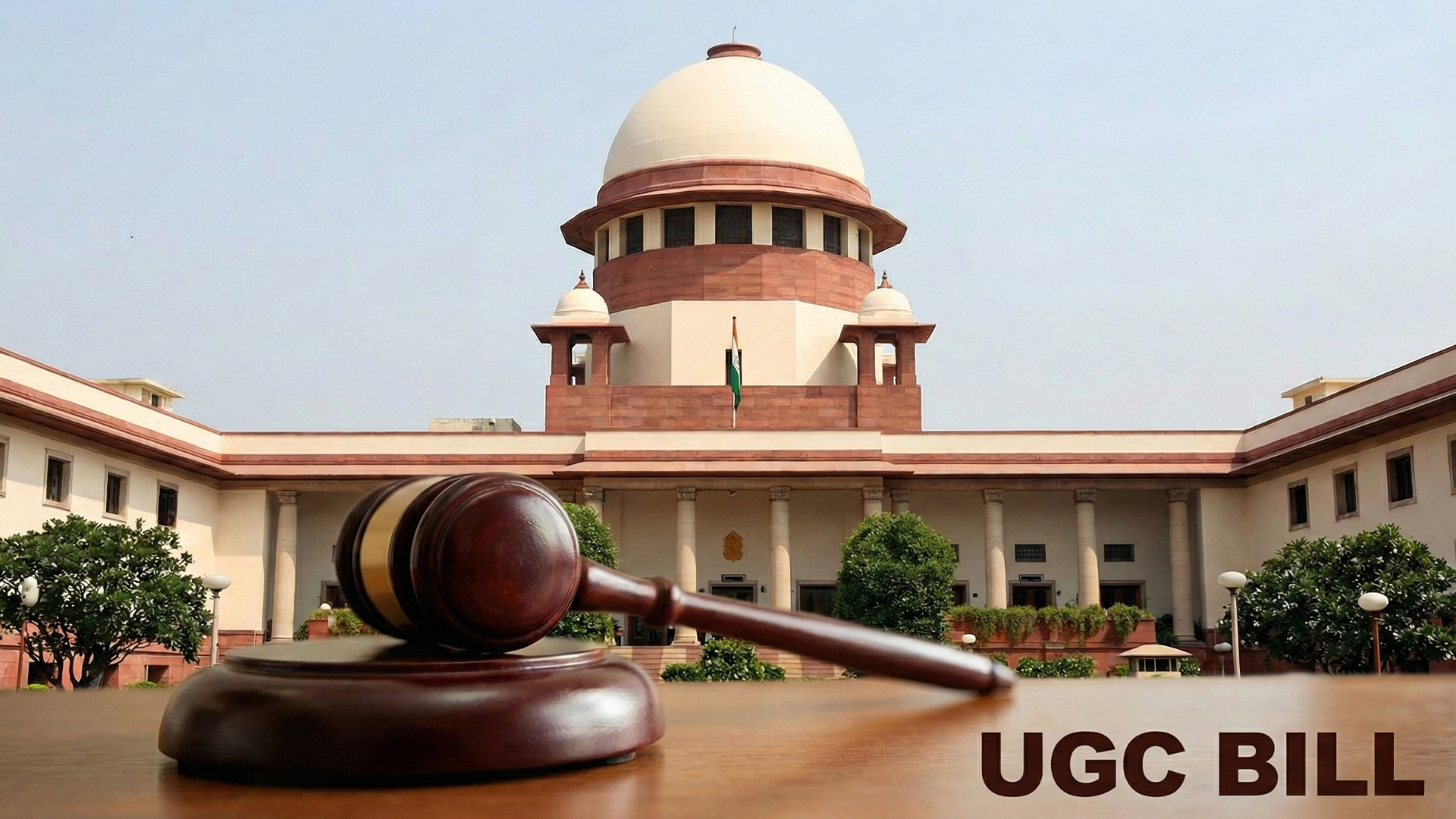
Supreme Court stays UGC equity regulations 2026

Top court halts new norms over vagueness and misuse concerns; old anti-discrimination rules remain in force

The Supreme Court of India has temporarily stayed the University Grants Commission’s (UGC) Promotion of Equity in Higher Education Institutions Regulations, 2026, citing vague language and the risk of misuse. Until the matter is fully heard, the 2012 UGC anti-discrimination regulations will continue to apply across all universities and colleges.

A bench led by Chief Justice Surya Kant and Justice Joymalya Bagchi heard multiple petitions challenging the 2026 regulations, which were framed to promote equity and curb discrimination on campus. Petitioners argued that the new rules focus primarily on Scheduled Castes (SC), Scheduled Tribes (ST), and Other Backward Classes (OBC), leaving general-category students outside the scope of Equal Opportunity Centres, grievance redressal mechanisms, helplines, and ombudsperson processes. Critics warned that this selective coverage could violate Articles 14 and 15 of the Constitution, which guarantee equality and non-discrimination.

The court observed that certain provisions were prima facie vague and potentially open to abuse, cautioning that implementing them without scrutiny could have “serious societal impacts” and may even divide communities. The bench issued notices to the Union of India and the UGC, directing them to respond before the next hearing, scheduled for March 19, 2026.

The Supreme Court’s decision comes amid widespread protests and public debates across several states, where students, faculty, and civil society groups expressed concerns about the equity regulations, demanding clarity and inclusive protection.

With the stay in place, the 2012 regulations remain the operative framework, ensuring that anti-discrimination measures continue without interruption. Legal experts say the interim order provides time for the judiciary to examine constitutional validity, ensure broader inclusivity, and prevent potential misuse of the 2026 rules.

Also Read: Ajit Pawar’s funeral with state honours

Google rolls out AI tools for JEE prep

Google's Gemini AI joins students and teachers to make learning smarter

Imagine having a personal tutor available anytime, anywhere,  that’s exactly what Google is bringing to India’s students. With its latest AI initiatives, the tech giant is making exam prep and classroom learning smarter, more interactive, and surprisingly accessible.

For millions of JEE Main aspirants, Google’s AI platform Gemini now offers free full-length mock tests. Students can simply ask Gemini to “take a JEE Main mock test,” and the AI generates questions from trusted Indian education partners like PhysicsWallah and Careers360, providing instant feedback and explanations. It’s like having a patient tutor who never gets tired of repeating tricky concepts,  helping students spot strengths, weaknesses, and where to focus next.

But Google isn’t stopping at exams. Its philanthropic arm, Google.org, is putting ₹85 crore into AI learning projects aimed at public schools and colleges. The initiative hopes to reach 75 million students and nearly 2 million teachers by 2027, introducing voice-based lessons, personalised study tools, and interactive classroom aids. Students can learn at their own pace, and teachers get tools to make lessons more engaging without extra stress.

On the higher education front, Chaudhary Charan Singh University (CCSU), Meerut, in partnership with Google Cloud and the Ministry of Skill Development and Entrepreneurship (MSDE), is launching India’s first AI-enabled university pilot. From AI tutors to multilingual support and automated administration, the project aims to make university learning more efficient, inclusive, and human-centric.

Also  Read: NASA unveils its supercomputer computer Athena

Economic Survey 2026 sees 7.4% GDP growth

Fastest-growing major economy, but external challenges persist

The Economic Survey 2026, tabled in Parliament on January 29 ahead of the Union Budget, presents an optimistic picture of India’s economy, highlighting strong growth, stable fundamentals and resilient domestic demand. At the same time, it cautions policymakers against global risks that could weigh on future momentum.

Prepared by the office of the Chief Economic Adviser and presented by Finance Minister Nirmala Sitharaman, the survey notes that India continues to be the fastest-growing major economy globally. The country’s GDP growth for FY26 is estimated at about 7.4 per cent, while growth for FY27 is projected in the range of 6.8 to 7.2 per cent, supported by consumption, investment and policy stability.

According to the report, private consumption has emerged as a key growth driver, backed by rising incomes, urban demand and steady rural recovery. Government capital expenditure, which remains at historically high levels, has also played a critical role in crowding in private investment and strengthening infrastructure development.

The survey highlights continued expansion in manufacturing and services, aided by production-linked incentive schemes, improving ease of doing business and stronger participation in global value chains. Services exports, particularly in IT and professional services, have touched record highs, helping cushion the economy against external shocks.

On the fiscal front, the survey points to improved macroeconomic stability, with the fiscal deficit narrowing steadily from pandemic-era levels. Tax collections, including GST and direct taxes, remain buoyant, providing room for sustained public spending while keeping debt levels in check.

However, the Economic Survey strikes a note of caution on the global outlook. It flags risks arising from geopolitical tensions, volatile commodity prices, financial market uncertainty and slowing global growth. The report also notes challenges related to currency movements and external capital flows, underscoring the need for prudent macroeconomic management.

Also Read: Ajit Pawar’s funeral in Baramati with state honours

NASA unveils its supercomputer computer Athena

Fastest, most efficient system to boost space and science research

NASA has launched its most powerful and energy-efficient supercomputer yet, called Athena. It can perform more than 20 quadrillion calculations every second, making it faster and smarter than any NASA computer before. Athena will help researchers run complex simulations, process huge amounts of data, and develop advanced artificial intelligence models.

The supercomputer is installed at NASA’s Ames Research Center in California, a hub for high-tech computing. It will support a wide range of NASA missions, including designing new spacecraft, simulating rocket launches, and studying our planet’s climate. By handling these tasks faster and more efficiently, Athena will save time and reduce costs for the agency.

NASA says Athena is not just for its internal projects. Scientists from outside the agency can also apply to use the system for projects connected to NASA’s work. This makes it a shared resource for research across space and Earth sciences.

The name Athena comes from the Greek goddess of wisdom and strategy, reflecting the computer’s role in supporting smart decisions and innovation. The name also connects symbolically to NASA’s Artemis program, which is focused on returning humans to the Moon.

Athena is part of NASA’s High-End Computing Capability, which combines supercomputers with cloud services. This setup lets scientists pick the best tools for different tasks, whether it’s AI, simulations, or analyzing scientific data.

NASA officials say Athena is an important step toward future discoveries. With this new computing power, the agency can tackle bigger challenges in space exploration, Earth observation, and science research. Athena will help NASA researchers turn complex ideas into real solutions faster than ever before.

Also Read: CISA Chief under review for ChatGPT file uploads

Nuclear risks, climate crisis push Doomsday clock

Scientists warn nuclear risks, climate crisis and AI threats are escalating worldwide

The world is closer to catastrophe than ever before, according to the Bulletin of the Atomic Scientists, which has moved the Doomsday Clock to 85 seconds before midnight, the closest point in its nearly eight-decade history.

The Doomsday Clock is a symbolic measure created in 1947 to warn humanity about existential threats of its own making. Midnight represents a global disaster, and the clock is reset each year by leading scientists based on risks such as nuclear conflict, climate change, biological threats and emerging technologies.

Announcing the latest update, scientists said the decision reflects a sharp rise in nuclear danger, worsening geopolitical conflicts, unchecked climate breakdown, and the growing risks posed by artificial intelligence.

They warned that relations among nuclear-armed states, particularly the United States, Russia and China,  have deteriorated, while arms-control agreements meant to reduce the risk of nuclear war are weakening or expiring. Ongoing conflicts, including Russia’s war in Ukraine and rising tensions in other regions, have increased the chances of miscalculation or escalation involving nuclear weapons.

Climate change was flagged as another accelerating threat. Scientists said governments continue to fall short on emissions cuts, even as extreme weather events become more frequent and destructive, increasing global instability and humanitarian crises.

A major new concern highlighted this year is the rapid development of artificial intelligence, especially its use in military systems and the spread of disinformation. Experts cautioned that AI-driven misinformation could undermine trust in institutions, fuel conflict and weaken democratic societies. They warned that the technology is advancing faster than global rules to control it.

Bulletin leaders stressed that the clock is not a prediction, but a warning. They said humanity still has the tools and knowledge to step back from the edge, but doing so requires urgent action, international cooperation and responsible leadership.

“The world is sending us clear danger signals,” the scientists said, urging governments to reduce nuclear risks, tackle climate change seriously, and put strong safeguards around powerful new technologies before it is too late.

Also Read: Trump issues Iran warning as US military inches closer

Trump warning to Iran as US military inches closer

US president presses Iran to accept a nuclear deal, signals military action if talks fail

US President Donald Trump has issued a strong warning to Iran, saying the country has very little time left to agree to a new nuclear deal with Washington. His message came as US warships, including the aircraft carrier USS Abraham Lincoln, entered the Middle East, increasing pressure on Tehran and raising fears of a fresh military confrontation.

In a public statement, Trump urged Iran’s leaders to return to negotiations and accept what he called a “fair deal” that would permanently block Iran from developing nuclear weapons. He made it clear that the United States wants diplomacy but is prepared to use force if talks fail. Trump warned that any future military action would be far more severe than earlier US strikes on Iranian nuclear sites.

The movement of American naval forces is being seen as a signal that the US is serious about its warning. Senior US officials said the deployment is meant to protect American interests and allies in the region, especially amid concerns about Iran’s missile and drone capabilities.

Iran responded cautiously but firmly. Its mission to the United Nations said Tehran is open to talks, but only if they are based on mutual respect. At the same time, Iran warned that it would strongly defend itself if attacked, saying any aggression would be met with a powerful response. Iranian leaders continue to deny that the country is seeking nuclear weapons, insisting its nuclear program is for peaceful purposes.

The growing tension has also affected global markets. Oil prices rose to their highest levels in months, as investors worried that conflict in the Middle East could disrupt energy supplies.

Also Read: Supreme Court stays UGC equity regulations 2026