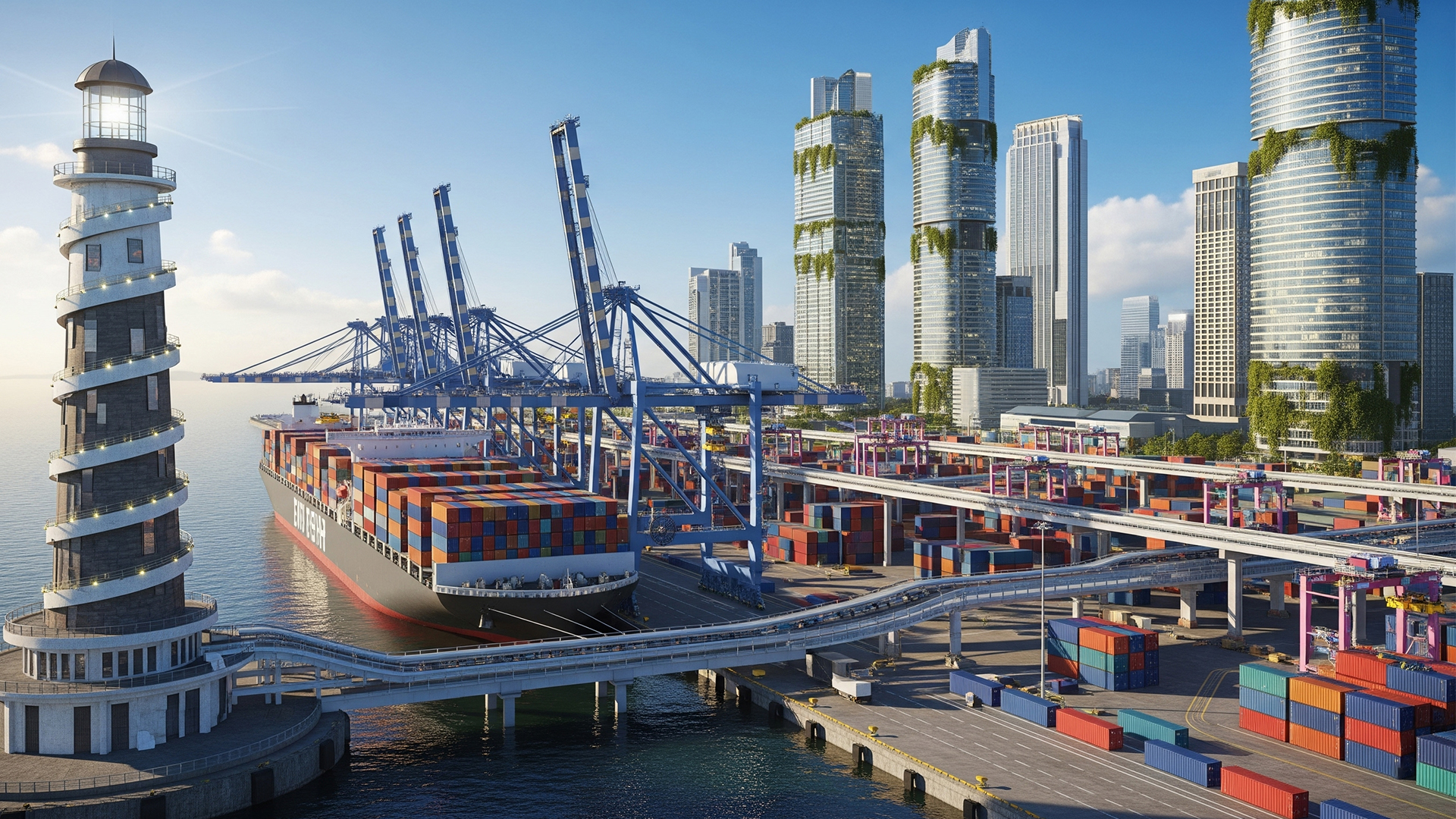
The Adani Group, along with Sri Lankan and Indian partners, is accelerating the development of the Colombo West International Terminal (CWIT) in Sri Lanka, aiming to double container capacity well ahead of schedule.
The $840 million deep-water terminal, led by Adani Ports and Special Economic Zone (APSEZ), is now expected to be fully operational by late 2026, months before the original February 2027 deadline. The first phase of the terminal, equipped with fully automated systems, was launched in April 2025.
Once complete, CWIT will be able to handle 3.2 million TEUs (twenty-foot equivalent units) annually, significantly boosting Sri Lanka’s port capacity and positioning Colombo as a major transshipment hub in the Indian Ocean.
The Colombo West International Terminal (CWIT) is being developed through a strategic public-private partnership that brings together international expertise and local oversight. Adani Ports holds a 51% majority stake, making it the lead investor in the project. John Keells Holdings (JKH), one of Sri Lanka’s largest listed companies, owns 34%, while the Sri Lanka Ports Authority (SLPA) retains the remaining 15%. This ownership structure ensures a balanced collaboration that supports both commercial efficiency and national interest in a key regional infrastructure asset.
The project is part of a 35-year build-operate-transfer (BOT) agreement and represents the first foreign investment in the Port of Colombo.
Although the developers initially sought $553 million in funding from the U.S. International Development Finance Corporation (DFC), the proposal was later withdrawn. Adani and partners opted instead for internal financing and a structured capital management plan, allowing construction to move forward without delays.
The terminal is a key strategic asset in the region, especially as India and China vie for influence in the Indian Ocean. With more than 60% of Colombo’s transshipment volumes linked to India, the terminal is seen as a vital link in regional trade networks.
The project also fits into Adani’s broader expansion strategy in Sri Lanka, including proposed renewable energy investments—though previous disagreements over wind energy contracts had strained ties.
Despite earlier concerns about foreign influence and national security, particularly from Indian political circles regarding potential Chinese control. Sri Lanka’s government has framed the deal as a win for economic development and sovereignty.
Also Read: Why Has Adani Group Barred Sanctioned Vessels from Ports?