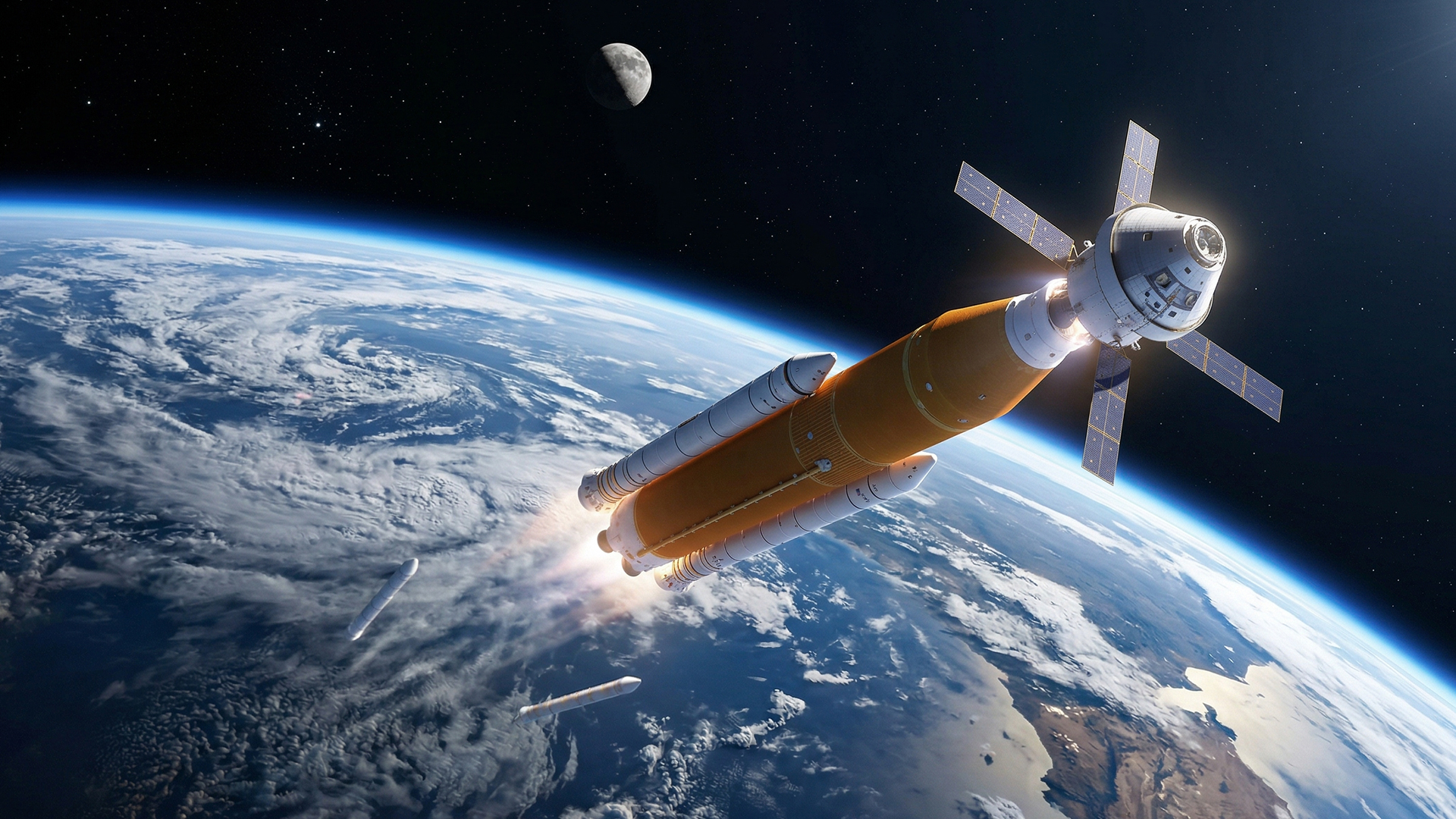
NASA has launched its Artemis II mission, sending four astronauts on a historic voyage around the Moon and back — the first humans beyond Earth orbit since the Apollo program in 1972.
The Space Launch System (SLS) rocket, the most powerful ever built by NASA, lifted off from the Kennedy Space Center in Florida at 6:35 p.m. EDT on April 1, 2026. Spectators along the Space Coast cheered as the towering rocket blazed through the sky, marking a moment of triumph for human space exploration.
Aboard the Orion spacecraft are Commander Reid Wiseman, Pilot Victor Glover, Mission Specialist Christina Koch, and Canadian astronaut Jeremy Hansen. The crew represents several historic firsts: Koch is the first woman to travel to lunar orbit, Glover is the first Black astronaut in deep space, and Hansen is the first non-U.S. astronaut to reach this far from Earth.
Orion successfully reached Earth orbit, deployed its solar panels, and began a series of system checks. The spacecraft will soon fire its engines to begin a trans-lunar trajectory, carrying the astronauts around the far side of the Moon. Unlike Apollo missions, Artemis II will not land on the lunar surface. Instead, it will focus on testing spacecraft systems and life-support equipment in deep space. The mission is expected to last about 10 days, ending with a splashdown in the Pacific Ocean.
The goal of Artemis II is to validate Orion’s performance with humans on board, paving the way for future missions, including Artemis III, which aims to land astronauts on the Moon again. NASA officials say the mission marks a major milestone in human spaceflight, inspiring a new era of exploration and bringing humanity closer to sustained lunar presence and eventually, journeys to Mars.
Also Read: Iran fires largest missile barrage at Israel