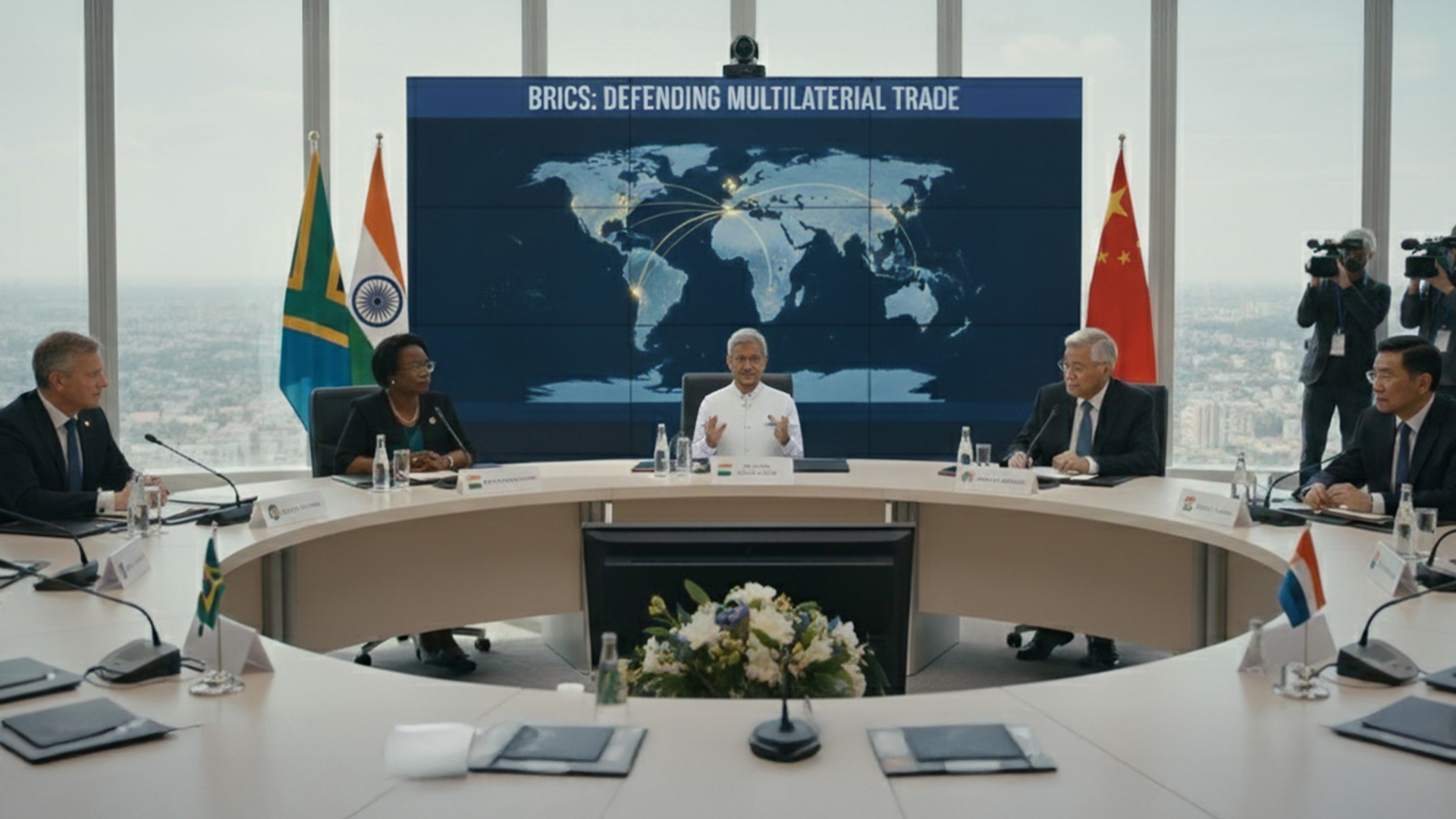
External Affairs Minister S. Jaishankar has called on BRICS nations to defend the multilateral trading system as global protectionism and tariff volatility threaten international commerce. Speaking on the sidelines of the UN General Assembly (UNGA) session during a meeting of the Bloc’s foreign ministers, Mr. Jaishankar emphasized the importance of dialogue, diplomacy, and adherence to international law in a turbulent global environment.
“When multilateralism is under stress, BRICS has stood firm as a strong voice of reason and constructive change,” Mr. Jaishankar said in a social media post. He added that rising protectionism, tariff fluctuations, and non-tariff barriers are affecting trade flows, and BRICS must play a proactive role in upholding the principles of a rules-based international trading system.
Mr. Jaishankar’s remarks come weeks after the United States imposed 50% tariffs on Indian exports, including an additional 25% penalty related to India’s purchase of Russian oil, among the highest tariffs levied globally. Against this backdrop, he highlighted the need for BRICS to advocate for fair and equitable trade while advancing collective reforms in international institutions.
He also stressed the necessity for comprehensive reform of the United Nations, particularly the Security Council, urging BRICS to amplify its call for changes that better reflect contemporary geopolitical realities. “Technology and innovation will define the next phase of BRICS cooperation,” he noted, pointing to the bloc’s potential to lead in emerging areas while supporting sustainable development.
Looking ahead to India’s chairship of BRICS in 2026, Mr. Jaishankar outlined priorities including food and energy security, climate action, and sustainable development, driven by digital transformation, startups, innovation, and strengthened development partnerships.
During the UNGA session, Mr. Jaishankar engaged in a series of bilateral and multilateral discussions. He met counterparts from Sierra Leone, Romania, Cuba, Austria, Brazil, South Africa, Indonesia, Russia, Uruguay, Colombia, and Antigua and Barbuda. In discussions with UAE Deputy Prime Minister and Foreign Minister Abdullah bin Zayed Al Nahyan, the leaders exchanged perspectives on strengthening bilateral cooperation.
He described a “lively discussion” with Austrian Foreign Minister Beate Meinl-Reisinger on geopolitics and the strategic choices facing India and Europe. Mr. Jaishankar also held talks with IBSA (India-Brazil-South Africa) ministers, where the grouping called for transformative reforms in the UN Security Council.
With Russian Foreign Minister Sergey Lavrov, he discussed bilateral ties, the Ukraine conflict, and developments in West Asia. He co-chaired the India-CELAC Foreign Ministers’ Meeting alongside Colombia’s Rosa Yolanda Villavicencio, where the two sides agreed to strengthen cooperation across agriculture, trade, health, digital technology, disaster response, and capacity building, while exploring emerging areas such as artificial intelligence, critical minerals, space, and renewable energy.
The External Affairs Minister underscored the shared urgency of reforming multilateral institutions to better represent the voice of the Global South, emphasizing India’s commitment to global partnerships that foster inclusive growth, technology-led innovation, and sustainable development.
Mr. Jaishankar’s engagements at the UNGA reflect India’s broader strategy of consolidating alliances, advocating for fair trade, and positioning itself as a leader in multilateral diplomacy while preparing for its BRICS chairship next year.