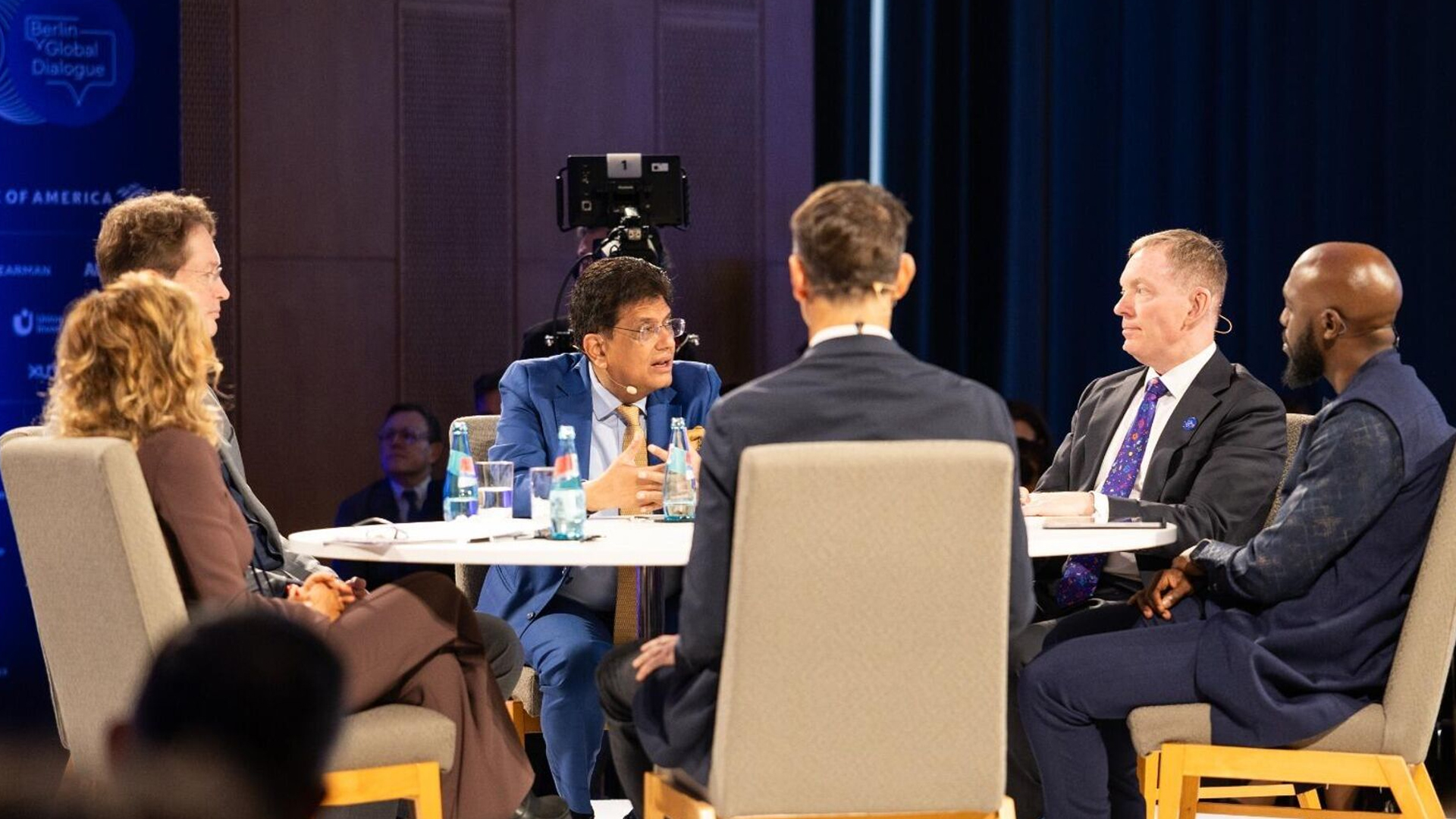
At the Berlin Global Dialogue in Germany, India’s Commerce and Industry Minister, Piyush Goyal, declared that New Delhi will not enter trade agreements under pressure or without safeguarding its national interests.
“We are in active dialogue with the European Union. We are talking to the United States, but we do not do deals in a hurry and we do not do deals with deadlines or with a gun to our head,” Goyal said.
India continues to negotiate a prospective bilateral deal with the United States and a long-pending free-trade agreement (FTA) with the EU.
However, Goyal emphasised that New Delhi will reject any imposition of restrictive conditions that could hinder its future trade options, asserting that deals must reflect long-term partnerships built on trust and mutual benefit.
In Berlin, Goyal met with key European officials, including Valdis Dombrovskis, the EU Commissioner for Economy & Productivity, to discuss progress on the India-EU FTA.
He stressed that while both sides are making advances on some chapters, sensitive issues like environmental standards, rules-of-origin and market access remain unresolved.
Goyal’s remarks come at a time when India is under growing pressure from Western partners to curb purchases of Russian crude oil.
He questioned why India was being singled out when other nations such as Germany and the UK are reportedly seeking exemptions from US sanctions on Russian oil.
“The decision to buy a particular product from a country is something that the entire world will have to take a call on,” Goyal said.
He reiterated that India’s trade policy is anchored in national interest, stating: “I do not think India has ever decided who its friends will be based on any other considerations other than national interest.”
He pointed out that the country will not accept being told who it can or cannot do business with.
India is also confronting high tariff barriers from the United States, where Indian goods have faced steep duties in recent months.
In response, Goyal said, “We’ve accepted that there are tariffs on us, and we’re looking at newer markets, stronger domestic demand and a resilient structure.” He noted India’s demographic strengths—about 1.4 billion people with an average age of 28.5 years—as a foundation for its long-term strategy.
While New Delhi remains open to trade pacts, Goyal made clear that timelines and deadlines will not drive India’s choices. Trade deals, he said, should span decades, not merely address short-term access or tariff concessions. “Trade deals are for the longer duration. It is not only about tariffs or access to goods and services; it is also about trust and relationship,” he told the conference.
As negotiations continue with both the EU and the US, the Indian government appears determined to strike deals that suit its future economic ambition—rather than concede to external timetables or conditions.
With key issues still on the table, including market access, sustainability clauses, and reciprocal obligations, the outcome of these talks may shape India’s trade architecture for years to come.
Also Read: ₹116-Crore CGST Administrative Complex Launched in Ghaziabad