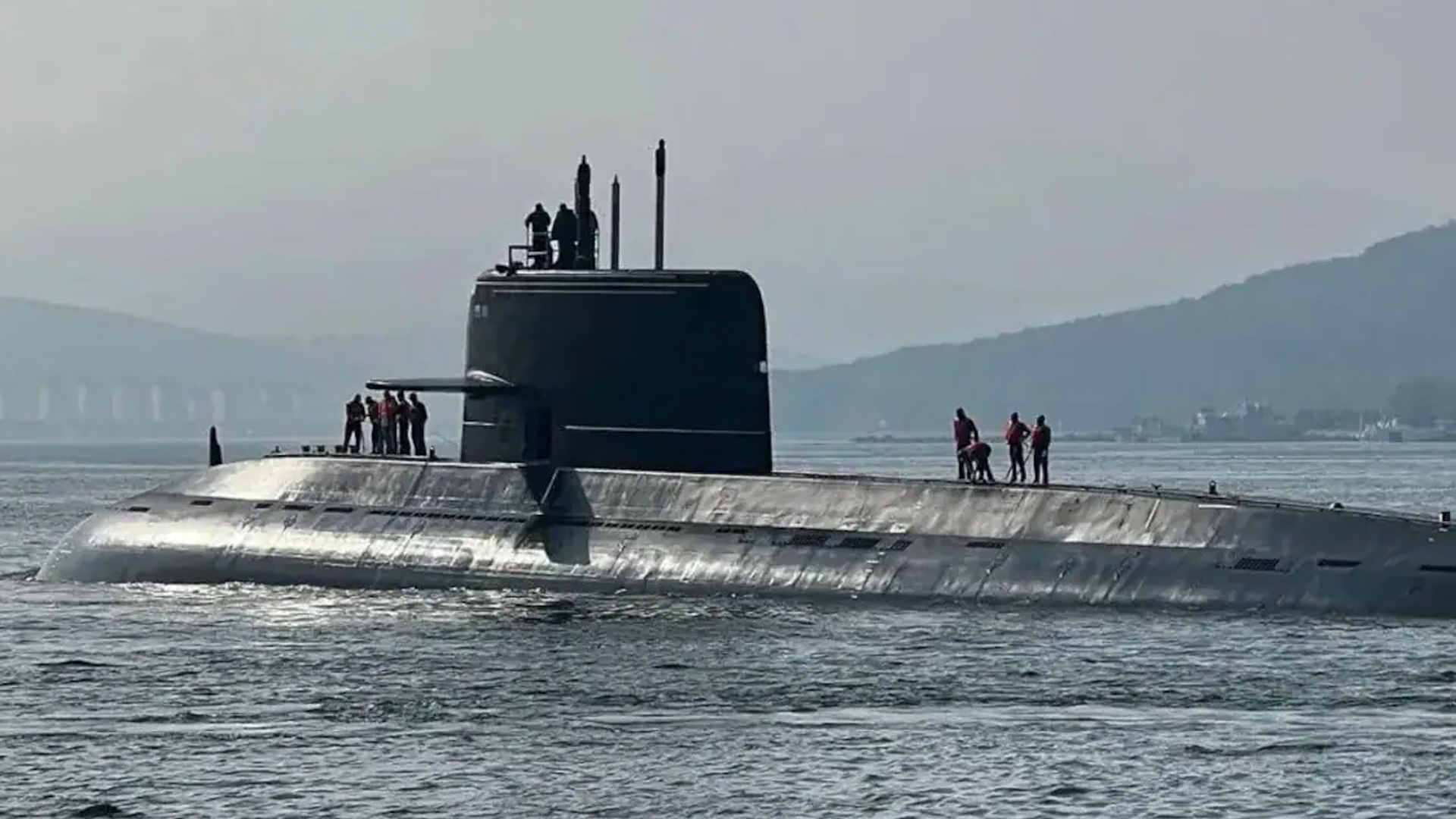
China has delivered the third of the eight advanced Hangor-class submarines to Pakistan, further strengthening Islamabad’s naval fleet and enhancing its maritime presence in the Indian Ocean. The submarine was officially launched at a ceremony in Wuhan, Hubei province, on Thursday, August 14, 2025, according to China’s state-run Global Times.
The third delivery comes just months after the second submarine was handed over in March this year. The first of the series was launched in 2024. These transfers form part of a broader Sino-Pakistani naval modernization program that aims to boost Pakistan’s maritime security capabilities and safeguard its sea lines of communication.
Vice Admiral Abdul Samad, Pakistan’s Deputy Chief of Naval Staff (Projects-2), said during the ceremony that the Hangor-class submarines would be “instrumental in sustaining regional power equilibrium and ensuring maritime stability.” He emphasized that the submarines’ advanced weaponry and sensors would give Pakistan a stronger hand in deterring threats and balancing rival naval powers.
Features of the Hangor-Class Submarines
Chinese military experts quoted in Global Times described the Hangor-class as equipped with strong underwater combat capabilities, comprehensive sensor systems, excellent stealth characteristics, high mobility, long endurance, and formidable firepower. The submarines are based on China’s Type 039A/041 Yuan-class design, which has been the backbone of the People’s Liberation Army Navy’s diesel-electric submarine fleet.
Each Hangor-class submarine can reportedly carry heavyweight torpedoes and anti-ship cruise missiles, significantly extending Pakistan’s strike capability in the Arabian Sea. Their advanced air-independent propulsion (AIP) systems allow them to remain submerged longer than conventional diesel-electric submarines, making them harder to detect.
A Long-Term Maritime Partnership
China and Pakistan have been close defense partners for decades, with Beijing serving as Islamabad’s primary source of military hardware. According to the Stockholm International Peace Research Institute (SIPRI), more than 80 percent of Pakistan’s arms imports over the past five years have come from China. These include modern naval frigates, J-10CE fighter jets, VT-4 battle tanks, and reconnaissance vessels.
In 2022, China delivered the first batch of J-10CE fighters to Pakistan, which were later deployed in the country’s western border regions. Pakistan also jointly produces the JF-17 fighter jet with China, underscoring their deep defense-industrial collaboration.
The submarine program represents the most ambitious naval project between the two countries so far. In 2015, Pakistan signed a deal with China to acquire eight Hangor-class submarines, with four to be built in China and four at Karachi Shipyard & Engineering Works (KS&EW). The contract, valued at around USD 4-5 billion, was one of the largest defense deals in Pakistan’s history. The project is scheduled to be completed by 2028.
Regional Implications
The strengthening of Pakistan’s submarine fleet comes at a time of heightened strategic competition in the Indian Ocean Region. India, which already operates a fleet of Scorpène-class submarines and nuclear-powered boats, views the China-Pakistan naval collaboration with concern. Indian naval strategists warn that combined Chinese and Pakistani deployments could complicate New Delhi’s maritime security calculus.
The Gwadar port in Pakistan’s Balochistan province, developed with Chinese investment under the China-Pakistan Economic Corridor (CPEC), is widely seen as a key node in Beijing’s “string of pearls” strategy to expand its presence across the Indian Ocean. Chinese submarines have already been spotted operating in the Arabian Sea in recent years, raising questions about long-term Chinese naval access to Gwadar.
A Symbol of Deepening Ties
For Pakistan, the Hangor-class submarines not only modernize its navy but also symbolize the strategic trust underpinning its relationship with China. For Beijing, the transfers are part of a broader effort to project influence in the Indian Ocean and counterbalance India and its partners, including the United States.
Also Read: Pakistan Resumes Rescue as Flash Floods Claim Over 300 Lives; Monsoon Death Toll Rises to 657