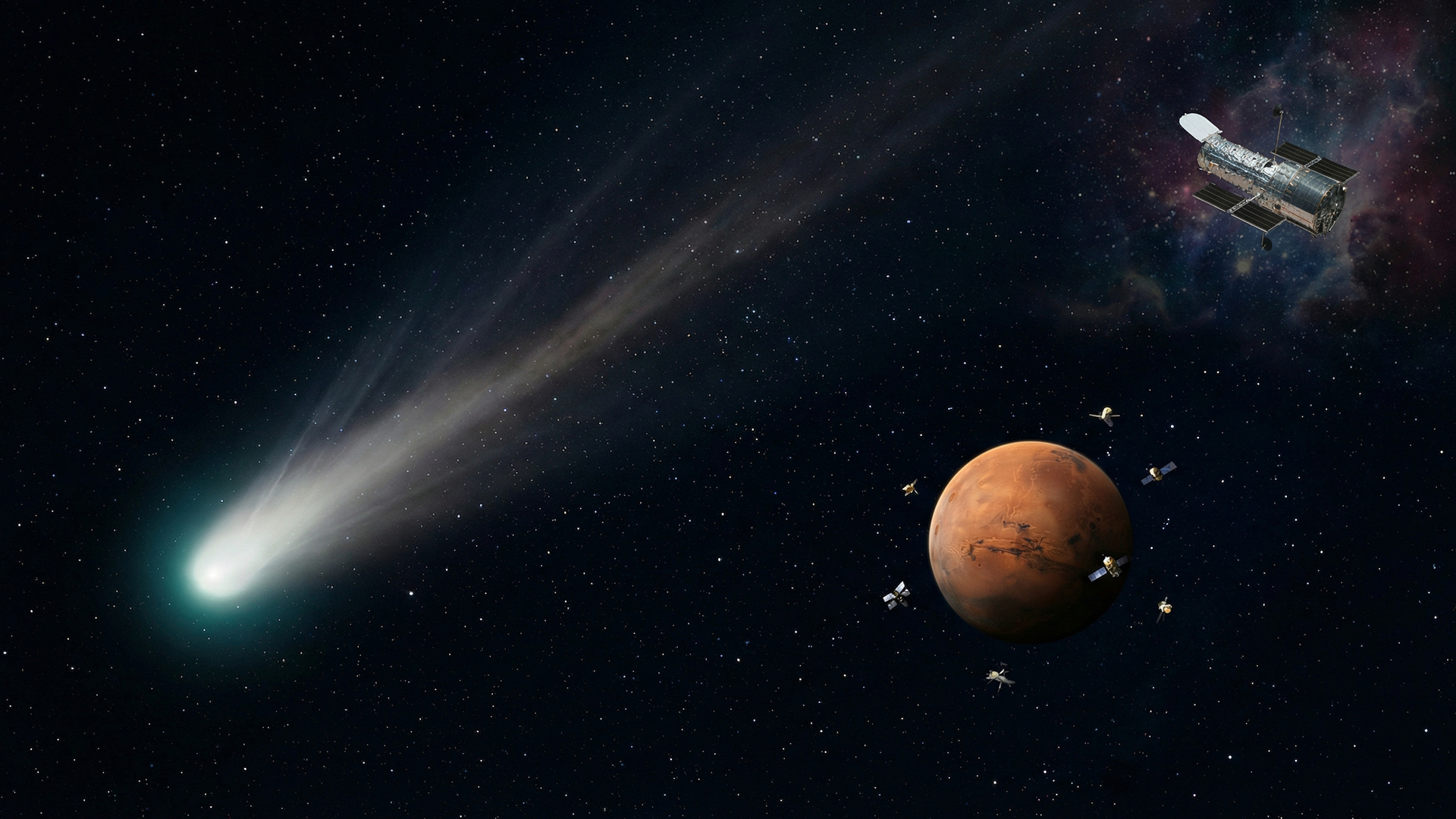
NASA is closely observing 3I/ATLAS, a rare interstellar comet traveling through our solar system at more than 130,000 miles per hour. The comet, discovered on July 1, 2025, is only the third confirmed interstellar object ever detected, making it a valuable scientific opportunity. Because it formed around another star, understanding its structure and chemistry could offer new insights into how distant planetary systems are built.
To study the comet from multiple vantage points, NASA is using a powerful network of more than 12 spacecraft and telescopes scattered across the solar system. As the comet passed near Mars, the Mars Reconnaissance Orbiter (MRO) snapped detailed images using its high-resolution HiRISE camera. The MAVEN orbiter captured ultraviolet views that help scientists study the gases escaping from the comet’s surface. Even the Perseverance rover managed to record a faint glimpse from the Martian surface.
Several solar-observing missions, including STEREO, SOHO, and PUNCH, also tracked the comet as it moved through the inner solar system. STEREO used stacked image processing to make the faint object more visible during observations taken in mid-September.
Farther from Mars, NASA’s deep-space missions contributed too. The Psyche spacecraft collected multiple observations that helped refine the comet’s path by nearly ten times. The Lucy mission captured images showing the comet’s bright coma, a cloud of gas and dust surrounding its core, and its growing tail.
Early estimates from the Hubble Space Telescope suggest the comet’s nucleus could be as large as 3.5 miles (5.6 km) wide, though it may be smaller. Despite its speed, the comet poses no threat to Earth. Its closest approach will occur on December 19, 2025, at a safe distance of 170 million miles.
Scientists say this flyby offers a once-in-a-generation chance to study material from another star system, without leaving our own.
Also Read: $10-billion push to lift India’s chip industry by 2032