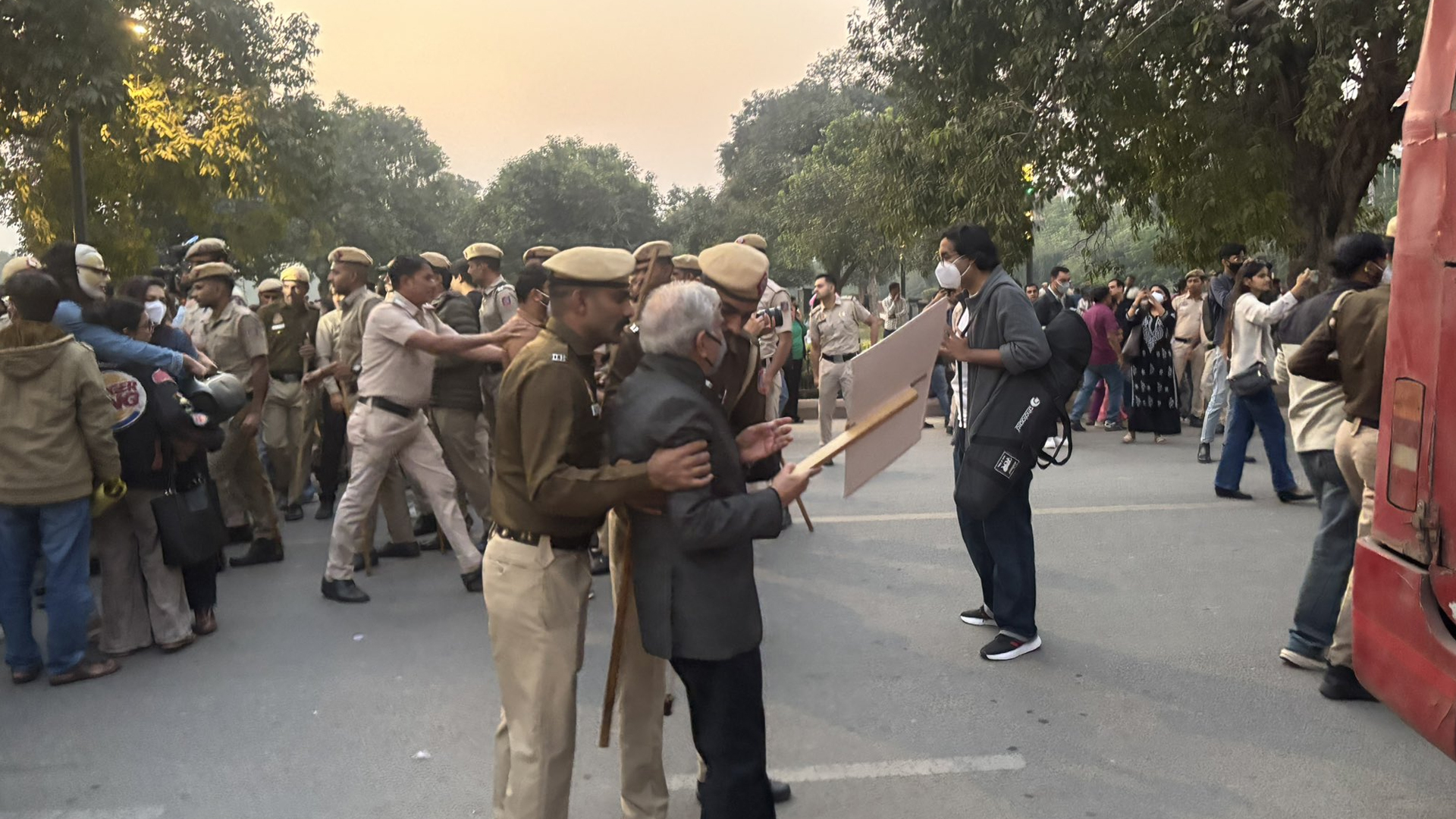
New Delhi witnessed a chaotic turn during an anti-pollution protest near India Gate on Sunday, as demonstrators reportedly used chilli (pepper) spray against police officers. Authorities have arrested 15 participants for their alleged involvement in the violent clash.
The protest was organised to draw attention to Delhi’s deteriorating air quality, which remains in the “very poor” category. On Monday morning, the city’s overall Air Quality Index (AQI) stood at 397, with more than half of its 39 monitoring stations recording values above 400. Such readings indicate severe pollution, raising health concerns for residents, especially children and the elderly.
Police said tensions escalated when protesters refused repeated requests to clear the road. Barricades had been set up to ensure ambulances and emergency vehicles could pass through, but a section of the crowd resisted. Officers attempted to remove those blocking the road, which led to some protesters sitting down and ultimately spraying chilli pepper on the police. Three to four officers were injured and are receiving treatment at Ram Manohar Lohia (RML) Hospital.
The Delhi Coordination Committee for Clean Air, which supported the demonstration, criticised the government’s approach, claiming that temporary measures like water sprinkling and cloud seeding do not address the root causes of pollution.
Adding to the controversy, images from the protest showed a few demonstrators carrying posters and raising slogans in support of Maoist leader Madvi Hidma. Police have said they are investigating how these unrelated slogans appeared during an environmental protest.
An FIR has been filed under multiple sections, including obstruction of government work, and those detained are being processed at the Parliament Street Police Station.
Despite the violent turn, organisers emphasised that the protest’s core aim was to raise awareness about Delhi’s toxic air, urging authorities to implement long-term solutions to protect public health. With air pollution levels showing no immediate signs of easing, public demonstrations are likely to continue, reflecting widespread frustration over environmental and health concerns in the capital.
Also Read: Justice Surya Kant becomes India’s 53rd Chief Justice