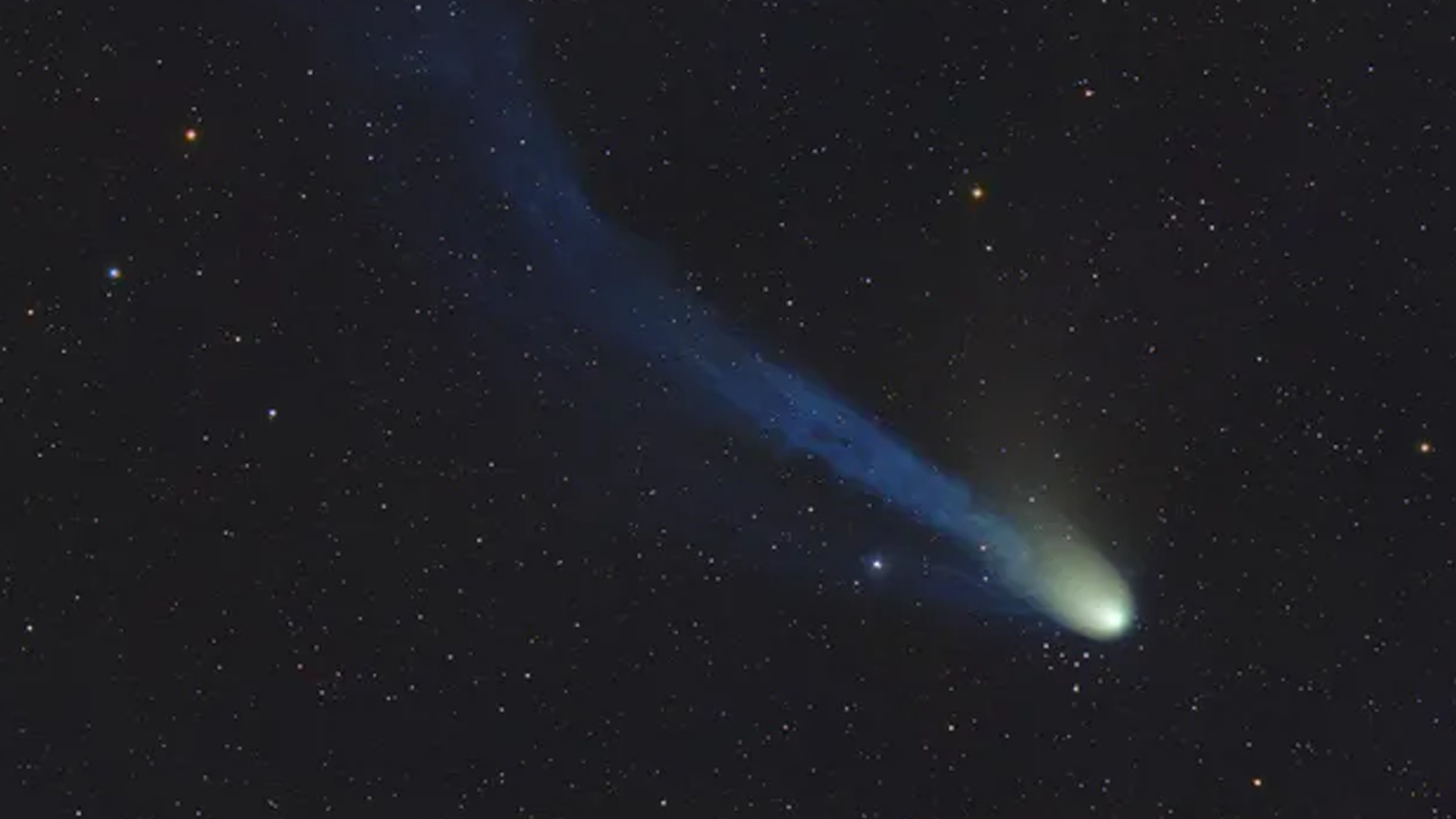
Scientists have uncovered compelling new evidence that a massive comet, known as the “Devil Comet,” may have played a critical role in delivering water to our planet. So, next time you happen to catch a glimpse of a comet streaking across the night sky, don’t just admire its beauty, consider it a cosmic delivery truck carrying something incredibly important: water.
The Mysterious Devil Comet
Comet 12P/Pons-Brooks, nicknamed the Devil Comet for its distinctive horn-like shape, measures roughly the size of Mount Everest. Unlike typical comets, this celestial body is cryovolcanic, erupting water and gases from its icy interior like a frozen volcano. These eruptions occur roughly every 15 days as the comet rotates, creating a unique and dynamic surface. Scientists studied it using powerful telescopes in Chile and Hawaii.
Water’s Cosmic Fingerprint
The origin of Earth’s water has puzzled scientists for decades. One long-standing hypothesis suggests that comets bombarded the early Earth, delivering water and possibly organic molecules essential for life. However, previous studies showed that most comets’ water didn’t match the isotopic signature of Earth’s oceans.
Recent observations using the Atacama Large Millimeter/submillimeter Array (ALMA) in Chile and NASA’s Infrared Telescope Facility (IRTF) in Hawaii reveal that the Devil Comet’s water vapor exhibits a deuterium-to-hydrogen ratio strikingly similar to that of Earth’s oceans. This isotopic “fingerprint” suggests that comets like 12P/Pons-Brooks could indeed have been major contributors to Earth’s water supply.
Unlocking Earth’s Origins
This discovery not only strengthens the idea that comets delivered water to early Earth but also highlights that comets are active, evolving bodies rather than inert ice balls. The cryovolcanic activity observed on the Devil Comet offers new insights into the dynamic nature of these space objects.
Comet 12P/Pons-Brooks orbits the Sun every 71 years and was last visible during the April 2025 total solar eclipse, providing a rare opportunity for detailed study. Its next approach won’t be until late in the 21st century, making this a pivotal moment for researchers.
Also Read: Australia Expels Iran Ambassador After ‘Tehran-Directed Attacks on Jewish Community’