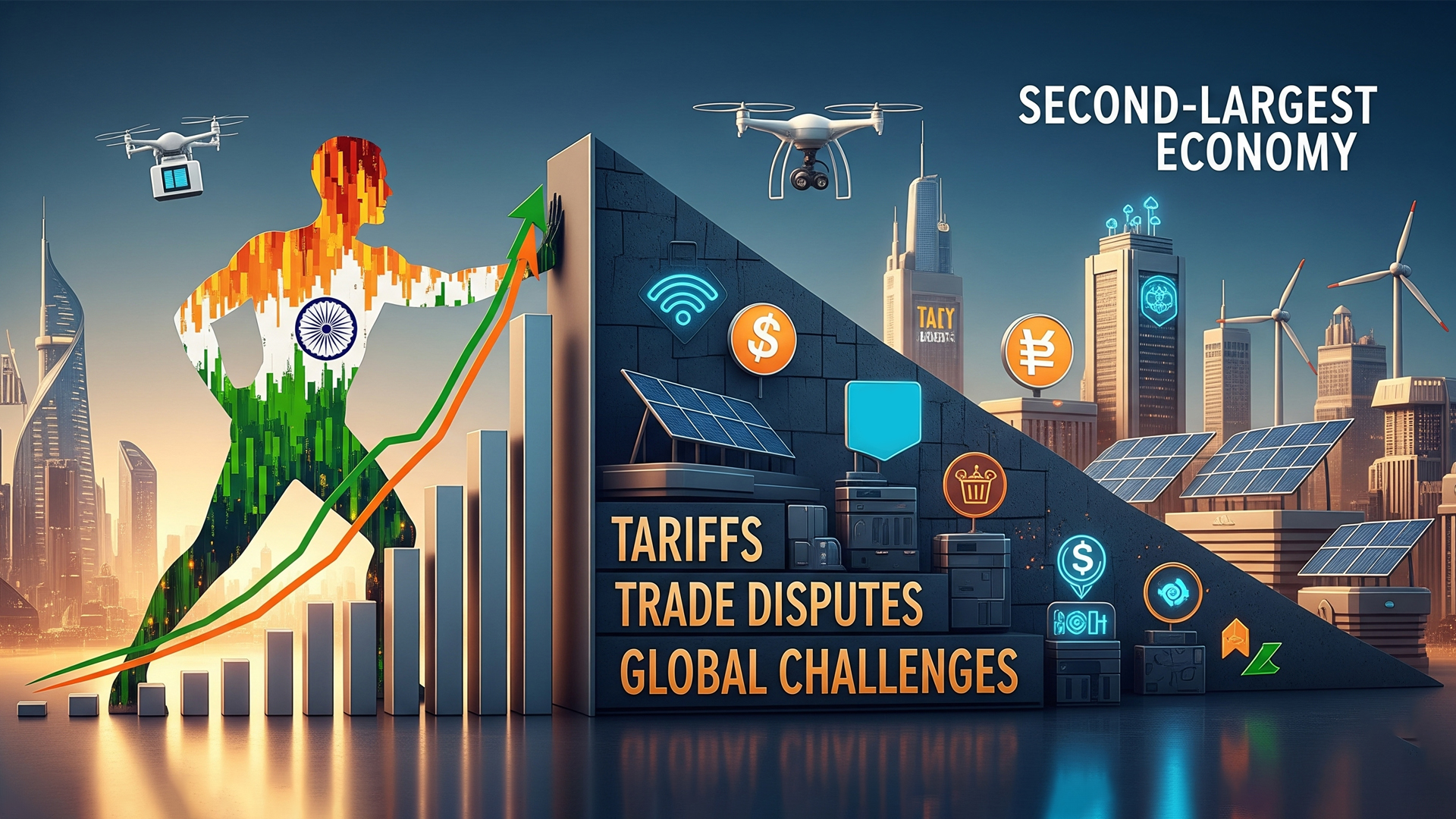
India is on track to become the world’s second-largest economy by 2038, with a projected GDP of $34.2 trillion (PPP), according to the August 2025 issue of EY Economy Watch. The report comes a day after the United States imposed steep 50 per cent tariffs on Indian goods, highlighting India’s resilience amid global trade challenges.
EY’s analysis places India alongside the world’s five largest economies—China, the US, Germany, and Japan—while noting that India’s growth trajectory is uniquely strong. The report cites favorable demographics, high savings and investment rates, fiscal sustainability, and rising domestic demand as key drivers of India’s long-term economic potential.
China, while projected to maintain the world’s largest economy by 2030 with $42.2 trillion GDP (PPP), faces constraints due to an ageing population and rising debt levels. The US remains strong but contends with high debt exceeding 120 per cent of GDP and slower growth prospects. Germany and Japan, despite their advanced economies, are limited by high median ages and reliance on global trade. In contrast, India combines a youthful population, a skilled workforce, and a sustainable fiscal outlook, giving it the most favorable long-term growth trajectory.
EY India’s Chief Policy Advisor, DK Srivastava, said, “India’s comparative strengths, including its young and skilled workforce, robust saving and investment rates, and relatively sustainable debt profile, will help sustain high growth even in a volatile global environment. By building resilience and advancing capabilities in critical technologies, India is well-placed to move closer to its Viksit Bharat aspirations by 2047.”
The report highlights that India’s median age is 28.8 years in 2025, providing a demographic dividend that supports both productivity and consumption. Government debt-to-GDP is projected to decline from 81.3 per cent in 2024 to 75.8 per cent by 2030, while other major economies face rising debt burdens. The International Monetary Fund projects India’s economy to reach $20.7 trillion (PPP) by 2030, reinforcing EY’s outlook of India’s ascent to the world’s second-largest economy by 2038.
EY cites several factors behind India’s sustained growth. High savings and investment rates are fueling capital formation, while fiscal consolidation is improving sustainability. Structural reforms such as the Goods and Services Tax (GST), the Insolvency and Bankruptcy Code (IBC), financial inclusion via UPI, and production-linked incentives are strengthening competitiveness across industries.
Public investment in infrastructure and the adoption of emerging technologies—including artificial intelligence, semiconductors, and renewable energy—are also highlighted as critical to long-term economic resilience. These measures are expected to enhance India’s industrial capacity, foster innovation, and maintain growth momentum despite external shocks such as trade tariffs.
While the US tariffs have sparked concerns for sectors like textiles and apparel, EY notes that India’s macroeconomic fundamentals and proactive policy measures provide a strong buffer against global disruptions. By leveraging its demographic advantage, sustaining fiscal prudence, and investing in technology-driven growth, India is positioned to maintain a robust trajectory toward becoming a $34.2 trillion economy by 2038.