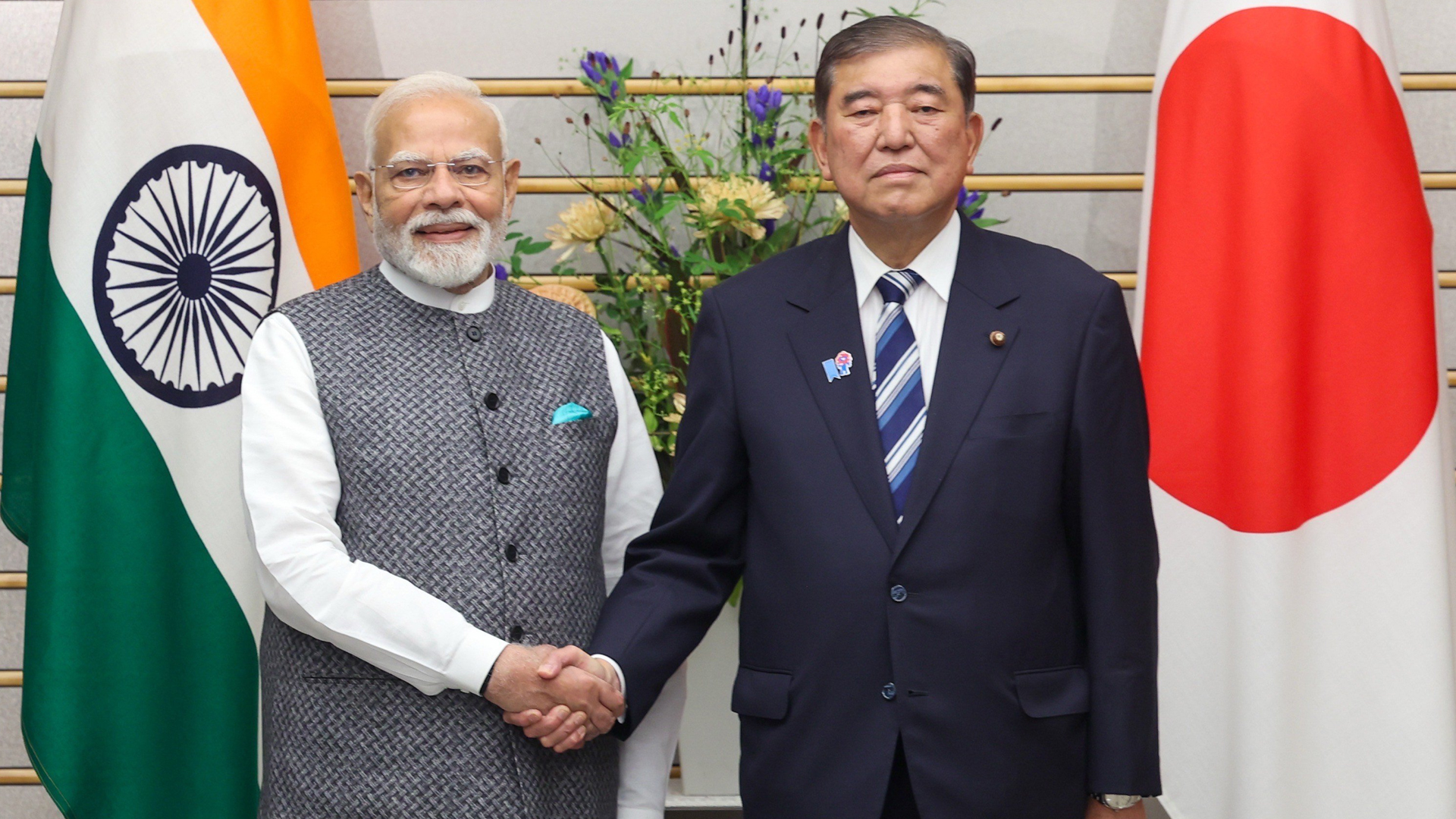
New Delhi: India and Japan have significantly strengthened their bilateral engagement with the launch of a comprehensive framework for economic security cooperation. The initiative aims to bolster strategic sectors and safeguard critical supply chains amid growing global uncertainties.
The framework, formalized under the India-Japan Dialogue on Economic Security, was launched in late 2024 and is co-chaired by India’s Foreign Secretary and Japan’s Vice Foreign Minister. It reflects both countries’ commitment to aligning closely on securing access to critical technologies and resources, fostering industrial collaboration, and ensuring regional economic stability.
The cooperation focuses on five priority sectors: semiconductors, critical minerals, clean energy, pharmaceuticals, and digital infrastructure. A parallel private-sector dialogue has been established between key industry bodies, including Japan’s Keidanren and India’s Confederation of Indian Industry (CII), with a joint action plan developed in coordination with JETRO and JCCII.
Semiconductor development stands as a cornerstone of the partnership. Japanese firm Renesas Electronics has opened an OSAT (Outsourced Semiconductor Assembly and Test) facility in Gujarat in collaboration with CG Power. The company has also partnered with IIT Hyderabad and India’s C-DAC to support chip research and skill development. Meanwhile, Tokyo Electron and TATA Electronics are working together to build a broader semiconductor ecosystem in India.
Japan is also playing a pivotal role in supporting India’s critical minerals strategy. A Memorandum of Cooperation was signed in August 2025 between India’s Ministry of Mines and Japan’s Ministry of Economy, Trade and Industry (METI) to enhance supply chains for rare earth elements and other strategic minerals. Japanese trading company Toyota Tsusho is developing a rare earth refining project in Andhra Pradesh, aimed at supporting next-generation manufacturing.
In the clean energy sector, India and Japan are expanding collaboration under the Joint Crediting Mechanism, along with a newly signed Joint Declaration on Hydrogen and Ammonia. Japanese companies IHI and Kowa are working with Adani Power to conduct ammonia co-firing tests at the Mundra thermal plant. Separately, a 400 MW renewable energy portfolio is being developed in Karnataka by Clean Max Osaka Gas, backed by financing from the Japan Bank for International Cooperation (JBIC).
Digital infrastructure is another major area of focus. NEC is partnering with Reliance Jio to develop Open RAN and 5G infrastructure in India. Meanwhile, NTT DATA and Neysa Networks, with support from the Telangana government, are investing ₹10,500 crore to establish a state-of-the-art AI data center cluster in Hyderabad. Japan’s JICT and JBIC are actively financing these digital initiatives.
Scientific cooperation has also expanded in 2025, declared the Year of Science, Technology, and Innovation Exchanges. Joint projects are underway in fields such as artificial intelligence, biotechnology, quantum computing, and space technology. Talent exchange programs like Sakura Science and LOTUS are enabling Indian students and researchers to engage more deeply with Japan’s innovation ecosystem.
This wide-ranging cooperation underscores a shared strategic vision for a secure, rules-based Indo-Pacific. As economic and geopolitical dynamics continue to evolve, India and Japan are positioning themselves as trusted partners in shaping resilient, future-ready supply chains and innovation-driven growth.
Also Read: India’s GDP Grows 7.8% in Q1 FY26, Highest in Five Quarters