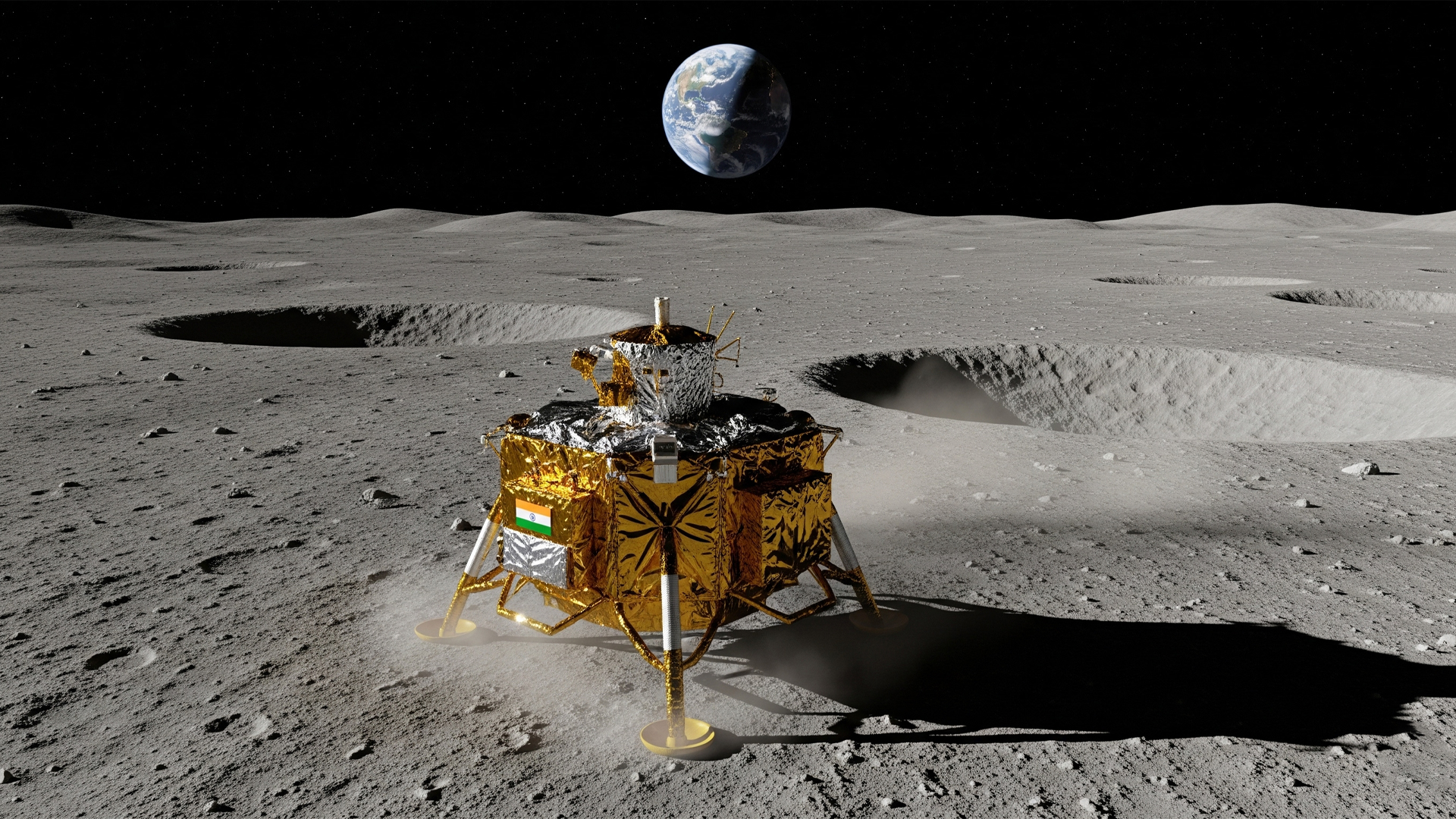
The Indian Space Research Organisation (ISRO) has issued an open call to the scientific community, inviting proposals to analyze data collected by its Chandrayaan‑3 mission. Through this initiative, ISRO aims to further unlock the mysteries of the Moon’s south pole and foster academic engagement in planetary research.
Chandrayaan‑3 made history in August 2023 by successfully landing near the lunar south pole, a feat accomplished by no other country at the time. Its lander, Vikram, and rover, Pragyan, conducted in-situ experiments, generating an extensive dataset now made available to researchers via ISRO’s PRADAN portal.
In its latest Announcement of Opportunity (AO), ISRO has called upon scientists, researchers, and academic institutions to submit proposals focusing on key areas such as lunar surface composition, seismic activity, thermal properties, and the Moon’s plasma environment. While proposals must center on Chandrayaan‑3 data, ISRO has encouraged integration with data from Chandrayaan‑1, Chandrayaan‑2, and other international missions to promote comprehensive lunar studies.
Each project is designed to be completed within three years, with potential for a one-year extension based on performance. Selected projects will receive financial support, including funding for Junior Research Fellows (JRFs), access to computational facilities, conference travel, and contingency expenses. Principal Investigators are also encouraged to involve interns for focused lunar data analysis and to conduct workshops and outreach activities to foster broader community engagement.
This open data initiative empowers India’s scientific community to unlock the Moon’s mysteries, reinforcing ISRO’s vision of harnessing space technology for national development and inspiring the next generation of space scientists.
The data from instruments like ChaSTE (Chandra’s Surface Thermophysical Experiment), ILSA (Instrument for Lunar Seismic Activity), RAMBHA-LP (Langmuir Probe), and two spectrometers onboard Pragyan, LIBS and APXS, have already revealed several groundbreaking findings. These include the detection of sulfur and other elements at the lunar surface, temperature variations indicating potential subsurface ice, and natural seismic events at the south pole, which is a first in lunar exploration.
This initiative marks a new chapter in Chandrayaan‑3’s mission, strengthening India’s position in global lunar research.
Also Read: ISRO Saw Exponential Rise in Missions Over Past Decade, Says Chairman V Narayanan