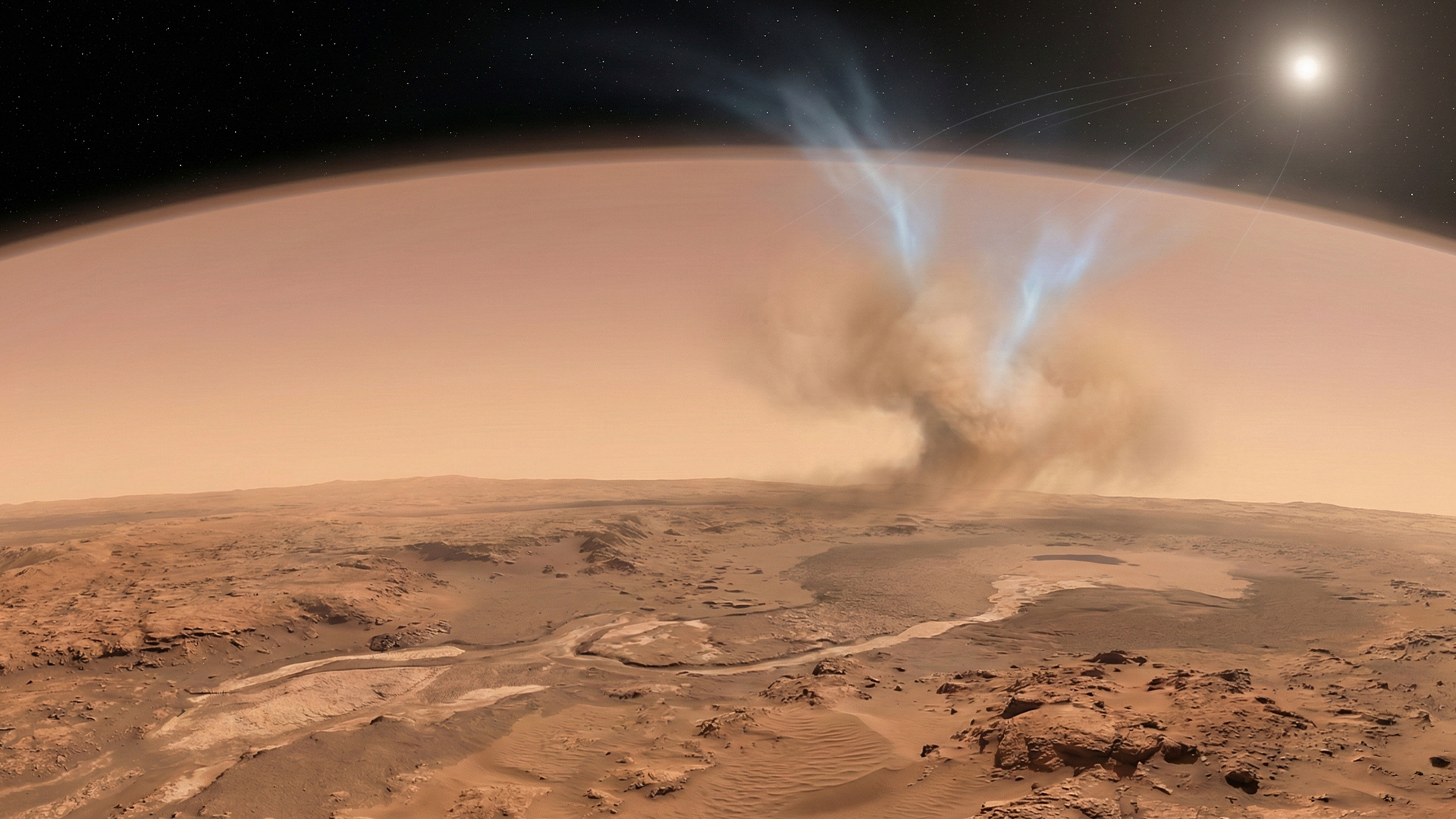
For decades, scientists have been intrigued by a mystery: why did Mars, once home to rivers, lakes, and possibly oceans, become the dry, frozen desert we see today? New research suggests that dust storms may have quietly drained much of its water into space.
Using data from Mars’ upper atmosphere, researchers discovered that regional dust storms can push water vapor far above the surface, where sunlight breaks it apart into hydrogen and oxygen. Hydrogen, being extremely light, escapes the planet’s gravity and drifts into space. During one storm, water vapor levels were 10 times higher than usual, and hydrogen levels spiked 2.5 times, showing that even smaller, short-lived storms can play a significant role in the planet’s water loss.
Earlier theories focused on massive, planet-wide storms as the main culprit, but this study shows that frequent, smaller storms can also steadily strip Mars of its water over billions of years. This could explain why so much of Mars’ water seems to be missing, something earlier models struggled to account for.
Understanding how Mars lost its water is key to unlocking its climate history and its potential to support life in the past. Scientists believe early Mars had a thicker atmosphere and warmer climate, which allowed liquid water to flow on the surface. Over time, as water escaped into space, the planet cooled and dried, creating the barren landscape we see today.
This breakthrough gives researchers a clearer picture of Mars’ transformation from a watery world to a desert planet. It also highlights the dramatic role that dynamic, everyday events like dust storms can play in shaping a planet’s environment. It makes us wonder that even small forces in space can have massive consequences.
Also Read: Amazon launches major office in Bengaluru