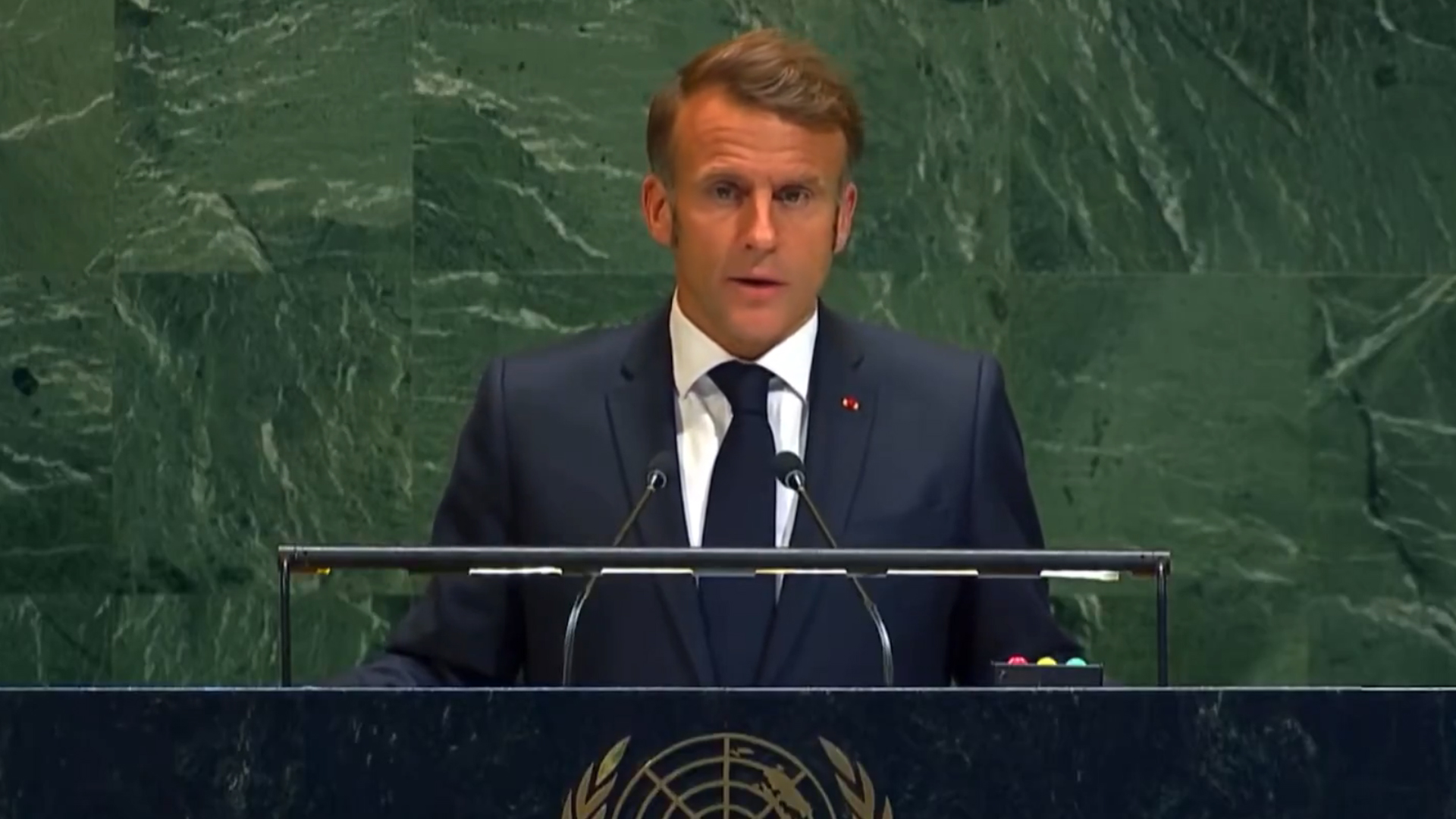
In a landmark move at the United Nations General Assembly on September 22, 2025, French President Emmanuel Macron announced France’s official recognition of the State of Palestine.
This declaration, made during a high-level summit co-hosted with Saudi Arabia, marks a significant shift in international diplomacy concerning the Israeli-Palestinian conflict.
President Macron emphasized that the recognition was not merely symbolic but a necessary step toward achieving lasting peace in the region.
He stated that “the time has come to end the war in Gaza, the massacres, and the death.” Macron framed the decision as a strategic step against Hamas, asserting that empowering a reformed Palestinian Authority (PA) would help marginalize the militant group and pave the way for a two-state solution.
The announcement was met with applause from many in the assembly, including Palestinian President Mahmoud Abbas, who addressed the summit virtually after being denied a visa by the U.S.
He commended the 149 nations that had already recognized a Palestinian state and called for Hamas to surrender its weapons to the PA.
France’s decision aligns with similar moves by other countries, including the United Kingdom, Canada, Australia, and several European nations such as Belgium, Luxembourg, Malta, and Monaco.
With these additions, approximately three-quarters of UN member states have now recognized Palestine.
UN Secretary-General António Guterres supported the recognition, stating that Palestinian statehood is a “right, not a reward.”
He condemned the ongoing violence and settlement expansion, urging all parties to halt actions that undermine the prospects for a two-state solution.
However, the move has faced strong opposition from Israel and the United States. Israeli officials dismissed the initiative, with Prime Minister Benjamin Netanyahu warning that such recognition could lead to annexation of parts of the West Bank.
The U.S. administration, under President Donald Trump, also criticized the recognition, warning of potential Israeli retaliation and claiming the move could embolden Hamas.
In response to the escalating conflict in Gaza, President Macron proposed the establishment of a UN-mandated international stabilization force to oversee the disarmament of Hamas and support the PA in governing Gaza, the West Bank, and East Jerusalem.
The plan aims to marginalize Hamas by excluding it from power and providing security and training to the PA police force.
The diplomatic developments in New York coincide with intensified military actions in Gaza City, where Israeli forces have launched a new ground offensive, resulting in significant casualties.
The humanitarian crisis continues to worsen, with tens of thousands displaced since mid-August.
Arab and Muslim leaders are set to meet with President Trump to discuss their separate plan for a stabilization force in Gaza.
They are likely to insist that the PA be given a future role in governance and that any roadmap to a two-state solution exclude further Israeli settlements or annexation of the West Bank.
As the international community grapples with these developments, the recognition of Palestine by France and other nations underscores a growing global consensus in favor of a two-state solution.
However, the stark divisions between key international actors, particularly Israel and the U.S. on one side and France and its allies on the other, highlight the complexities and challenges that lie ahead in achieving lasting peace in the region.
Also Read: U.S. Court Examines Potential Breakup of Google’s Ad Tech Business