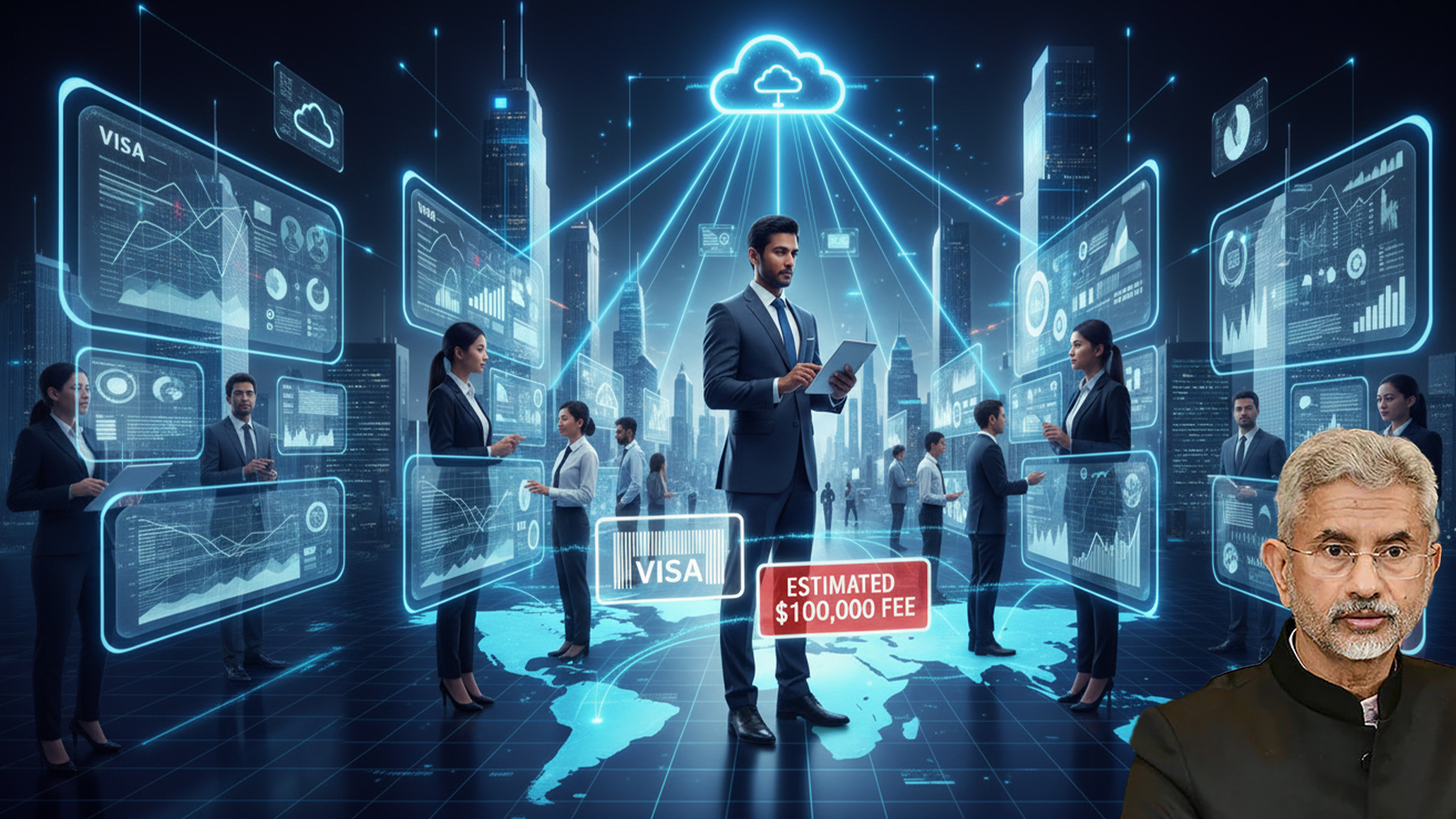
Days after U.S. President Donald Trump announced a new $100,000 fee on H-1B visas, India’s External Affairs Minister S. Jaishankar called for the creation of a “global workforce” model to address today’s evolving talent and demographic realities. Speaking on Thursday at the ‘At the Heart of Development: Aid, Trade, and Technology’ event, organised by the Observer Research Foundation (ORF) on the sidelines of the UN General Assembly, Jaishankar highlighted the growing limitations of relying solely on national demographics to meet global talent requirements.
“Where that global workforce is to be housed and located may be a matter of political debate. But there’s no getting away from the reality. Demands cannot be met in many countries purely out of national demographics,” Jaishankar said. He argued that nations must design a more acceptable, contemporary, and efficient framework that allows labour mobility across distributed global workplaces.
The minister warned that traditional models of workforce allocation are increasingly inadequate in a multipolar and turbulent world. He stressed that global labour mobility and strategic workforce distribution are critical to addressing gaps created by demographic shifts and rising skill demands.
Jaishankar also predicted the emergence of new trade arrangements and partnerships driven by necessity rather than tradition, as countries seek to diversify their economic and strategic ties. “Countries today will feel the desire, sometimes even the compulsion, to have new partners and new regions,” he said. He added that despite growing global turbulence, trade “does find a way,” facilitated by enhanced infrastructure, digital platforms, and connectivity networks.
Highlighting India’s approach to self-reliance and capacity-building, Jaishankar pointed to the importance of constructing multipolarity through national experiences that can be shared internationally. He cited India’s Digital Public Infrastructure as an example of a system that is far more adaptable, relevant, and transposable for diverse societies compared with European or American models.
Addressing the challenges of unpredictability and volatility in global politics, Jaishankar emphasized that resilience is now central to diplomacy. “You have to de-risk, hedge, safeguard yourself against unforeseen contingencies, and really build policy and plans around that. That’s a very big challenge for the entire world,” he said.
He further underscored that de-risking strategies must go beyond supply chains to encompass protection against over-dependence on specific markets or connectivity nodes, as the global economic chain has become “far more risky and difficult to assume.”
Jaishankar’s remarks come amid heightened global discussions on workforce migration, talent mobility, and the implications of U.S. visa reforms, including the recent H-1B fee hike. The minister’s call for a distributed, flexible, and globally integrated workforce reflects India’s broader strategic vision for navigating complex geopolitical and economic landscapes while leveraging national innovations for global applicability.
Also Read: 18 Districts in Orissa on Rain Alert