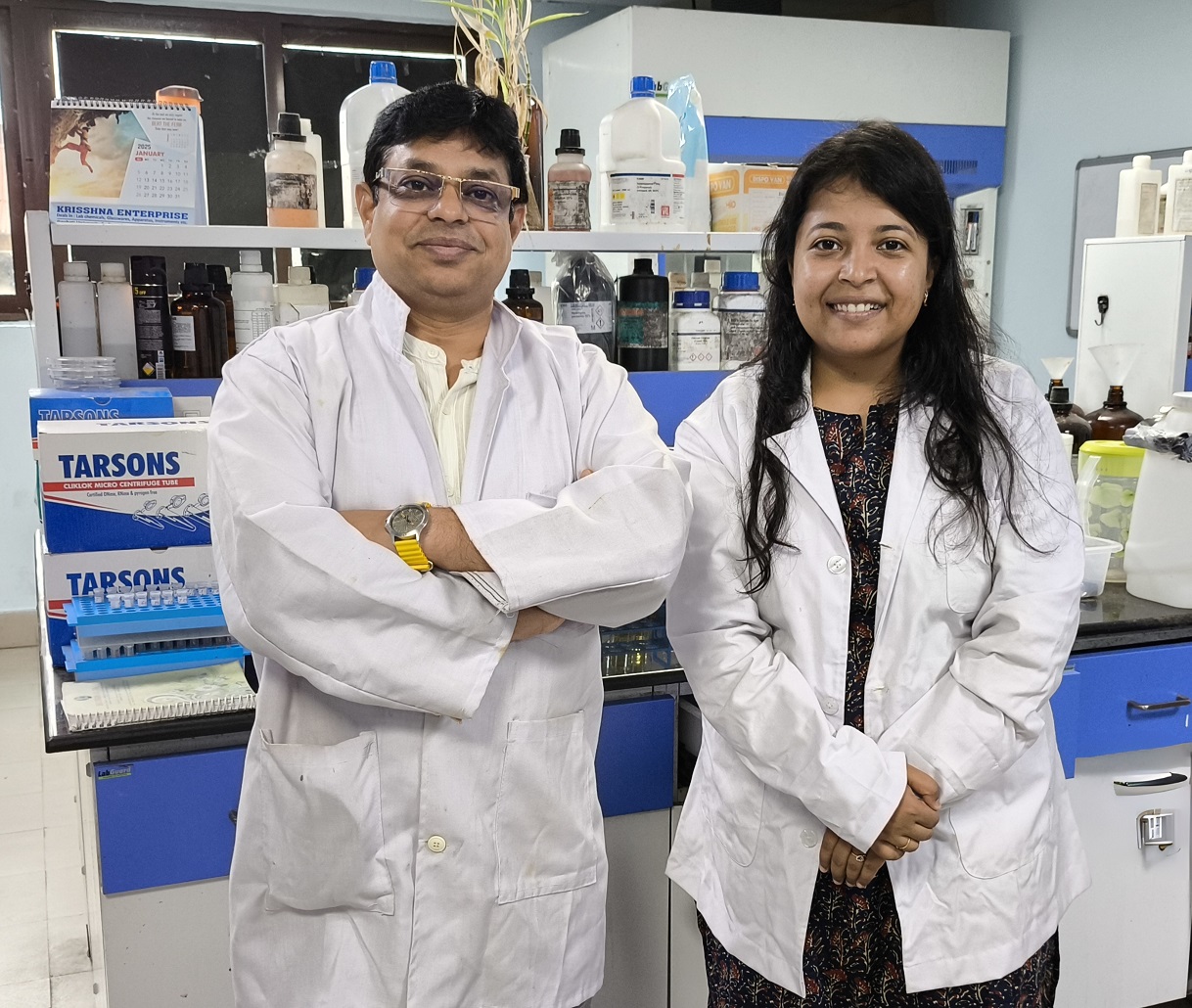
Guwahati: Researchers at the Indian Institute of Technology (IIT) Guwahati have developed a novel nanosensor capable of detecting Mercury and harmful antibiotics in water in less than 10 seconds. The breakthrough technology, led by Prof. Lal Mohan Kundu of the Department of Chemistry, uses carbon dots derived from milk protein and thymine, a nucleobase, to identify contaminants with high sensitivity.
With increasing urbanisation, industrialisation, and pharmaceutical overuse, water contamination is emerging as a pressing global concern. Mercury, even in trace amounts, is highly toxic and linked to cancer, neurological disorders, and cardiovascular diseases. Similarly, tetracycline antibiotics, widely used to treat respiratory infections, can enter the environment through improper disposal, contributing to antibiotic resistance and other health hazards. Rapid detection of these substances is crucial for both public health and environmental safety.
The IIT Guwahati sensor operates on a simple yet effective principle: carbon dots glow under ultraviolet (UV) light but dim in the presence of harmful substances such as Mercury or tetracyclines. This dimming provides an immediate visual signal of contamination.
“Our sensor can detect Mercury and tetracyclines at extremely low concentrations,” said Prof. Kundu. “We synthesised carbon dots from low-cost, biogenic precursors—milk protein and thymine. Their nanoscale size and inherent fluorescence make this a highly sensitive and rapid detection technique. The sensor has potential applications not only in water testing but also in biological systems.”
On a laboratory scale, the sensor has demonstrated reliable detection within 10 seconds of exposure to contaminants. Mercury can be detected at concentrations as low as 5.3 nanomolar (1.7 parts per billion), below the safety thresholds set by the U.S. Environmental Protection Agency. Tetracycline antibiotics are detectable at 10–13 nanomolar concentrations.
To ensure versatility, the researchers tested the sensor in diverse samples, including tap and river water, milk, urine, and serum. For practical, on-the-spot testing, the team also coated the sensor onto paper strips, allowing rapid detection with a simple UV lamp.
The research, co-authored by Prof. Kundu and his scholars Ms. Pallabi Paul and Ms. Anushka Chakraborty, was published in the journal Microchimica Acta. The team emphasises that the technology is still at the laboratory stage and requires further validation before commercial deployment.
Beyond water testing, the sensor’s biocompatibility and sensitivity open possibilities for broader biomedical applications. Its low cost, rapid response, and accuracy make it a promising alternative to conventional water quality monitoring techniques.
Prof. Kundu added, “With rising concerns over environmental pollutants and antibiotic residues, such a sensor can play a crucial role in safeguarding both human health and ecosystems. This is a step forward in developing accessible, real-time detection tools for harmful substances in water and other biological fluids.”
Also Read: At SCO Summit, Modi Denounces Terror Double Standards, Calls for Global Unity