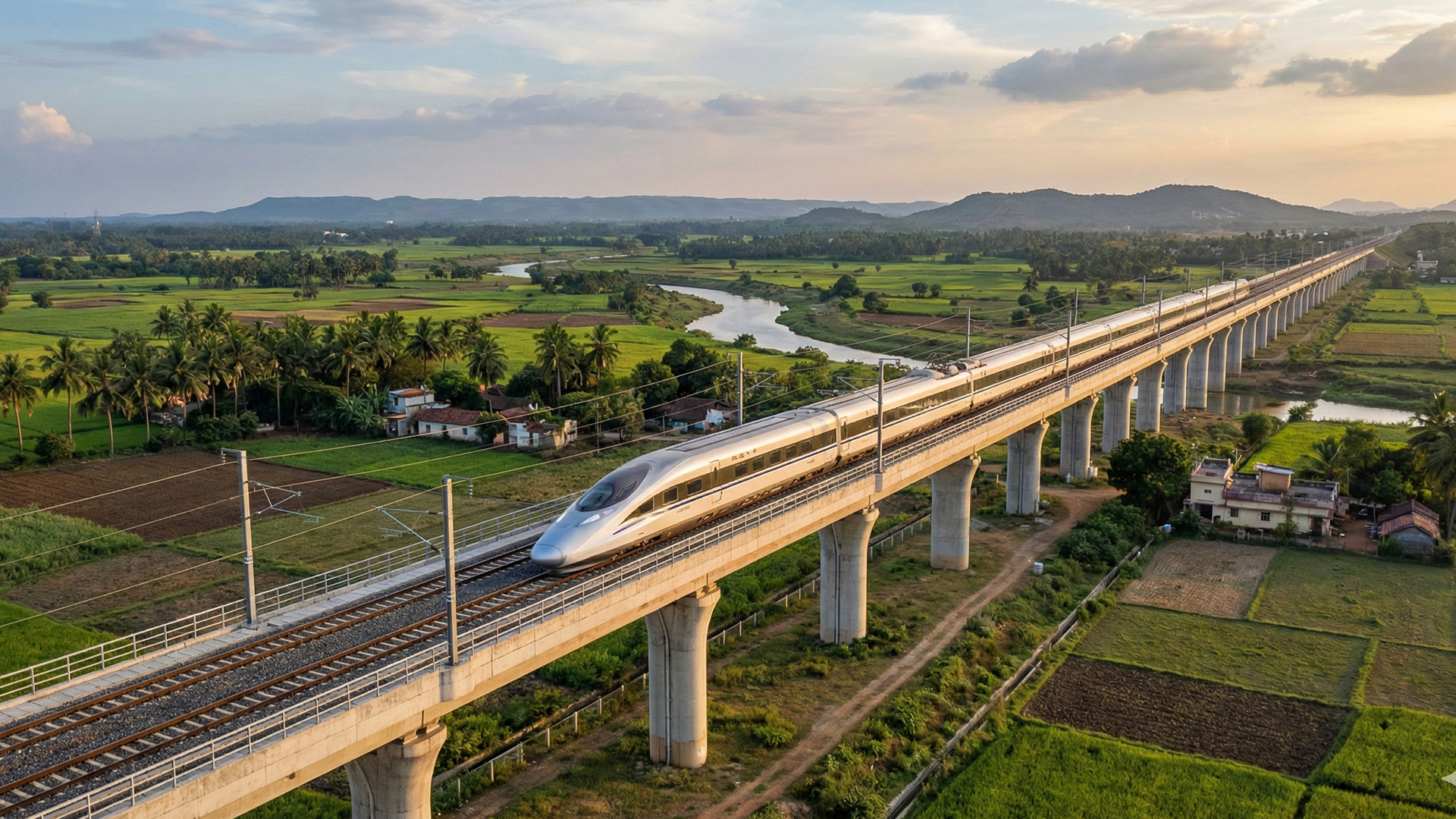
Finance Minister Nirmala Sitharaman announced in the Union Budget 2026–27 the development of seven high‑speed rail corridors connecting major Indian cities. The initiative aims to drastically cut travel times and enhance regional economic growth through modern, fast, and sustainable transport networks.
The planned corridors will connect key urban hubs, including Mumbai–Pune, Pune–Hyderabad, Hyderabad–Bengaluru, Hyderabad–Chennai, Chennai–Bengaluru, Delhi–Varanasi, and Varanasi–Siliguri. Together, these lines will cover approximately 4,000 kilometres, serving millions of passengers annually and improving accessibility across the country.
The estimated investment for these projects is around ₹16 lakh crore, reflecting the scale of the government’s commitment to rail modernization. Once operational, travel times will be significantly reduced — for instance, the Mumbai–Pune journey could take less than an hour, while Delhi to Varanasi could be completed in under four hours.
The high‑speed rail corridors are part of a broader modernization strategy, with Indian Railways receiving ₹2.93 lakh crore for the year. Of this, ₹1.20 lakh crore will be spent on safety upgrades, including advanced train protection systems, electrification, and maintenance improvements.
In addition to passenger services, the government also announced a new East–West Dedicated Freight Corridor linking Dankuni in West Bengal to Surat in Gujarat, designed to streamline cargo movement and decongest existing passenger lines.
Also Read: Defence budget at ₹7.85 lakh crore