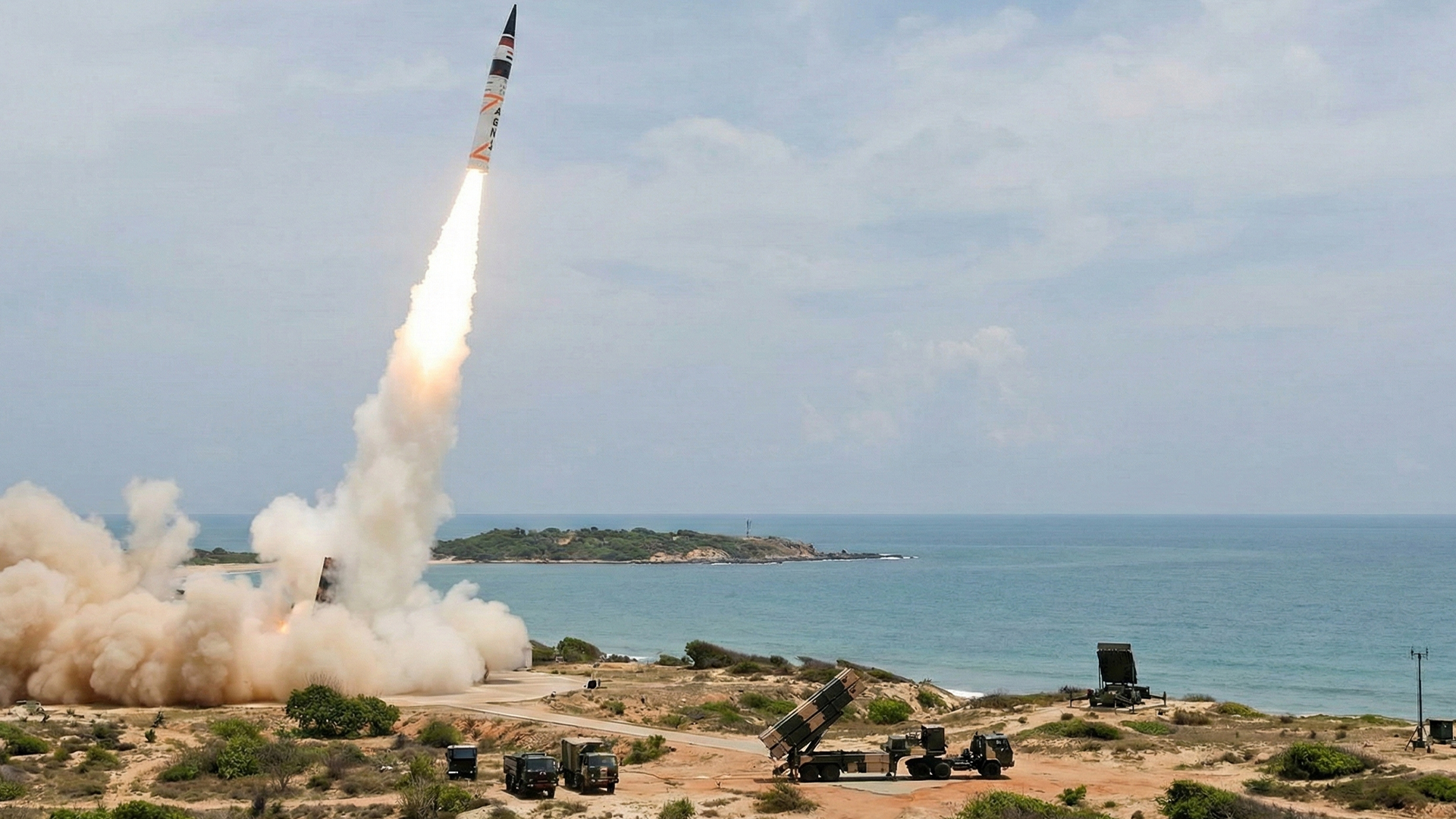
India successfully test-fired the Agni-3 ballistic missile, capable of carrying nuclear warheads, from Chandipur, Odisha, on Friday, February 6, 2026, officials confirmed. The launch was part of a routine exercise by the Strategic Forces Command (SFC) to ensure the missile’s readiness and reliability.
The missile took off from a mobile launcher and followed its pre-planned trajectory into the Bay of Bengal, with its flight closely monitored by tracking radars, telemetry systems, and observation ships. Defence experts said the launch demonstrated the missile’s accuracy and operational capabilities, reaffirming India’s strategic deterrence.
The Agni-3, an intermediate-range ballistic missile, can strike targets over 3,000 km away. Designed to carry both conventional and nuclear warheads, it plays a key role in India’s defence strategy. The missile is about 17 metres long, weighs roughly 50 tonnes, and uses a two-stage solid propellant system with advanced navigation and guidance technologies to ensure precision.
Officials noted that the missile tested was randomly drawn from production stock, highlighting confidence in its performance and reliability. Regular exercises like this help the SFC maintain operational readiness and proficiency with India’s strategic missile arsenal.
Developed by the Defence Research and Development Organisation (DRDO), the Agni-3 is part of a wider family of missiles, including Agni-1, 2, 4, 5, and newer variants. Each launch is closely studied to improve capabilities and maintain a credible minimum deterrent in a challenging security environment.
With this successful test, India continues to strengthen its strategic defence posture, assuring both its own preparedness and regional stability.
Also Read: AI stethoscopes help bridge screening gaps