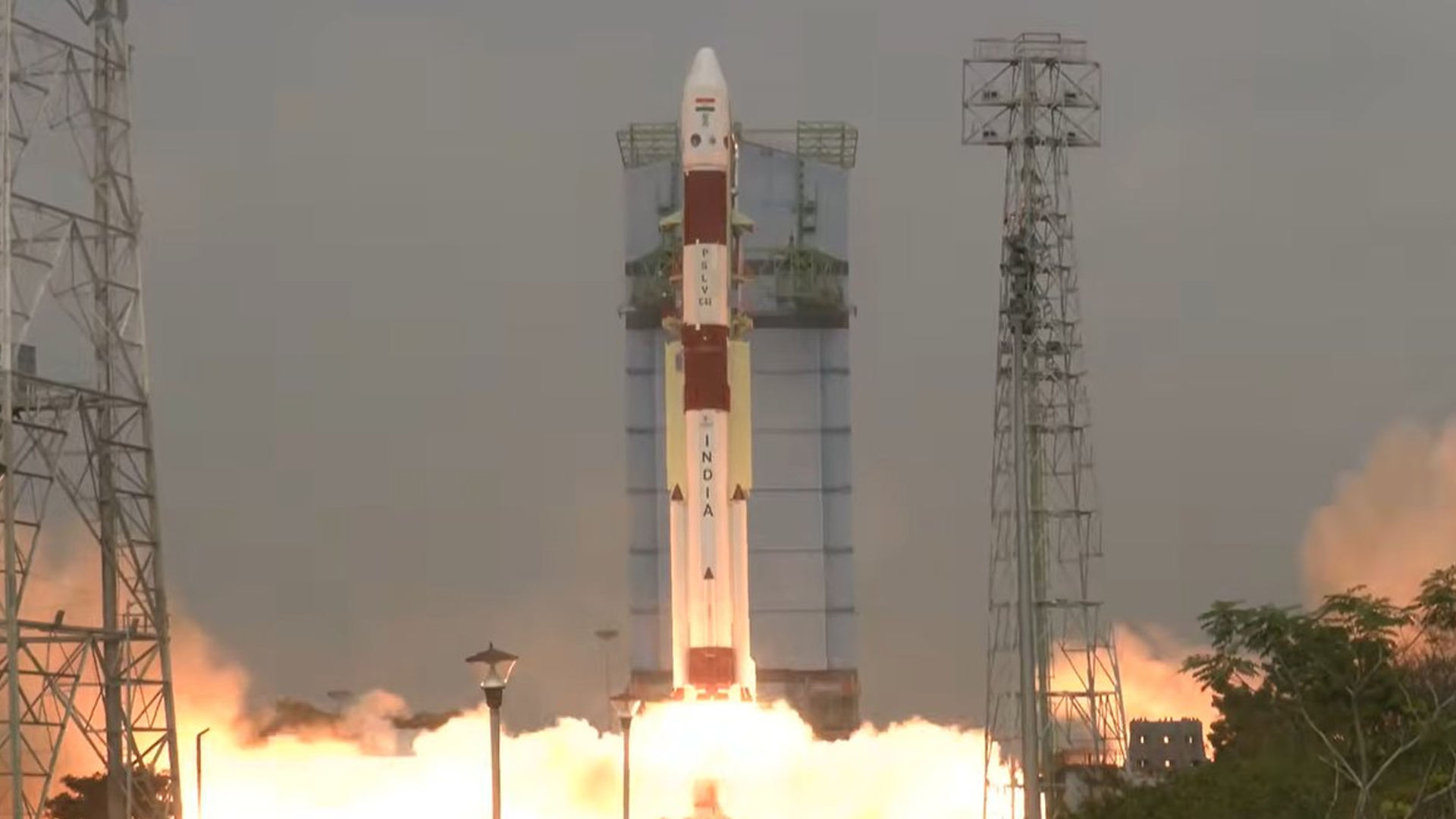
The Indian Space Research Organisation (ISRO) began India’s space journey for 2026 with the launch of PSLV-C62 from the Satish Dhawan Space Centre, Sriharikota, on January 12. The rocket carried EOS-N1, an Earth observation satellite, along with 14 co-passenger satellites from India and abroad.
The launch took place at around 10:18 a.m. and initial stages of the mission progressed as planned. PSLV-C62, known for its consistent performance over the years, successfully lifted off and completed the first two stages of flight normally. This mission was operated by NewSpace India Limited (NSIL), ISRO’s commercial arm, and marked the 64th flight of the PSLV.
EOS-N1, also referred to as Anvesha, is a hyperspectral Earth observation satellite. It has been designed to capture high-resolution data that can be used for agriculture monitoring, environmental studies, water resource management, urban planning, and disaster response. The satellite was expected to strengthen India’s remote sensing and data-driven decision-making capabilities.
Along with EOS-N1, the rocket carried 14 smaller satellites, including technology demonstration and commercial payloads. Among them was an experimental satellite intended to demonstrate controlled atmospheric re-entry, highlighting ISRO’s growing focus on advanced and sustainable space technologies.
However, ISRO later confirmed that the mission faced a technical anomaly during the third stage of flight. A deviation in the vehicle’s performance was observed towards the end of the PS3 stage. As a result, the mission could not be completed as planned.
ISRO Chairman V. Narayanan stated that the launch vehicle performed normally until the anomaly occurred and that a detailed technical analysis is underway to identify the exact cause. The space agency has assured that findings from this review will be used to strengthen future missions.
Despite the setback, the launch underlines India’s continued momentum in space exploration and commercial satellite launches. ISRO is expected to proceed with upcoming missions in 2026 after completing corrective actions, reinforcing its focus on reliability, innovation, and global collaboration in space technology.