Guwahati: For more than a decade, the Government of India has made sustained efforts to put Northeast India on the country’s tourism map. From cultural showcases to skill development programs, the Ministry of Tourism has invested heavily in campaigns promoting the region as India’s “unexplored paradise.”
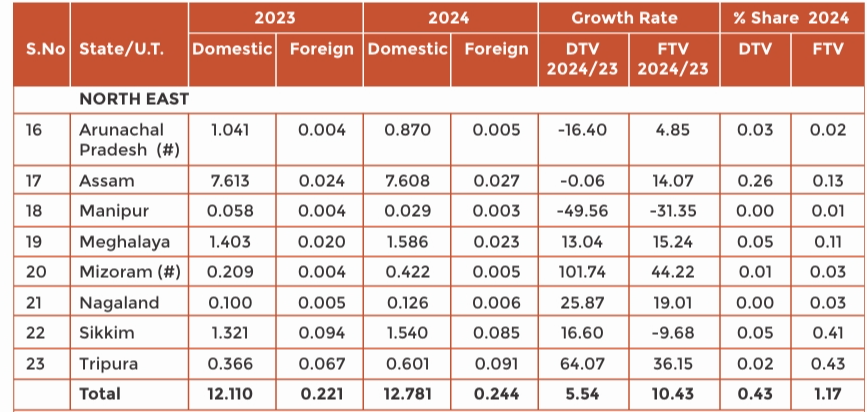
Yet, despite these initiatives, the numbers paint a sobering picture: the Northeast accounted for just 0.43% of India’s domestic tourist visits and 1.17% of foreign tourist arrivals in 2024, according to the India Tourism Data Compendium 2025.
The eight states of Northeast India are blessed with scenic natural beauty, salubrious weather, rich biodiversity, rare wildlife, historical sites, distinct cultural and ethnic heritage, and warm, welcoming people.
The region offers unforgettable experiences for tourists interested in wildlife, religious, cultural, and ethnic tourism, river cruises, golf, and a host of other activities.
The latest data reveals that the eight northeastern states collectively hosted 12.78 million domestic tourists and 0.244 million foreign tourists in 2024. While these figures mark modest growth of 5.54% and 10.43%, they remain marginal compared to the tens of millions of visitors drawn annually to states like Uttar Pradesh, Tamil Nadu, or Rajasthan.
For domestic tourist visits, the top five states were Uttar Pradesh (646.81 million; 21.94%), Tamil Nadu (306.84 million; 10.41%), Karnataka (304.56 million; 10.33%), Andhra Pradesh (290.27 million; 9.85%), and Rajasthan (230.08 million; 7.80%), together accounting for 60.38% of total domestic visits.
In the case of foreign tourists, Maharashtra (3.70 million; 17.69%), West Bengal (3.12 million; 14.92%), Uttar Pradesh (2.27 million; 10.83%), Gujarat (2.27 million; 10.86%), and Rajasthan (2.07 million; 9.90%) led the numbers, collectively attracting 64.34% of total foreign visits. No monuments from the Northeast featured among the top ten most visited monuments for either domestic or foreign tourists.
The only positive trend has been the relatively higher share of foreign tourists compared to domestic visitors. In 2024, the region welcomed 244,000 foreign tourists, accounting for 1.17% of national foreign tourist visits—nearly three times higher in relative terms than domestic arrivals.
The Ministry of Tourism has consistently emphasized the region’s potential. One of its flagship initiatives, the International Tourism Mart (ITM), is held annually in the Northeast to showcase its destinations, products, and culture.
The most recent edition took place in Kaziranga, Assam, from November 26 to 29, 2024, bringing together domestic and international buyers, sellers, and policymakers to promote the region globally. In parallel, the Ministry has invested in building human capital to strengthen tourism infrastructure.
Through its Central Institutes of Hotel Management (CIHMs) in Guwahati and Shillong, it provides professional education and training in hospitality, creating a skilled workforce. Additionally, under the Capacity Building for Service Providers (CBSP) scheme, skill development programs provide education, training, and certification to service providers across various levels of the hospitality sector.
Despite these efforts, the Northeast’s share of India’s tourism remains minimal.
Assam remains the anchor, attracting 7.61 million domestic tourists in 2024, though domestic growth stagnated at -0.06%, even as foreign arrivals rose by 14.07%. Assam’s share of India’s total tourism remains just 0.26% for domestic and 0.13% for foreign tourists.
Smaller states, however, are driving the most growth. Mizoram recorded a 101.74% increase in domestic visitors and 44.22% in foreign arrivals, while Tripura surged with 64.07% growth in domestic arrivals and 36.15% in foreign arrivals, now holding the region’s highest share of India’s foreign tourist inflow at 0.43%.
Meghalaya saw a 13.04% rise in domestic and 15.24% in foreign arrivals, while Sikkim grew domestically by 16.6%, though foreign arrivals declined by 9.68%.
Nagaland recorded respectable growth, driven by the Hornbill Festival, though numbers remain modest. Arunachal Pradesh faced a 16.4% fall in domestic arrivals, despite a slight rise in foreign visitors. Manipur, impacted by unrest, suffered the steepest decline: domestic arrivals fell by 49.56% and foreign arrivals by 31.35%.
The latest figures highlight a central paradox: even as the government ramps up promotion, training, and infrastructure-building, the Northeast continues to attract only a sliver of India’s tourists.
Structural issues such as poor connectivity, inadequate last-mile facilities, restricted access in sensitive areas, and lingering safety concerns persist.
The Northeast’s diversity—from the palaces of Tripura and monasteries of Sikkim to Meghalaya’s living root bridges and Arunachal’s wild landscapes—is unmatched. While initiatives like ITM, CIHMs, and CBSP have recognized this potential, translating them into visible growth on the ground remains a challenge.
Until that happens, the Northeast will continue to be a region of immense promise, waiting to convert its natural and cultural wealth into measurable tourism growth.
Also Read: How Kaziranga’s insects and spiders hold the key to climate resilience