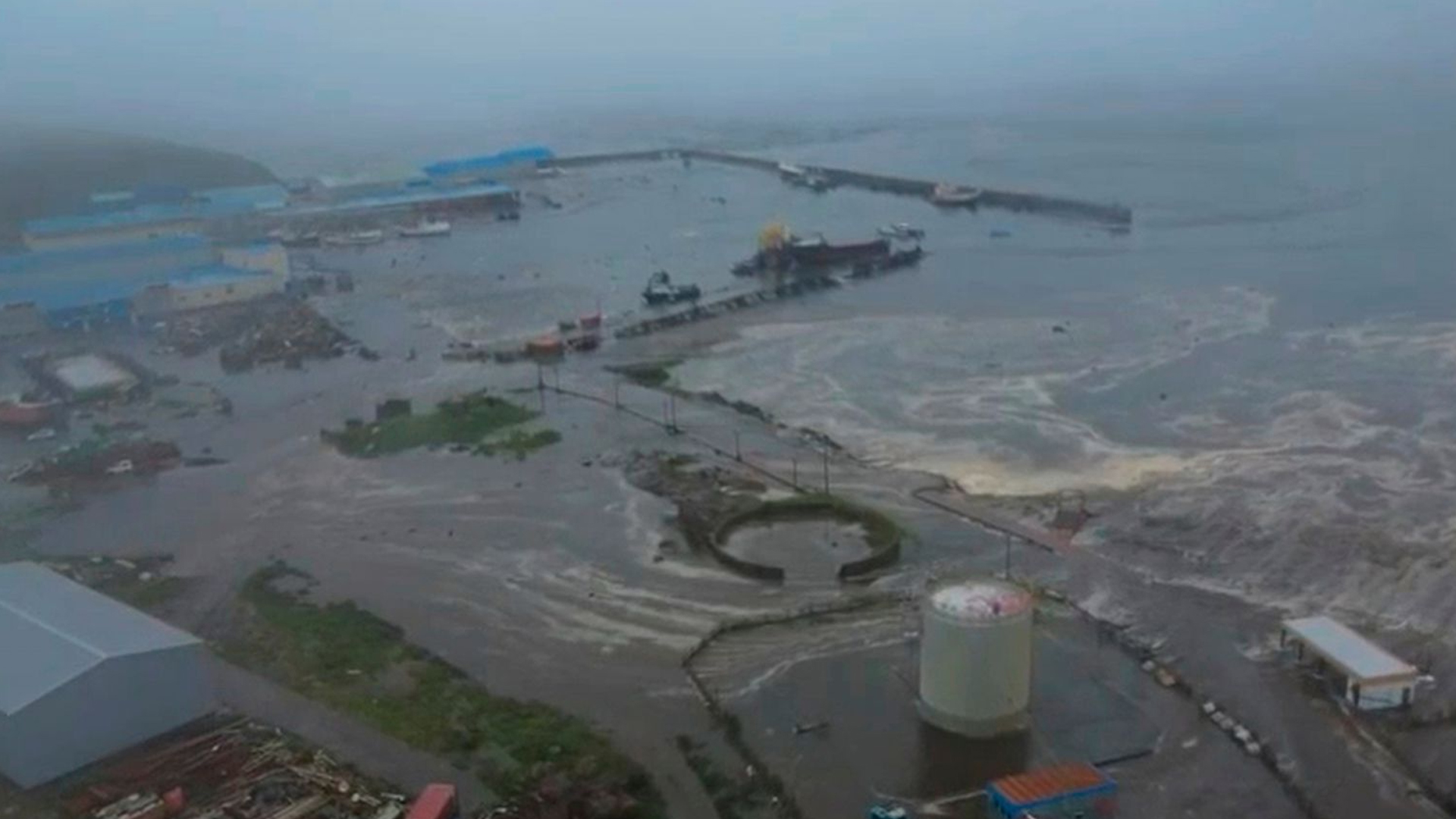
A strong undersea earthquake measuring 7.4 magnitude struck off the Kamchatka Peninsula in Russia’s Far East early Saturday, 13 September, triggering widespread tremors and briefly raising concerns of a potential tsunami.
According to the United States Geological Survey (USGS), the earthquake occurred at a depth of approximately 39 kilometres, with the epicentre located around 111 km east of Petropavlovsk-Kamchatsky, a city situated near the southeastern coast of the peninsula.
Shortly after the tremor, the Pacific Tsunami Warning Center (PTWC) issued a tsunami threat alert, warning that hazardous waves could impact coastal areas within 300 kilometres of the epicentre. However, the warning was lifted a few hours later, as no significant wave activity was observed, and authorities confirmed that there was no tsunami threat.
Tremors Across the Region
Residents in the Kamchatka region reported experiencing strong shaking, but there were no immediate injuries or major damage. In Petropavlovsk-Kamchatsky, some buildings were temporarily evacuated as a precaution. A resident described the tremor as a long, rolling motion, not violent, but very unsettling.
The quake was initially recorded at magnitude 7.5, but the USGS later downgraded it to 7.4 after further analysis.
Seismically Active Region
The Kamchatka Peninsula is situated within the seismically active Pacific Ring of Fire, a region renowned for its frequent and intense geological activity, including earthquakes and volcanic eruptions.
This is not the first major quake in the region this year. In July 2025, a much stronger 8.8-magnitude earthquake struck off the same coast, triggering four-metre-high tsunami waves and prompting widespread evacuation alerts from Japan to Hawaii. That quake was one of the most powerful globally since the devastating 2011 earthquake and tsunami in Japan, which left over 15,000 people dead.
Preparedness and Monitoring
Emergency services in Kamchatka remain on alert. While there are no reports of casualties or significant infrastructure damage, authorities have urged residents to stay informed through official channels and review local emergency protocols in case of aftershocks.
A spokesperson for the Russian Academy of Sciences mentioned that the region is tectonically active, and such strong earthquakes are not uncommon. Seismologists continue to monitor the area closely for tremors.
Also Read: NATO Strengthens Eastern Defences After Russian Drones Shot Down Over Poland