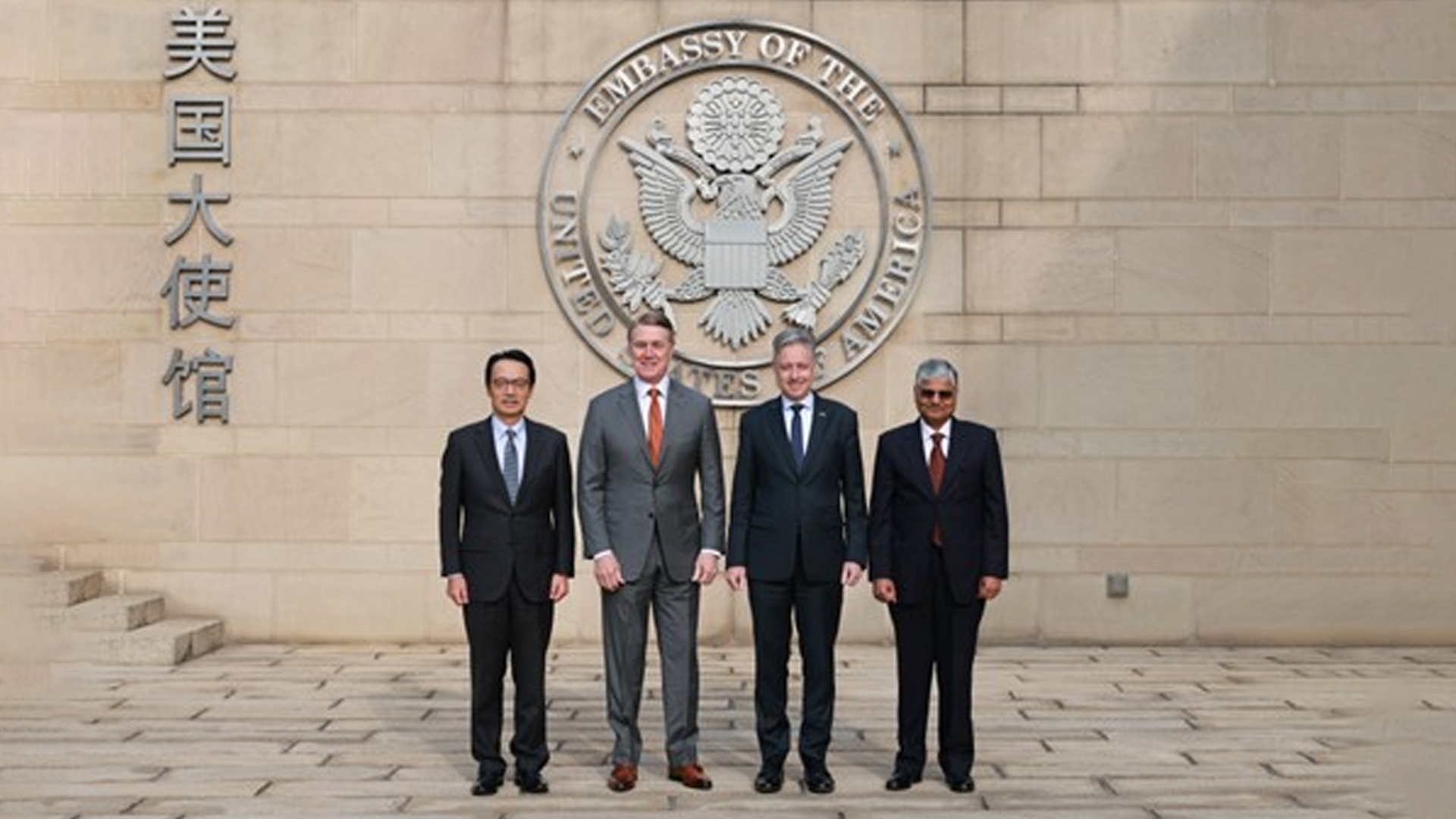
In a rare and closely watched diplomatic move, the ambassadors of the four Quad countries, India, the United States, Australia and Japan, held a publicised meeting in Beijing, signalling unity and shared strategic intent amid heightened regional tensions, particularly around Taiwan.
The meeting was hosted at the United States Embassy in Beijing and was confirmed by US Ambassador to China David Perdue through a social media post. He described the Quadrilateral Security Dialogue (Quad) as a “force for good” and emphasised the strong and stable partnership among the four nations. The image shared from the meeting included India’s Ambassador to China, Pradeep Kumar Rawat, along with his Australian and Japanese counterparts.
Although Quad coordination is not new, such a visible and openly acknowledged meeting in China’s capital is uncommon. Analysts see the public nature of the engagement as significant, especially given Beijing’s long-standing unease with the Quad grouping. China has repeatedly criticised the Quad, viewing it as an exclusive bloc aimed at containing its rise, and has argued that regional cooperation should not target any third country.
The timing of the meeting has drawn particular attention. It comes amid escalating tensions in the Taiwan Strait, with China conducting large-scale military drills around Taiwan. These developments have raised concerns across the Indo-Pacific region and beyond, prompting renewed diplomatic and strategic coordination among like-minded countries.
While the Indian Embassy in Beijing did not issue a separate official statement, the participation of India’s envoy alongside other Quad ambassadors reinforces New Delhi’s continued engagement with the grouping. The Quad has consistently highlighted principles such as respect for international law, freedom of navigation, regional stability and a free, open and inclusive Indo-Pacific.
Observers note that the Quad is not a formal military alliance, but its growing diplomatic visibility reflects shared concerns over security, economic resilience and regional order. The Beijing meeting, though symbolic, sends a clear message of coordination and resolve among the four democracies at a time of shifting geopolitical dynamics.
Also Read: Trump pulls national guard from Chicago, LA and Portland