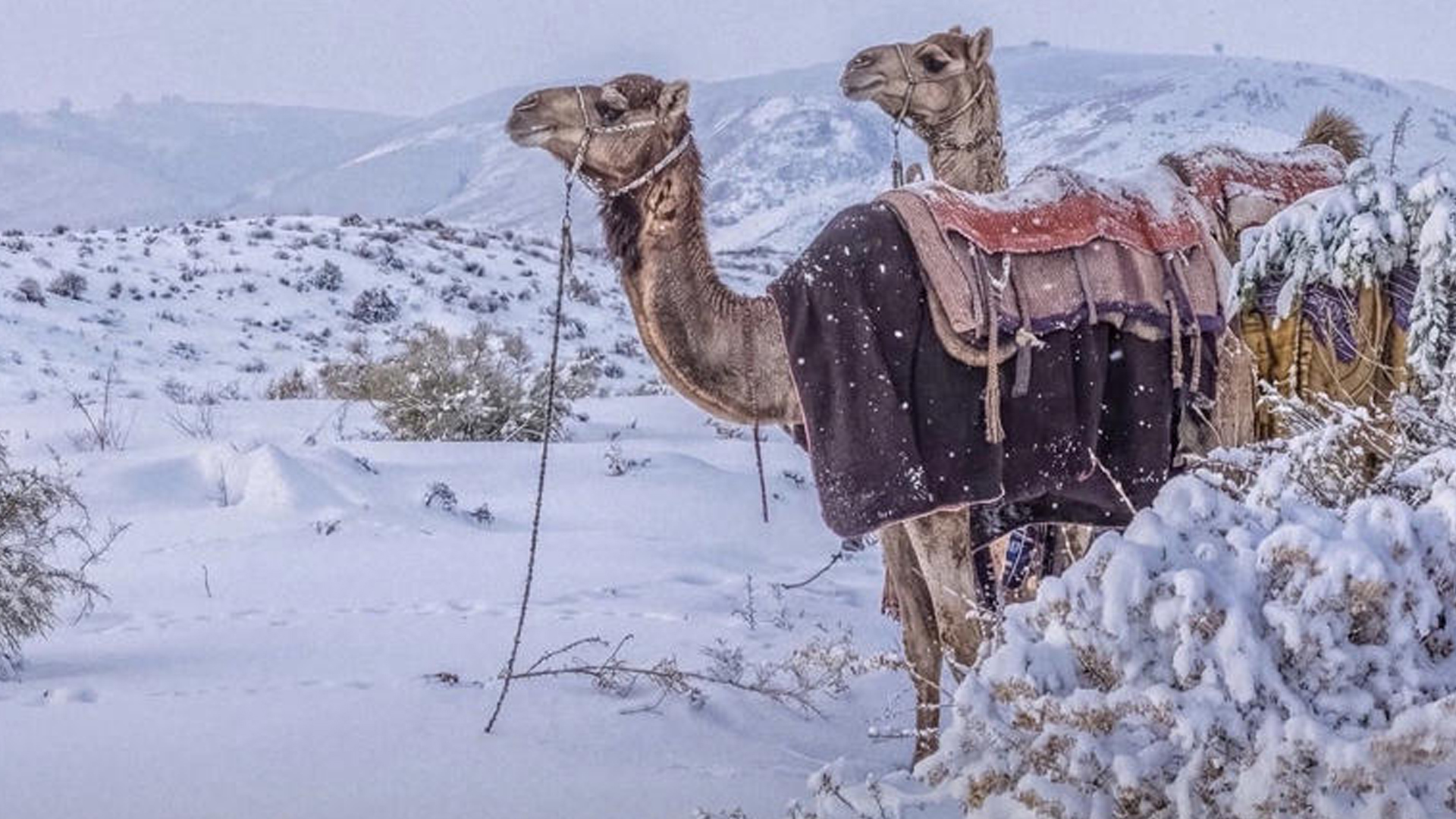
For residents of northern Saudi Arabia, December brought a sight many had never seen in their lifetime, snow falling on desert mountains and rocky plains.
Parts of Tabuk, Al Jouf and Hail woke up to white landscapes as temperatures plunged below freezing, triggering Saudi Arabia’s first widespread snowfall in nearly 30 years. Mountains such as Jabal Al Lawz were blanketed in snow after a powerful cold wave swept through the region, following days of rainfall and strong winds.
Videos of camels trudging through snow, children playing on icy ground, and desert hills glowing white quickly flooded social media. For many locals, it was a moment of disbelief and celebration. Authorities, meanwhile, issued safety advisories, warning of slippery roads and sudden weather changes.
Meteorologists explained that the rare event was caused by a southward push of cold polar air, which collided with moisture-rich weather systems over the Arabian Peninsula, a combination seldom seen in this arid region.
Saudi Arabia’s snowfall is not an isolated case. Over the past five years, some of the world’s driest deserts have experienced rare snow events, reminding scientists and citizens alike of nature’s unpredictability.
In Chile, the Atacama Desert, considered the driest place on Earth, saw snowfall in 2025, surprising local communities and temporarily affecting astronomical observatories located in the region. Snow there is so uncommon that even scientists described the event as exceptional.
Elsewhere, parts of the Sahara Desert, particularly near Aïn Séfra in Algeria, have witnessed occasional snow, turning golden dunes into postcard-like scenes. China’s Taklamakan Desert has also recorded rare winter snowfalls, while Pakistan’s Katpana cold desert regularly sees snow due to its high-altitude location, creating dramatic contrasts between sand and ice.
Climate experts caution that these events are usually brief and localised, with snow melting quickly as temperatures rise. However, their emotional and visual impact is lasting.
Also Read: Trump recalls 30 US ambassadors in global shake-up