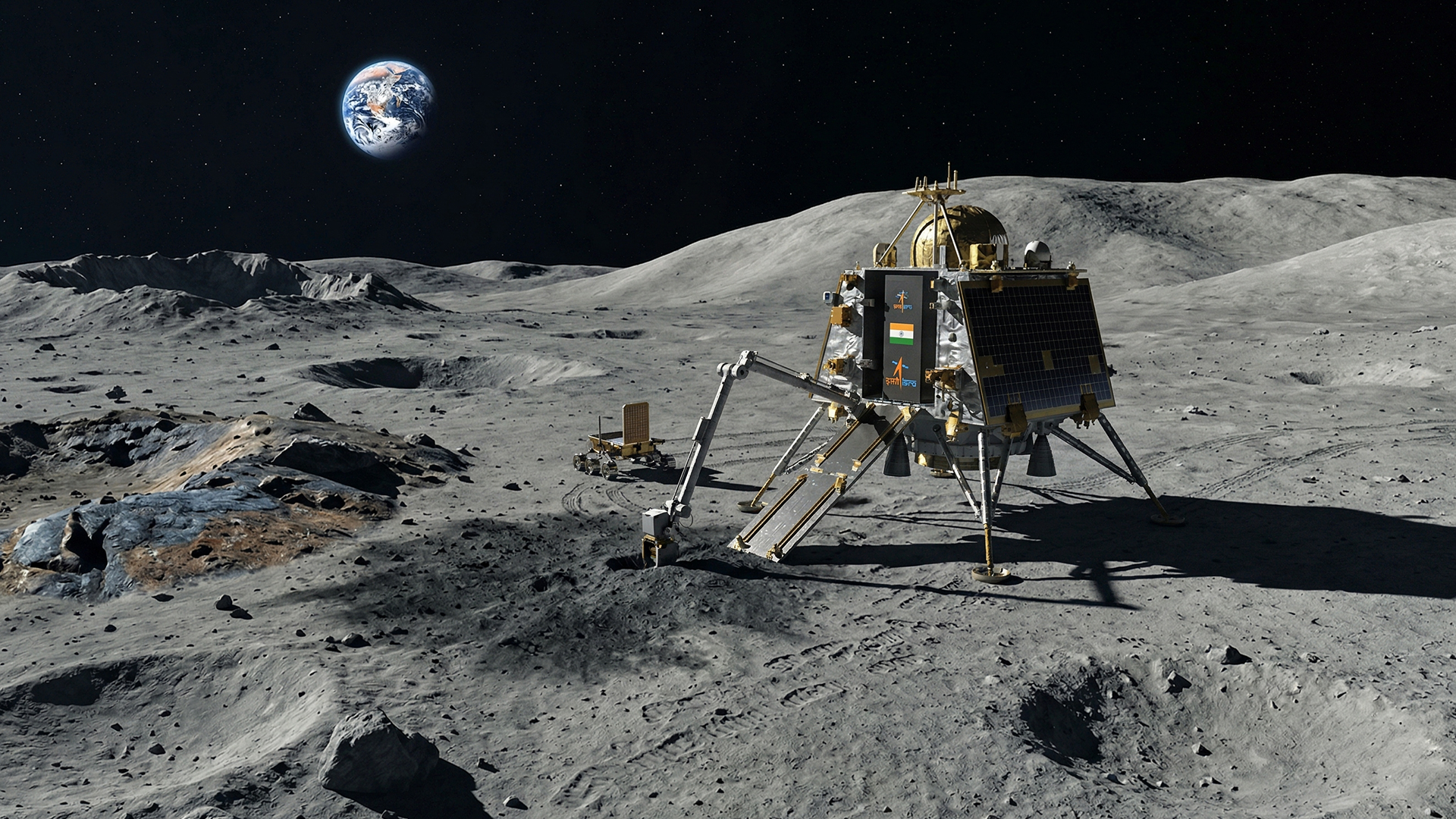
A team of Indian scientists has taken a giant leap in understanding the Moon’s ancient past, uncovering how some of its rarest rocks formed deep beneath the surface. Researchers from IIT Kharagpur and the Physical Research Laboratory (PRL) have studied titanium‑rich lunar rocks, a discovery that could shape India’s upcoming Chandrayaan‑4 mission.
These rocks, called ilmenite‑bearing cumulates (IBC), formed over 4.3 billion years ago, when the Moon was still molten and covered by a vast “magma ocean.” As the molten rock slowly cooled, heavier minerals sank while lighter materials floated upward, creating layers of different compositions. The titanium‑rich rocks found today are remnants of this ancient process.
To better understand how these rocks formed, the scientists recreated extreme lunar conditions in their lab, exposing samples to pressures over 3 gigapascals and temperatures above 1,500 °C. Their experiments showed how these ancient rocks partially melted and interacted with the surrounding lunar mantle, producing magmas that eventually reached the surface as titanium‑rich basalts.
One intriguing insight was that temperature played a key role. At higher temperatures, titanium‑rich magma could form directly, while at lower temperatures, it needed more time to evolve before reaching the surface. This explains why the Moon’s surface today shows such a diverse range of rock compositions.
The findings are more than just academic. They provide a roadmap for India’s Chandrayaan‑4, the country’s first sample‑return mission. Knowing where these valuable rocks are likely to be located helps mission planners choose landing sites, design instruments, and prioritize which samples to bring back to Earth.
Also Read: US eyes Iran’s Ghalibaf as possible negotiation partner