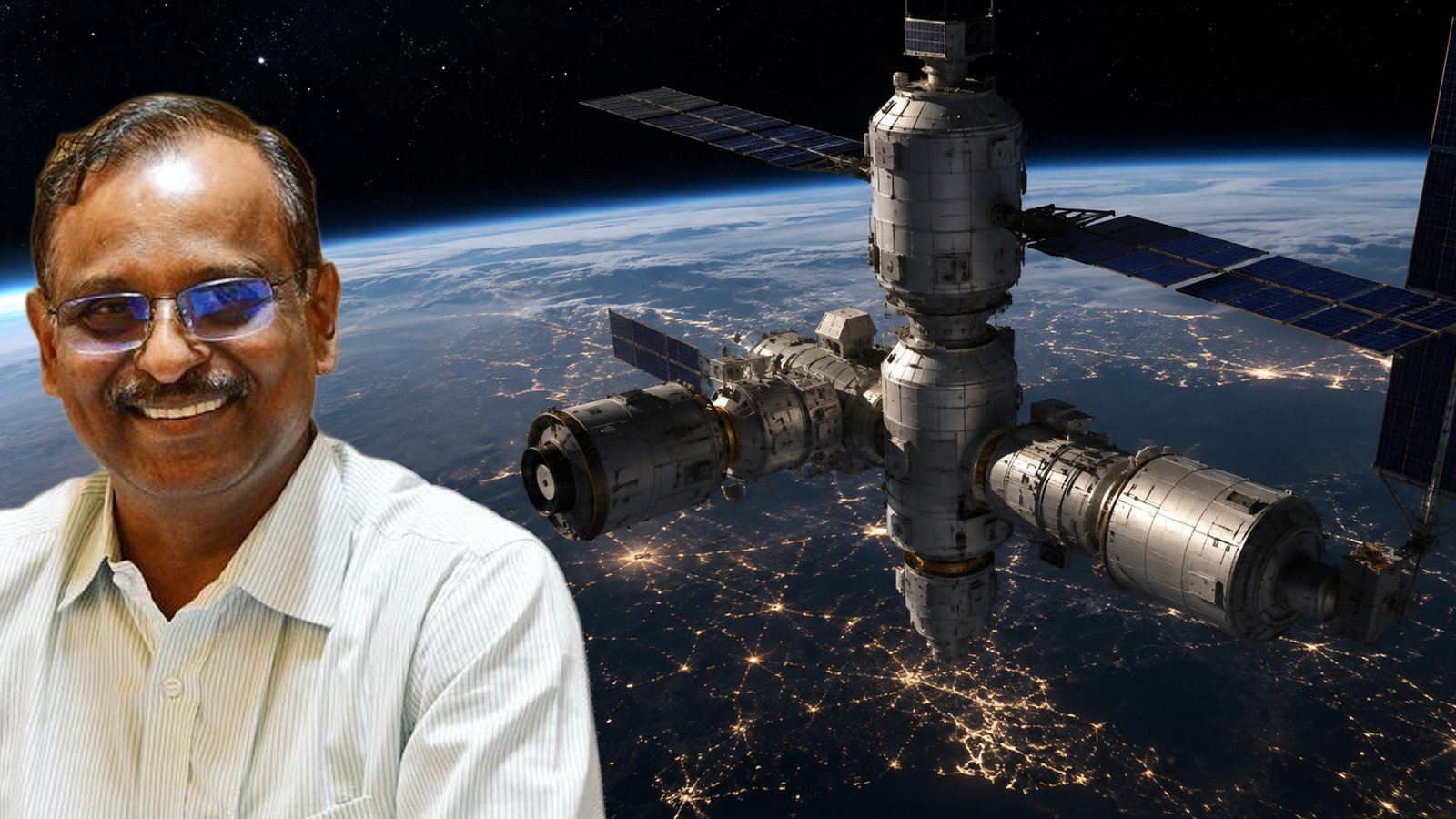
India is setting its sights on a permanent presence in space, with the country planning to establish its own space station by 2035. ISRO Chairman V. Narayanan announced the target at the third National Space Day celebrations in Ahmedabad, saying the first module of the proposed Bharatiya Antariksha Station (BAS) has already received approval.
The announcement marks another important step in India’s expanding human spaceflight programme. The proposed space station is being developed as part of the country’s longer-term space exploration plans and is expected to provide a platform for scientific research, technology experiments and extended human activity in orbit.
The Bharatiya Antariksha Station is planned as a five-module orbital facility. The Union Cabinet approved the development and launch of its first module, BAS-01, in September 2024. The first module is targeted for launch in 2028, while the complete station is expected to be established by 2035. The overall configuration has already undergone national-level review.
The project is closely linked to Gaganyaan, India’s first human spaceflight programme. Gaganyaan is designed to develop the technologies needed to send Indian astronauts into space safely and bring them back to Earth. The experience gained through the programme is expected to provide the foundation for longer-duration missions and eventually operations aboard the Indian space station.
India’s approach is deliberately phased. Instead of attempting to build the entire station in one go, ISRO plans to put individual modules into orbit and develop the facility progressively. This will allow the space agency to test systems, improve operational capabilities and build experience in maintaining a complex orbital platform.
The proposed station will also represent a significant change in the way India approaches human space exploration. Until now, India’s major space achievements have largely involved robotic missions, satellites and launch vehicles. A functioning space station would take the country into a new category of space activity, where astronauts could conduct experiments and work in orbit for longer periods.
Narayanan also highlighted how deeply space technology has become integrated into everyday life in India. According to the ISRO chief, space-based applications are now being used in more than 50 areas, covering services and activities that directly benefit citizens. These include communications, navigation, weather forecasting, disaster management, agriculture and Earth observation.
The country’s space programme has already undergone a major transformation in recent years. The success of Chandrayaan-3, which landed near the Moon’s south polar region in August 2023, demonstrated India’s ability to execute complex planetary missions. The achievement is also the reason August 23 is observed as National Space Day in India.
The next major milestone is Gaganyaan. India is preparing for uncrewed missions that will test the systems required before astronauts are sent into orbit. The human spaceflight programme involves developing a human-rated launch vehicle, crew escape technology, life-support systems, an orbital module and other critical infrastructure.
The space station is expected to build on those capabilities. A permanent orbital facility would require sophisticated docking systems, environmental control and life-support technology, reliable power systems, communications and the ability to transport crew and supplies between Earth and orbit.
India is also looking beyond the space station. The country’s broader space roadmap includes missions to the Moon and Venus, reusable launch technologies and the development of more capable launch vehicles. The Bharatiya Antariksha Station is therefore being positioned as one component of a much larger strategy for expanding India’s role in space exploration.
The project could also create new opportunities for India’s growing private space sector. Over the past few years, the government has increasingly encouraged private companies and startups to participate in satellite manufacturing, launch services, propulsion, space applications and other areas of the space economy.
This expanding ecosystem could provide additional industrial capacity as missions become larger and more complex for ISRO. Building a space station will require not just scientific expertise but also a reliable domestic supply chain capable of producing sophisticated components at scale.
The 2035 target is also significant from a strategic perspective. A national space station would give India an independent platform for conducting research and developing technologies in low Earth orbit. It could strengthen cooperation with other space agencies while giving Indian scientists and astronauts greater access to orbital research opportunities.
The idea of a space station may still sound distant. But the roadmap is already moving from vision to hardware, with the first module approved and a 2028 launch target in place.
If the schedule progresses as planned, the next decade could see India move from sending individual missions into space to building and operating its own home in orbit. The Bharatiya Antariksha Station, alongside Gaganyaan and future lunar missions, could become a defining part of India’s next phase of space exploration.