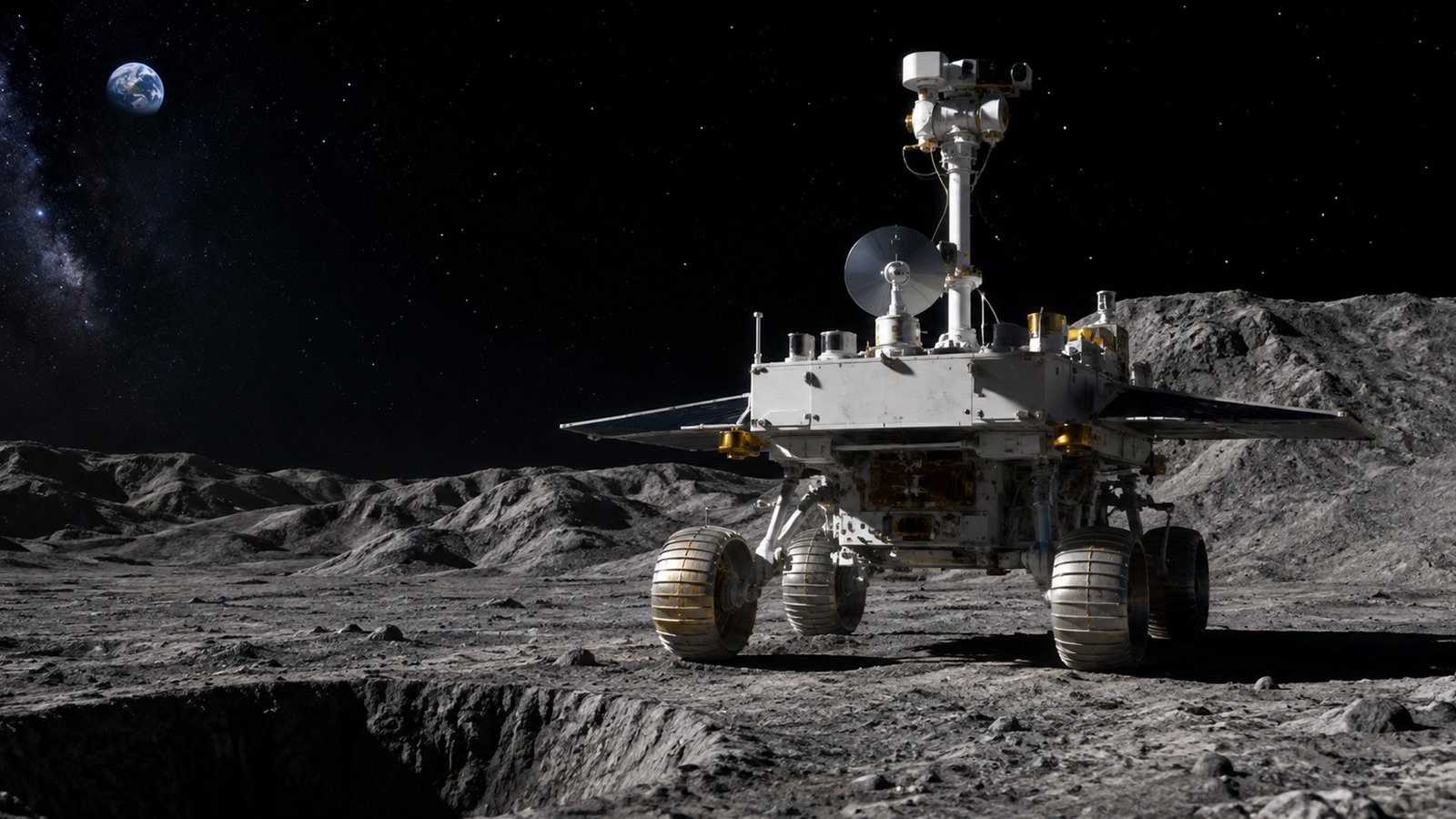
China has postponed the launch of its ambitious Chang’e-7 lunar mission, delaying a major step in its plans to explore the Moon’s south polar region. The mission was expected to lift off this week, but the launch window closed without the spacecraft beginning its journey. Chinese authorities have not announced a new launch date.
The mission was scheduled to launch from the Wenchang Spacecraft Launch Site in Hainan province aboard a Long March 5 heavy-lift rocket. Preparations had advanced significantly, with the rocket and spacecraft positioned for the planned launch.
The decision to postpone came after a review of the mission’s launch conditions. Chinese space authorities said the move was made after a comprehensive assessment, with safety and mission reliability remaining the priority. Officials have not provided detailed information about the specific technical or operational issue that led to the delay.
The timing of Chang’e-7 is particularly important because lunar missions cannot always be launched whenever convenient. The spacecraft must follow a carefully calculated trajectory, while lighting and environmental conditions at the intended landing region also have to be taken into account. A narrow launch window can therefore mean that even a short delay may require the mission to be moved to a later opportunity.
Weather conditions around the launch region were also being closely watched during the preparations. However, Chinese authorities have not officially identified weather as the reason for the postponement.
Chang’e-7 is one of China’s most ambitious robotic missions to the Moon and has been designed specifically to study the lunar south pole. The region has attracted enormous scientific interest because some of its deep craters remain in permanent darkness.
These permanently shadowed areas are extremely cold and receive little or no sunlight. Scientists believe they could contain deposits of water ice, potentially preserved for billions of years. Finding and studying this ice is considered one of the major goals of modern lunar exploration.
Water on the Moon could have enormous significance for future missions. It could be used for drinking water and life-support systems, while its components, hydrogen and oxygen, could potentially be used to produce rocket propellant. This could reduce the need to transport large quantities of supplies from Earth and make longer lunar missions more practical.
Chang’e-7 is designed to investigate these possibilities using several spacecraft elements. The mission is expected to include an orbiter, lander, rover and a small hopping probe. Working together, they will allow scientists to study different parts of the lunar south polar environment.
The hopping probe is particularly interesting because it is designed to reach areas that a conventional rover may find difficult to access. It could move between locations and investigate permanently shadowed regions, helping scientists understand the distribution and characteristics of possible water deposits.
The mission is also expected to carry scientific instruments from international partners, adding a collaborative dimension to China’s lunar exploration programme.
Chang’e-7 follows the successful Chang’e-6 mission, which achieved a major milestone in 2024 by collecting samples from the far side of the Moon and returning them to Earth. That mission demonstrated China’s ability to carry out complex operations on the lunar surface and safely bring material back home.
The new mission is part of a much larger Chinese lunar strategy. Beijing has set an ambitious goal of sending astronauts to the Moon before 2030 and is developing technologies for longer-term human activity there.
Chang’e-7 is expected to be followed by Chang’e-8, which will focus on scientific research and technology demonstrations on the lunar surface. Together, these missions are intended to build knowledge and capabilities that could eventually support the development of a lunar research station.
China’s lunar ambitions are unfolding alongside renewed interest in the Moon from other major space powers. The United States is pursuing its Artemis programme, while countries including India and Japan are also developing missions focused on lunar exploration. The south pole has emerged as a particularly important destination because of its potential water resources and unique environment.
For China, the postponement of Chang’e-7 is therefore a setback, but not a cancellation of its broader lunar ambitions. The mission remains an important part of the country’s long-term space programme.
The delay also highlights the difficulties involved in exploring the Moon. Launch opportunities, orbital mechanics, spacecraft performance and conditions at the destination all have to align. A mission travelling hundreds of thousands of kilometres through space leaves little room for error.
A new launch date will depend on when suitable conditions become available and how the mission is rescheduled. Until then, the spacecraft and launch team will remain part of an extensive preparation process aimed at ensuring a successful journey.