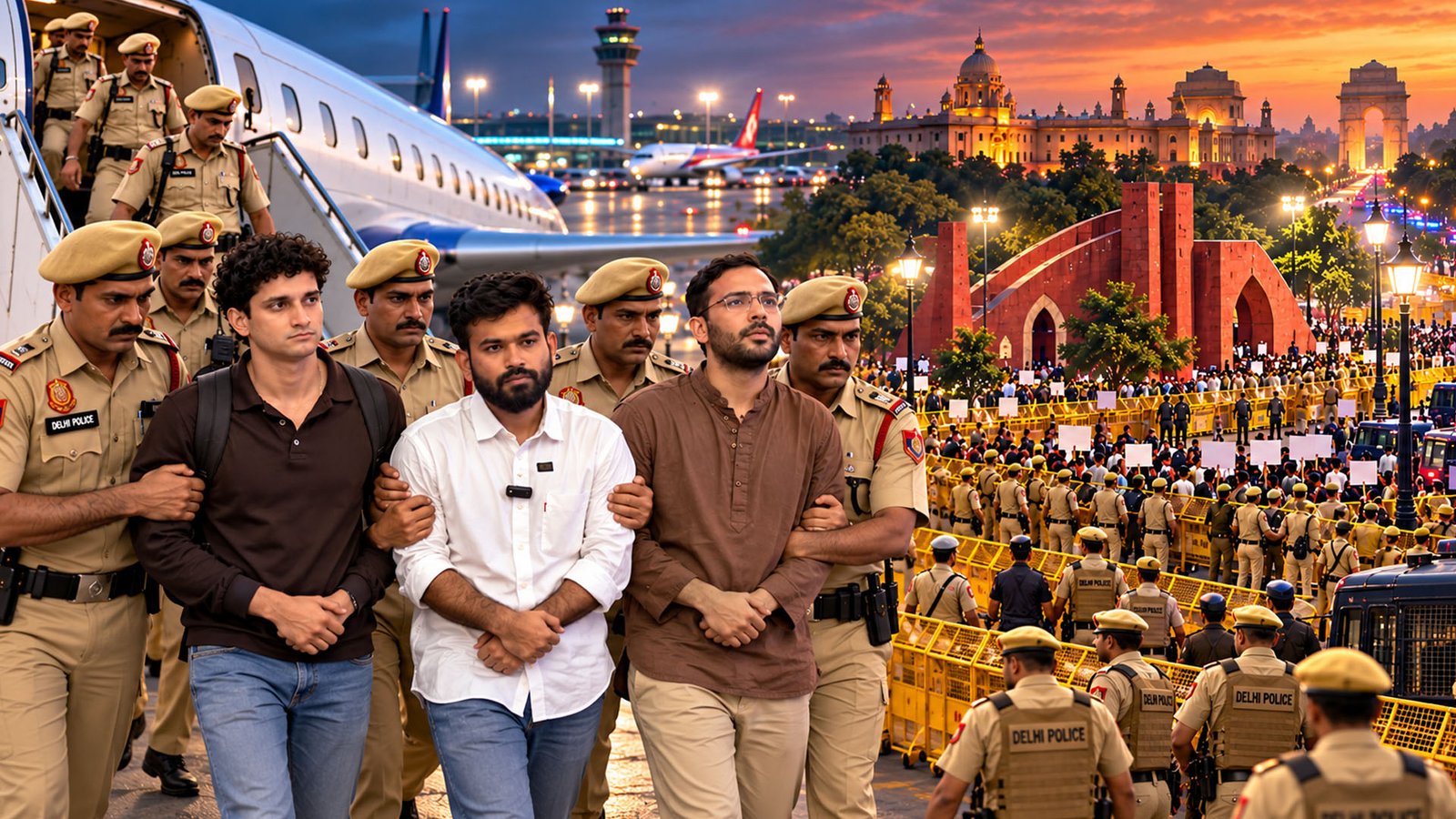
Police detained Cockroach Janta Party (CJP) leaders and activists in New Delhi and Mumbai on Saturday, October 10, as authorities moved to prevent planned demonstrations demanding the resignation of Chief Election Commissioner Gyanesh Kumar. The action triggered a wider debate over electoral transparency, preventive detentions and the right to peaceful protest.
CJP founder Abhijeet Dipke, co-convenor Saurav Das and spokesperson Ashutosh Ranka were detained by Delhi Police shortly after their flight from Mumbai landed at Indira Gandhi International Airport. The three were travelling to the capital to participate in a planned demonstration at Jantar Mantar against the Election Commission’s Special Intensive Revision (SIR) of electoral rolls.
Videos shared by the organisation showed police personnel entering the aircraft and taking the leaders into custody before they could leave. Dipke was heard telling officers that he had come prepared to be arrested. Police personnel asked him to cooperate, describing the action as a detention.
The CJP condemned the move, alleging that its leadership had been prevented from reaching the protest venue before the demonstration could begin. The organisation demanded the release of its leaders and accused the authorities of curbing peaceful political expression.
Tushar Gandhi detained in Mumbai
In a parallel development, activist Tushar Gandhi, great-grandson of Mahatma Gandhi, was detained in Mumbai along with others ahead of a solidarity protest planned at August Kranti Maidan.
The demonstration was intended to support the CJP’s campaign in Delhi and draw attention to concerns surrounding electoral roll revisions. Mumbai Police cited the absence of official permission for the proposed gathering.
The detentions in the two cities came amid heightened security arrangements and efforts to prevent protesters from assembling at the planned venues.
In Delhi, police had denied permission for the CJP’s demonstration, citing security and law-and-order concerns. Authorities deployed large numbers of police and paramilitary personnel, established barricades and introduced traffic restrictions across parts of the capital.
Several metro stations were shut temporarily, while restrictions on rail services and mobile internet affected movement and communication. Police also detained other individuals suspected of planning to join the protest.
Reports said YouTuber Dhruv Rathee and CJP legal team head Ratna Singh were among those detained. Lawyers and other demonstrators were also reportedly taken into custody near the Supreme Court and other locations.
The scale of the security operation raised questions about how authorities balance public order with the right to peaceful assembly. Protest organisers argued that the restrictions prevented citizens from exercising their democratic rights, while the police maintained that the planned gathering had not received the required permission.
Electoral roll revision at the centre of dispute
The protests are centred on the Election Commission’s Special Intensive Revision, an exercise aimed at verifying and updating electoral rolls. Such revisions are intended to identify deceased voters, duplicate entries, people who have moved and other ineligible registrations, helping maintain accurate voter lists.
However, opposition parties and civil society activists have raised concerns about the scale and transparency of deletions during the process. They argue that inadequate verification and grievance-redressal mechanisms could lead to eligible voters being excluded.
The CJP has demanded Gyanesh Kumar’s resignation, alleging that the handling of electoral roll revisions has undermined public confidence in the electoral process. The campaign has called for greater accountability and transparency in the preparation of voter lists.
The controversy has gained wider political significance because electoral rolls determine who can participate in elections. Any large-scale deletion of names therefore requires clear procedures, reliable verification and accessible mechanisms through which voters can challenge errors.
The Election Commission has maintained that electoral roll revisions are part of its responsibility to ensure accurate voter records. Names may be removed following verification where voters are found to have died, relocated or otherwise become ineligible. The prescribed procedures also allow claims and objections to be raised against draft electoral rolls.
Allegations of deliberate political manipulation remain contested and should be distinguished from the stated objectives of the revision exercise.
Political accountability and right to protest
The latest developments mark another phase in the CJP’s campaign, which has sought to mobilise citizens around questions of public accountability and institutional transparency. The group had announced its Delhi demonstration after earlier protests in Mumbai, demanding action over the electoral roll controversy.
The detentions have brought the focus beyond the original demand for the CEC’s resignation to the broader question of how peaceful demonstrations are handled by authorities.
Preventive action may be taken to maintain public order under applicable laws, but restrictions on gatherings and detentions also invite scrutiny over proportionality, legal safeguards and access to remedies.
The immediate issue is whether the detained leaders and demonstrators will be released and whether the campaign will be able to continue through other forms of protest. The larger challenge is restoring public confidence in electoral administration through transparent verification, timely correction of voter records and effective grievance redressal.
As the dispute continues, the Election Commission’s handling of the SIR exercise and the authorities’ response to public demonstrations are likely to remain under close political and public scrutiny. The episode has placed electoral integrity, civil liberties and institutional accountability at the centre of a widening national debate.