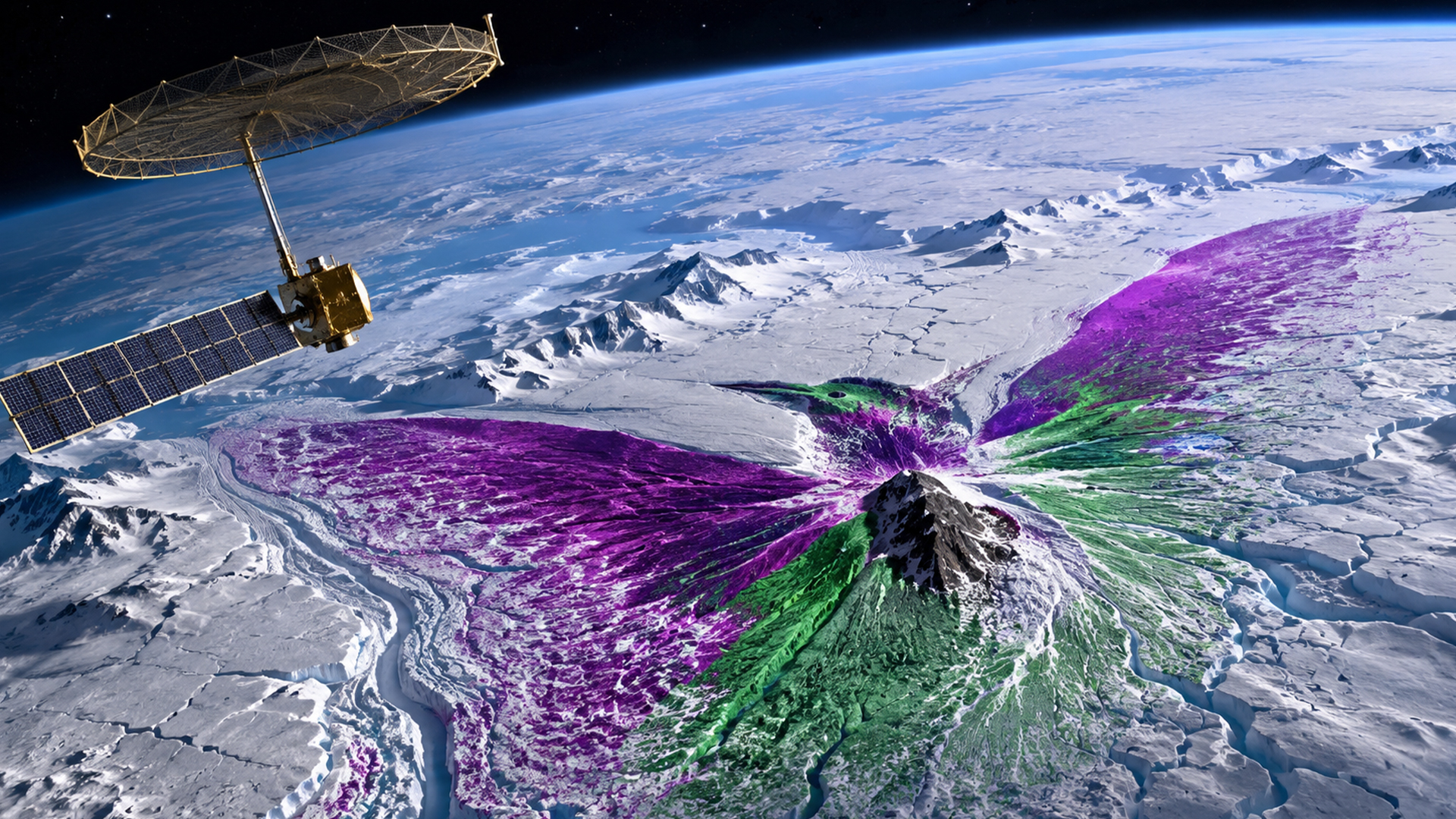
What looked like a breathtaking piece of nature’s artwork has turned out to be one of the latest scientific discoveries from Earth’s frozen south. A newly released image from the NASA-ISRO Synthetic Aperture Radar (NISAR) satellite has revealed a striking hummingbird-shaped pattern hidden beneath the vast ice sheet of East Antarctica, captivating scientists and space enthusiasts alike.
At first glance, the colourful image appears to show the outline of a giant hummingbird spreading its wings across the icy landscape. But the formation is not a bird, nor is it a mysterious geological structure. Instead, it is a natural pattern created by the slow movement of Antarctic ice around a rocky mountain peak, offering researchers a rare glimpse into the hidden forces constantly reshaping the frozen continent.
The remarkable image is among the first major observations released by the NISAR mission, a joint Earth observation project by NASA and the Indian Space Research Organisation (ISRO). Designed to monitor subtle changes across Earth’s land and ice surfaces, the satellite is expected to become one of the world’s most powerful tools for studying climate change, glaciers, earthquakes, forests and natural hazards.
The “hummingbird” sits near a rocky outcrop known as Nunatak Zaterjavshijsja in East Antarctica. A nunatak is a mountain peak that rises above surrounding ice. As glaciers slowly flow around this exposed rock over thousands of years, they develop cracks, stress lines and folds. When captured by NISAR’s sophisticated radar instruments, these features combine to form a pattern that remarkably resembles a bird in flight.
While the image has gone viral for its beauty, scientists say its real value lies beneath the colours.
Unlike ordinary satellite photographs, NISAR does not capture images using visible light. Instead, it uses advanced L-band and S-band Synthetic Aperture Radar that can penetrate clouds, darkness and even parts of snow and ice. This allows the satellite to collect highly detailed data around the clock, regardless of weather conditions—something especially valuable in Antarctica, where long periods of darkness and frequent cloud cover limit traditional imaging.
The vivid shades seen in the image are also not natural colours. They are radar-generated colours that represent tiny differences in the way the ice surface reflects radar signals. These colour variations help scientists identify areas where the glacier is stable, where it is under stress and where it is moving at different speeds.
Such information is becoming increasingly important as researchers work to understand how Antarctica is responding to global warming.
Antarctica contains nearly 90 per cent of the world’s ice and enough frozen water to significantly raise global sea levels if large portions were to melt. Even small changes in glacier movement can have long-term consequences for coastlines and communities around the world. By repeatedly scanning the continent, NISAR will help scientists detect tiny shifts in the ice—sometimes measuring movement as small as a few centimetres.
Researchers believe these observations will improve predictions of glacier behaviour, ice-sheet stability and future sea-level rise. The data could also help identify regions where ice is weakening long before dramatic changes become visible. Satellite observations are giving researchers new ways to understand glaciers, climate change and Earth’s evolving environment, with more such research covered in our science news and discoveries section.
The hummingbird image also marks an important milestone for the NISAR mission itself. Following months of calibration after its launch, the satellite has now begun delivering science-quality data to researchers worldwide. Every 12 days, NISAR will map nearly all of Earth’s land and ice-covered surfaces, creating one of the most comprehensive records of environmental change ever assembled.
Beyond Antarctica, the mission will monitor forests, wetlands, agricultural land, volcanoes, earthquakes and landslides. It will help governments improve disaster preparedness, support farmers with better land monitoring and provide scientists with a clearer understanding of how climate change is altering the planet.
The collaboration between NASA and ISRO is also being hailed as a landmark achievement in international space cooperation. By combining cutting-edge radar technology with global scientific expertise, the mission is expected to transform the way researchers observe Earth’s dynamic systems.
This first memory of NISAR may not be its technical specifications but the extraordinary hummingbird hidden beneath Antarctica’s frozen wilderness.
Even in one of the most remote places on Earth, nature continues to surprise us. What appears to be a beautiful work of art is, in fact, a detailed scientific map of flowing ice—one that could help researchers better understand the future of our warming planet.
Sometimes, the most important discoveries do not come in the form of dramatic explosions or distant galaxies. They emerge quietly, frozen beneath kilometres of Antarctic ice, waiting for the right technology to reveal their story.