Scientists have identified evidence of two previously unknown ancient human lineages that contributed DNA to modern humans, adding new complexity to the story of human evolution.
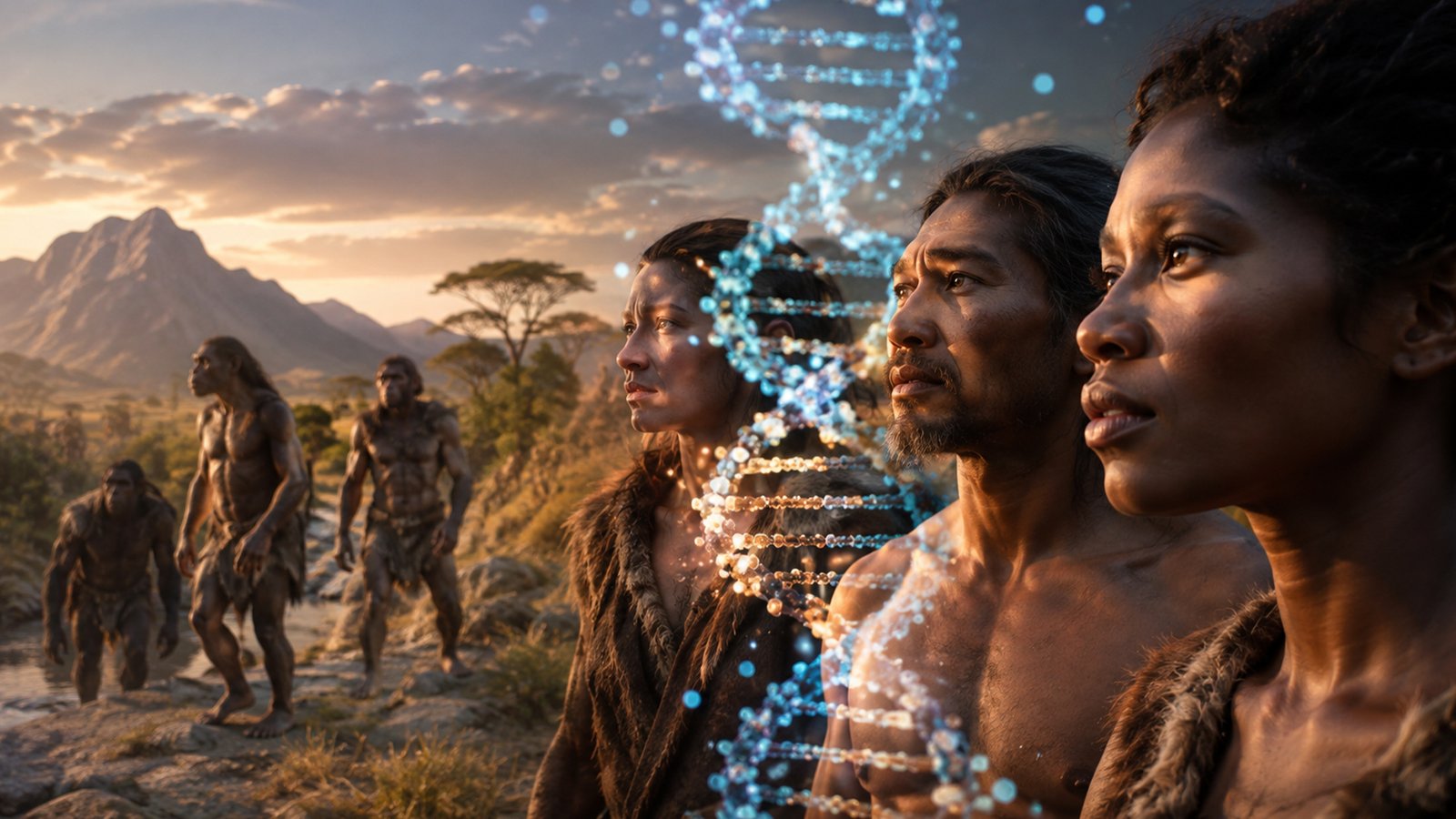
The study, published in Science, used genetic data from more than 500 modern human genomes to look for DNA inherited from ancient populations that have disappeared. These unidentified groups are known as “ghost lineages” because there are no confirmed fossils or complete ancient genomes that can clearly identify them.
The findings suggest that human evolution was not a simple journey from one population to another. Ancient human groups repeatedly separated, migrated and came back into contact, exchanging genes along the way. Some of those populations eventually vanished, but parts of their genetic legacy remained in later generations.
Researchers led by geneticist Priya Moorjani of the University of California, Berkeley, developed a method that can trace unusually old sections of DNA in modern genomes. The technique was tested against known Neanderthal and Denisovan ancestry before being used to search for unknown genetic contributions.
The first ghost lineage appears to have mixed with the ancestors of modern humans in Africa more than 50,000 years ago, before Homo sapiens began its major expansion beyond Africa.
Researchers estimate that this ancient population split from the lineage leading to modern humans around 800,000 years ago. Its genetic contribution is small but widespread, accounting for roughly 0.5% to 1% of the genomes of modern populations studied.
Scientists say one possible candidate for this mysterious group could be Homo heidelbergensis, an ancient human species that lived hundreds of thousands of years ago. However, the researchers have not established its identity, meaning the lineage remains a genetic mystery.
The second lineage is considerably older.
Researchers found traces of what they describe as a “super-archaic” lineage in populations from Oceania. This group may have separated from the ancestors of modern humans about 1.8 million years ago.
Its genetic contribution is tiny, estimated at only about 0.002% in the genomes examined. Yet its extreme age makes the discovery significant because it points to genetic exchanges involving human populations that existed long before modern humans emerged.
The researchers found that this ancient genetic material occurs in regions of the genome associated with Denisovan ancestry. This raises the possibility that Denisovans inherited the DNA from an even older human population and later passed it to modern humans.
One possible source is Homo erectus, an ancient human species that spread across Africa and Asia and survived for a very long period. But researchers stress that this remains a possibility rather than a confirmed identification because scientists have very limited genetic material from Homo erectus.
The discoveries also highlight how much scientists have learned from studying modern human DNA.
For years, human evolution was often illustrated as a branching tree, with populations separating and following independent paths. Genetic research has increasingly replaced that simple picture with something closer to a network, where ancient populations repeatedly encountered each other and exchanged genes. Genetic discoveries are continuing to reshape what scientists know about human ancestry and evolution, with more such research covered in our science news and discoveries section.
The new findings provide another example of that process.
Some of the DNA inherited from ancient populations appears in parts of the genome linked to functions including the immune system and metabolism. Researchers say such genetic exchanges could sometimes have helped ancient humans adapt to new environments, diseases, diets or climates.
This does not mean every piece of ancient DNA was beneficial. Genetic material can also disappear over generations if it provides no advantage or becomes harmful. But the survival of certain segments suggests that some ancient genetic variants may have played a role in human adaptation.
The research is particularly valuable because scientists cannot recover ancient DNA equally well from every part of the world.
DNA preservation is difficult in warm and humid climates, leaving major gaps in the ancient genetic record, especially in parts of Africa and Asia. That means some ancient populations may have disappeared without leaving DNA that researchers can extract directly from fossils.
The new approach offers a way around part of that problem.
By examining the genomes of people alive today, scientists can identify unusually old genetic segments and use them to reconstruct clues about populations that may have disappeared hundreds of thousands of years ago.
Researchers believe the technique could eventually reveal more ghost populations that have not yet been identified. It may be particularly useful for studying regions where ancient human remains are limited or poorly preserved.
The study also adds to the growing evidence that modern humans carry a surprisingly complicated genetic inheritance.
Neanderthals and Denisovans are already known to have contributed DNA to modern populations. The latest research suggests they were only part of a much larger story involving several ancient human groups.
For the moment, the newly detected populations remain nameless. Scientists do not know exactly what they looked like, where they lived or why they disappeared.
But their genetic fingerprints have survived.
That makes the discovery an unusual window into human ancestry. Populations that vanished long before recorded history may have left small pieces of themselves in people living today.
As scientists develop better ways to read the human genome, more of these hidden connections could emerge — revealing that the history of human evolution was not a straight path, but a long and complicated story of migration, survival and interbreeding.