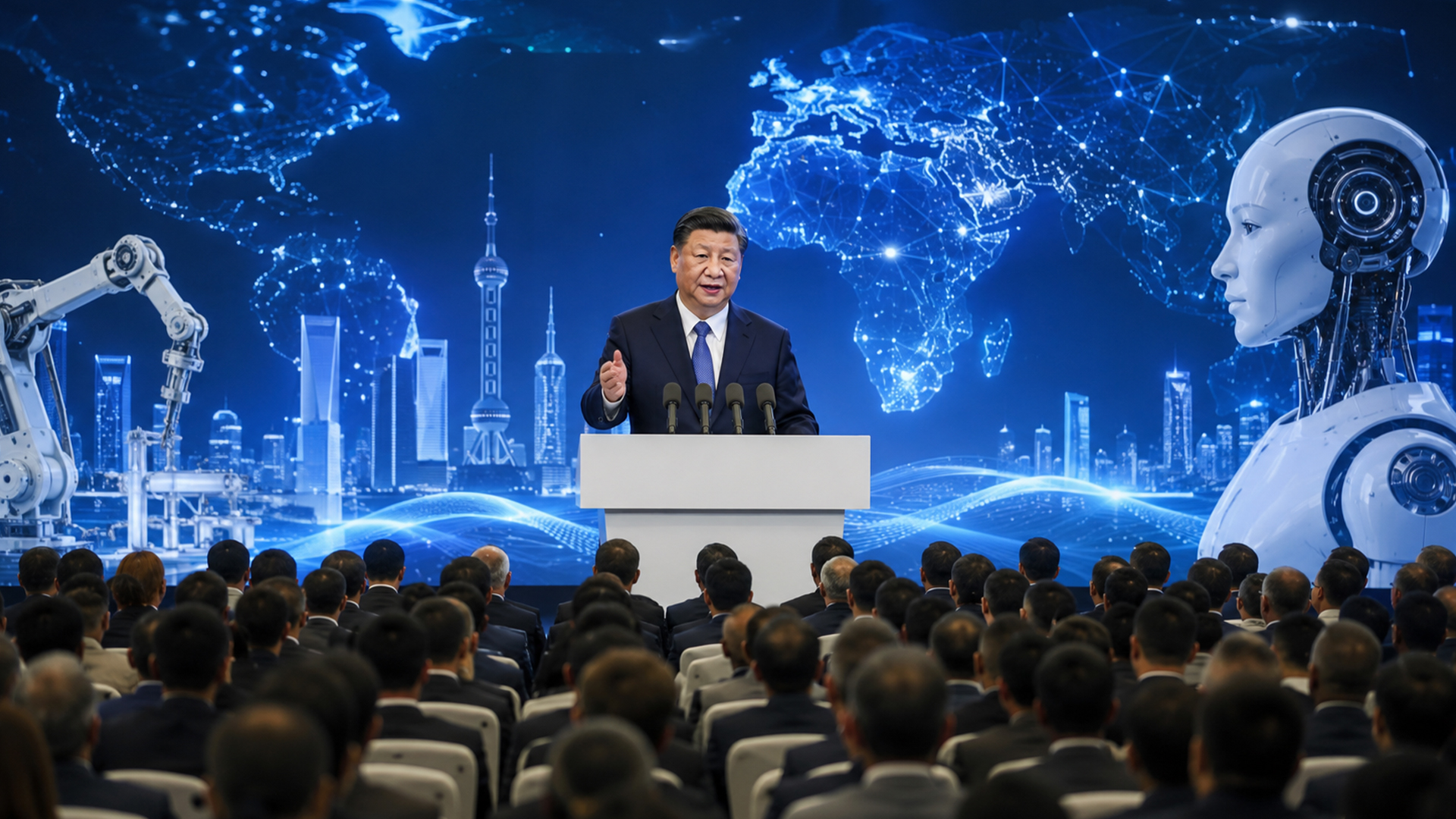
Chinese President Xi Jinping has called for China to play a leading role in shaping the future of artificial intelligence (AI), positioning the country as a champion of open cooperation and inclusive global AI development. Speaking at the World Artificial Intelligence Conference (WAIC) 2026 in Shanghai, Xi said AI should remain accessible to all nations and urged the international community to work together on global rules for the rapidly evolving technology.
His remarks come at a time when competition over artificial intelligence, advanced semiconductors and cutting-edge technologies is intensifying between China and the United States. As governments race to secure leadership in AI, Xi’s speech highlighted Beijing’s ambition to become a key force in setting international standards and expanding access to AI technologies.
Addressing delegates from governments, technology companies and research institutions, Xi said artificial intelligence should not become an exclusive technology controlled by a handful of countries. Instead, he called for an international AI ecosystem based on openness, cooperation and shared development, arguing that the benefits of AI should be available to both developed and developing nations.
The Chinese President stressed the need to establish a global governance framework for AI that promotes innovation while ensuring safety, fairness and responsible use. He said countries should strengthen collaboration in areas such as AI research, regulation, standards and talent development to maximise the technology’s positive impact on society.
Xi also warned against what he described as technological barriers and restrictions that limit access to advanced technologies. Although he did not directly name the United States, his comments were widely seen as a response to ongoing US export controls on advanced AI chips and semiconductor technologies that have affected Chinese companies.
Over the past few years, Washington has tightened restrictions on the export of high-end AI processors and chipmaking equipment to China, citing national security concerns. Beijing, in turn, has accelerated efforts to strengthen its domestic semiconductor industry while investing heavily in artificial intelligence research and innovation.
China has identified AI as one of its strategic priorities for future economic growth. The country is rapidly expanding investments in AI infrastructure, cloud computing, robotics, autonomous vehicles and intelligent manufacturing. Chinese technology companies have also introduced a growing number of generative AI models and enterprise AI solutions as they compete with global rivals.
At the Shanghai conference, Xi reiterated China’s willingness to share AI technologies with developing countries and support international cooperation in digital transformation. He said emerging economies should not be left behind as artificial intelligence reshapes industries, education, healthcare and public services around the world.
The President also emphasised the importance of balancing innovation with regulation. He noted that while AI has enormous potential to improve productivity and drive economic growth, governments must also address risks related to privacy, security, misinformation and ethical use. According to Xi, international collaboration will be essential to building public trust in artificial intelligence.
The World Artificial Intelligence Conference has become one of China’s flagship technology events, attracting policymakers, researchers and executives from leading global technology companies. This year’s edition placed particular emphasis on AI governance, industrial innovation and international collaboration, reflecting China’s ambition to play a larger role in shaping the future direction of the technology.
Xi’s speech comes as countries worldwide continue investing billions of dollars in artificial intelligence. The United States remains a leader in advanced AI models and semiconductor technologies, while China is rapidly strengthening its capabilities through government support, research institutions and private technology firms.
Analysts say Beijing’s latest push reflects both economic and geopolitical priorities. By promoting itself as a supporter of open AI collaboration, China is seeking to strengthen partnerships with developing nations while positioning itself as an alternative technology leader amid growing global competition.
However, challenges remain. Ongoing trade restrictions, access to advanced chips and concerns over AI security continue to shape the global technology landscape. Experts believe that while international cooperation is essential, competition between major powers is likely to remain a defining feature of the AI era.
For businesses and consumers, the race to lead artificial intelligence is expected to accelerate innovation across industries, from healthcare and education to finance and manufacturing. As governments compete to influence the future of AI, decisions made today could shape how the technology is developed, regulated and used for decades to come.
With his latest address, Xi Jinping has made it clear that China intends to be more than just a participant in the global AI race. By advocating inclusive AI governance, international cooperation and broader access to artificial intelligence technologies, Beijing is positioning itself as a central player in defining the next chapter of the world’s AI revolution.