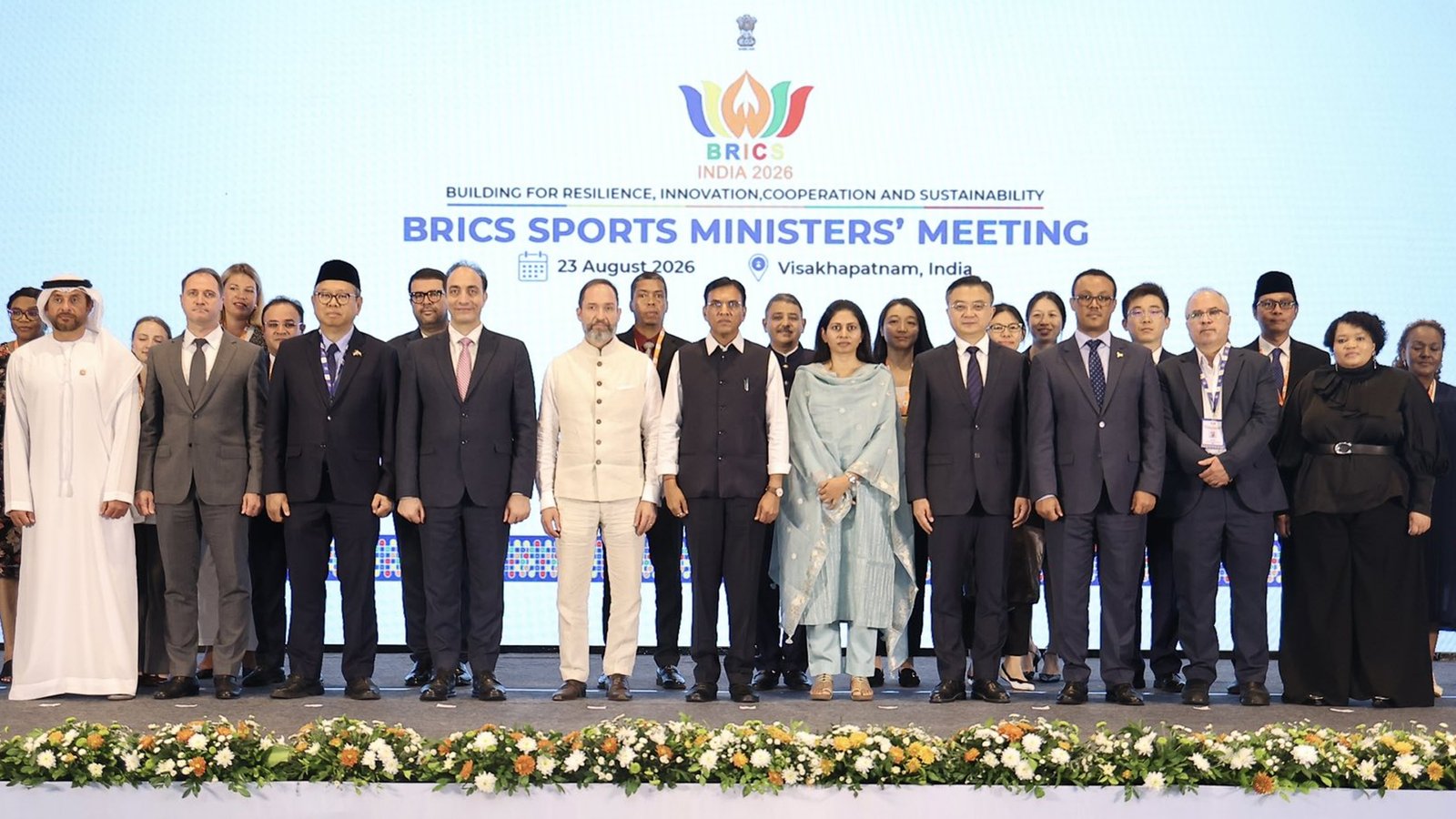
BRICS Sports Ministers adopted a joint declaration in Visakhapatnam on Sunday, August 23, reaffirming their commitment to closer cooperation in sports among the grouping’s 11 member countries. The meeting was held under India’s BRICS Chairship 2026 and brought together sports ministers and senior representatives to discuss ways to strengthen sporting partnerships and create more opportunities for athletes and sporting institutions.
The declaration was adopted by consensus and called for stronger cooperation through dialogue, mutual respect and inclusiveness. For India, the meeting was also an opportunity to push for practical initiatives that can take BRICS sports cooperation beyond official statements and into areas that directly benefit athletes, coaches, sporting bodies and the wider sports industry.
Union Minister for Youth Affairs and Sports Mansukh Mandaviya called for a BRICS Sporting Partnership that would focus on tangible outcomes. He said cooperation should translate into platforms for athlete and coach exchanges, joint competitions, sports science and technical knowledge-sharing. The approach reflects India’s effort to use sports not just as a competitive field but also as a tool for stronger people-to-people connections among BRICS nations. One of the major proposals emerging from the meeting is the creation of a BRICS Working Group on Sports Technology. The proposed platform will encourage cooperation in sports science, athlete performance, sports governance, artificial intelligence, digital transformation and other emerging technologies.
The focus on technology comes at a time when data, artificial intelligence and sports science are increasingly influencing how athletes train, compete and recover. Sharing expertise in these areas could help BRICS countries learn from one another and develop solutions suited to their own sporting ecosystems. Sports manufacturing was another key area discussed during the meeting. India proposed a BRICS Sports Manufacturing Conclave, with Udaipur in Rajasthan proposed as the venue for its first edition in November 2026.
The proposed conclave is expected to bring together manufacturers, exporters, investors, start-ups, technology companies and research institutions from BRICS countries. Discussions will focus on innovation, technology, quality standards, best practices, trade and supply chains. The initiative could be particularly significant for India’s growing sports goods industry. The government is working to strengthen domestic sports manufacturing and promote sports goods clusters, while also encouraging investment and technology partnerships. The conclave could provide Indian manufacturers and start-ups with an opportunity to connect with international businesses and explore new markets.
The meeting also looked beyond modern sporting disciplines to the traditional games that form part of the cultural identity of BRICS nations. India proposed the BRICS Traditional and Indigenous Sports Demonstration Games 2026, scheduled to be held in Ahmedabad on October 12 and 13. The event is planned as a non-competitive platform where participating countries can showcase their traditional and indigenous sports. Rather than focusing on medals or rankings, the programme will promote cultural exchange and help preserve traditional sporting practices.
The initiative gives traditional games a place in the broader BRICS sports agenda and could help younger generations discover sporting traditions that may otherwise receive limited international attention. It also creates another avenue for cultural diplomacy, allowing countries to share their heritage through sport. The BRICS sports meeting also placed emphasis on inclusion and wider participation. India highlighted its efforts to strengthen para-sports and expand opportunities for women in sport. Such areas are increasingly important as countries look to make sporting ecosystems more accessible and representative.
The ministerial meeting followed a BRICS Friendship Cycling Event held in Visakhapatnam. Mandaviya and Minister of State for Youth Affairs and Sports Raksha Khadse led the event, which was organised as part of the 87th edition of Fit India Sundays on Cycle. Sports representatives from several BRICS countries joined the cycling programme, which combined fitness with an informal opportunity for participants to interact. The event underlined the idea that sports cooperation can extend beyond formal competitions and ministerial meetings to everyday activities that encourage healthy lifestyles and closer social connections.
The sports ministers’ meeting was part of a wider series of BRICS engagements being hosted by India during its 2026 chairship. The country’s BRICS Chairship is guided by the theme “Building for Resilience, Innovation, Cooperation and Sustainability”, with a focus on people-centred development and practical cooperation. The sports agenda fits naturally into this wider approach. With technology transforming athletic performance, manufacturing becoming an increasingly important part of the sports economy and traditional games gaining renewed attention, the sector offers BRICS countries several areas for collaboration.
For India, the meeting also provides an opportunity to showcase its own sporting ecosystem. The country has been expanding its focus on athlete development, sports science, para-sports, sports infrastructure and domestic manufacturing. Bringing these areas into the BRICS framework could create opportunities for knowledge-sharing and international partnerships. The adoption of the joint declaration is therefore only the beginning. The proposed sports technology working group, manufacturing conclave and traditional sports demonstration games will now be important tests of how effectively the commitments made in Visakhapatnam can be translated into action.
If implemented successfully, the initiatives could give BRICS sports cooperation a more practical character, linking athletes and coaches with technology, industry and cultural exchange. For the member countries, the aim is not simply to compete against one another but to build stronger sporting systems together. The Visakhapatnam meeting has thus placed sports firmly within India’s wider BRICS agenda, with the emphasis now shifting from declarations to implementation and from discussions to opportunities that can be felt across the sporting community.