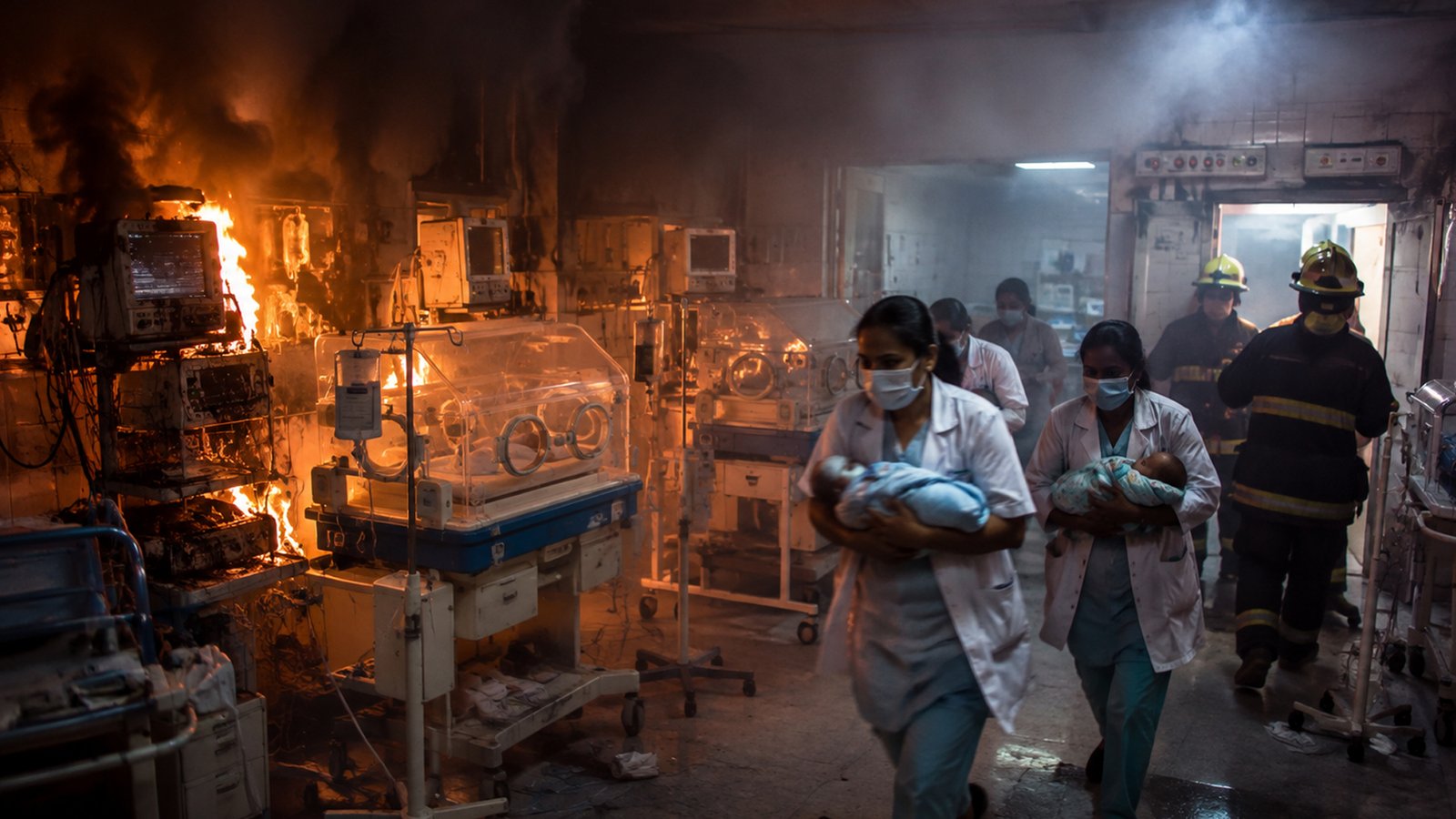
Three newborn babies died after a fire broke out in the Neonatal Intensive Care Unit (NICU) of a government hospital in Maharashtra’s Amravati in the early hours of Monday, August 24. The blaze reportedly began after a ventilator sparked or exploded on the third floor of the District Women’s Hospital, where dozens of newborns were receiving treatment.
The incident occurred at around 3:15 am to 3:30 am, when the hospital was largely quiet and the babies were under intensive medical care. According to officials, 39 newborns were admitted across the Special Newborn Care Unit (SNCU) at the time. The three babies who died suffered severe burns and smoke inhalation.
The fire triggered an immediate emergency response inside the hospital. Doctors, nurses and other staff rushed to the affected unit and began moving the newborns away from the fire and smoke. Medical equipment was disconnected where necessary as staff worked to get the infants out of the affected area.
Six babies who were critically affected were shifted to a nearby Super Speciality Hospital for further treatment, according to the initial reports. The remaining infants were evacuated from the affected unit. A later official update said 36 other children were rescued unharmed.
The exact cause of the fire remains under investigation. Initial information points to a ventilator as the source of the blaze, but authorities have not yet established why the equipment caught fire or whether a technical fault was involved.
The incident has raised fresh questions about hospital fire safety, particularly in critical care units where patients cannot be moved quickly without medical support. Newborns in an NICU often depend on ventilators, monitors, oxygen systems and other equipment, making emergency evacuation particularly challenging.
Amravati Police Commissioner Rakesh Ola said the SNCU had three sections — one each for inborn and outborn babies, along with a step-down section for infants who were closer to discharge. A total of 39 newborns were being treated across these sections when the fire broke out.
The administration has also addressed questions over whether the hospital had undergone the required fire safety checks. Amravati District Magistrate Saurabh Kataria said the hospital had undergone regular fire audits and had also applied for the audit for the current year. The administration rejected suggestions that mandatory fire safety checks had simply been skipped.
Officials said the investigation is now focusing on the equipment suspected to have triggered the fire. This will include determining what caused the ventilator to spark and whether any electrical or equipment-related fault contributed to the incident.
The tragedy has nevertheless brought hospital safety protocols back into focus. Fire prevention measures are particularly important in neonatal and intensive care units because patients are often unable to move independently and may require continuous respiratory or other life-support equipment.
The incident has also prompted a wider discussion about the need for regular inspection and maintenance of medical equipment. While fire audits are designed to assess the safety of a hospital building and its emergency preparedness, individual medical devices also require proper maintenance, servicing and electrical safety checks.
The rescue operation also highlighted the difficult circumstances faced by hospital staff during such emergencies. Nurses and doctors had to act quickly in a unit filled with fragile newborns, many of whom were connected to medical equipment. Their immediate response helped evacuate a large number of infants from the affected area.
The deaths have caused grief among families who had entrusted the government hospital with the care of their newborn children. For parents with babies in intensive care, the hospital is expected to be one of the safest places available. A fire inside such a unit can therefore be especially devastating.
Maharashtra Chief Minister Devendra Fadnavis has ordered a high-level inquiry into the incident, with authorities expected to examine the circumstances surrounding the fire and determine whether anyone should be held responsible.
The tragedy comes at a time when concerns over fire safety in healthcare facilities continue to draw attention. Hospitals house patients who may be unable to evacuate without assistance, making functioning fire alarms, emergency exits, firefighting systems, electrical safety measures and regular equipment maintenance essential.
The Amravati hospital fire has left three families mourning the loss of their newborns and raised difficult questions about safety in critical-care facilities. As the inquiry progresses, the focus will be on establishing what went wrong, whether the tragedy could have been prevented and what measures are needed to ensure the safety of newborns and other vulnerable patients in Maharashtra’s hospitals.