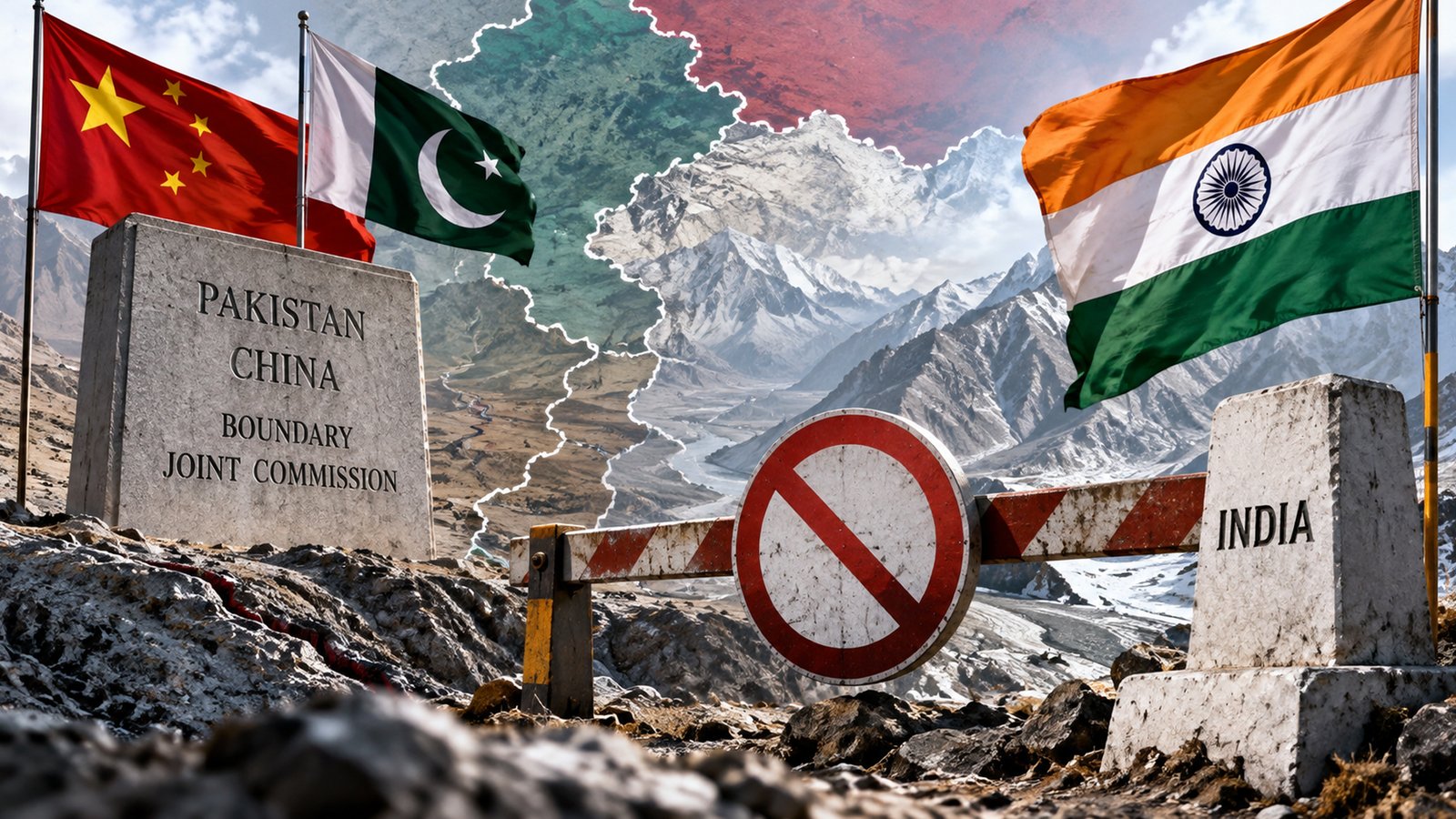
India has rejected the Pakistan-China Boundary Joint Commission, saying it has no legal basis and cannot deal with territories that New Delhi considers part of India. The response came after the commission held its first meeting in Islamabad on Wednesday, with Pakistan and China discussing border management, joint surveys, trade flows and people-to-people connectivity.
Ministry of External Affairs spokesperson Randhir Jaiswal said India’s position on the matter was “clear and consistent”. He said there was no recognised Pakistan-China boundary concerning Indian territory and rejected the joint commission as legally baseless.
Jaiswal reiterated India’s position that Jammu and Kashmir and Ladakh are integral parts of the country. He said Pakistan had no authority to enter into arrangements concerning territory that India says is under Pakistan’s illegal and forcible occupation.
The dispute is closely linked to the 1963 China-Pakistan Boundary Agreement. Under that agreement, Pakistan transferred control of the Shaksgam Valley, also known as the Trans-Karakoram Tract, to China. India has never recognised the agreement and has consistently described it as illegal and invalid.
The Shaksgam Valley is located in the broader region of Jammu and Kashmir claimed by India. New Delhi has maintained that Pakistan cannot negotiate or transfer territory that India regards as its own.
India also opposes the China-Pakistan Economic Corridor (CPEC), a major Belt and Road Initiative project. New Delhi has objected to the route because parts of the corridor pass through areas of Pakistan-occupied Kashmir that India claims as its territory.
The latest Pakistan-China boundary initiative has therefore brought the territorial dispute back into focus. While Islamabad and Beijing view their boundary arrangements as part of their bilateral relationship, India maintains that such agreements cannot alter its position on sovereignty.
Jaiswal said India “resolutely opposes and rejects” attempts to alter the status of territories that it considers under occupation or to legitimise what New Delhi calls illegal occupation. He added that any China-Pakistan boundary cooperation involving Indian territories would be completely unacceptable to India.
India has also rejected the idea that the new commission could have any effect on its territorial claims. New Delhi said any arrangement between Pakistan and China concerning Indian territory would have no bearing on India’s sovereignty over those areas.
The issue has its roots in the complex territorial history of the region. India, Pakistan and China have overlapping territorial claims and unresolved boundary disputes, particularly around Jammu and Kashmir and Ladakh. The 1963 China-Pakistan agreement remains one of the key points of disagreement between New Delhi and the two countries.
The new commission was created as an institutional mechanism for Pakistan and China to strengthen cooperation along their shared frontier. Its first meeting focused on practical areas such as border management, surveys and movement across the frontier. Pakistan has described the mechanism as part of its broader cooperation with China.
India, however, sees the issue differently because the boundary in question runs through territory it claims. Its latest statement makes clear that New Delhi will not recognise any bilateral arrangement that, in its view, affects the status of Indian territory.
The development comes amid a wider period of diplomatic activity involving India, China and Pakistan. India and China have separately been working to improve bilateral ties after years of tensions along their disputed Himalayan border, while China and Pakistan continue to maintain close strategic and economic relations.
The immediate focus will now be on how Pakistan and China implement the joint commission and whether its work expands beyond border management into territorial issues. India has already drawn a firm line, saying such cooperation cannot change its position on Jammu and Kashmir, Ladakh or the territories it claims as being under occupation.
New Delhi has also called on Pakistan to vacate territories that India says it occupies illegally, arguing that Islamabad should address that issue rather than enter into arrangements concerning those areas with China.