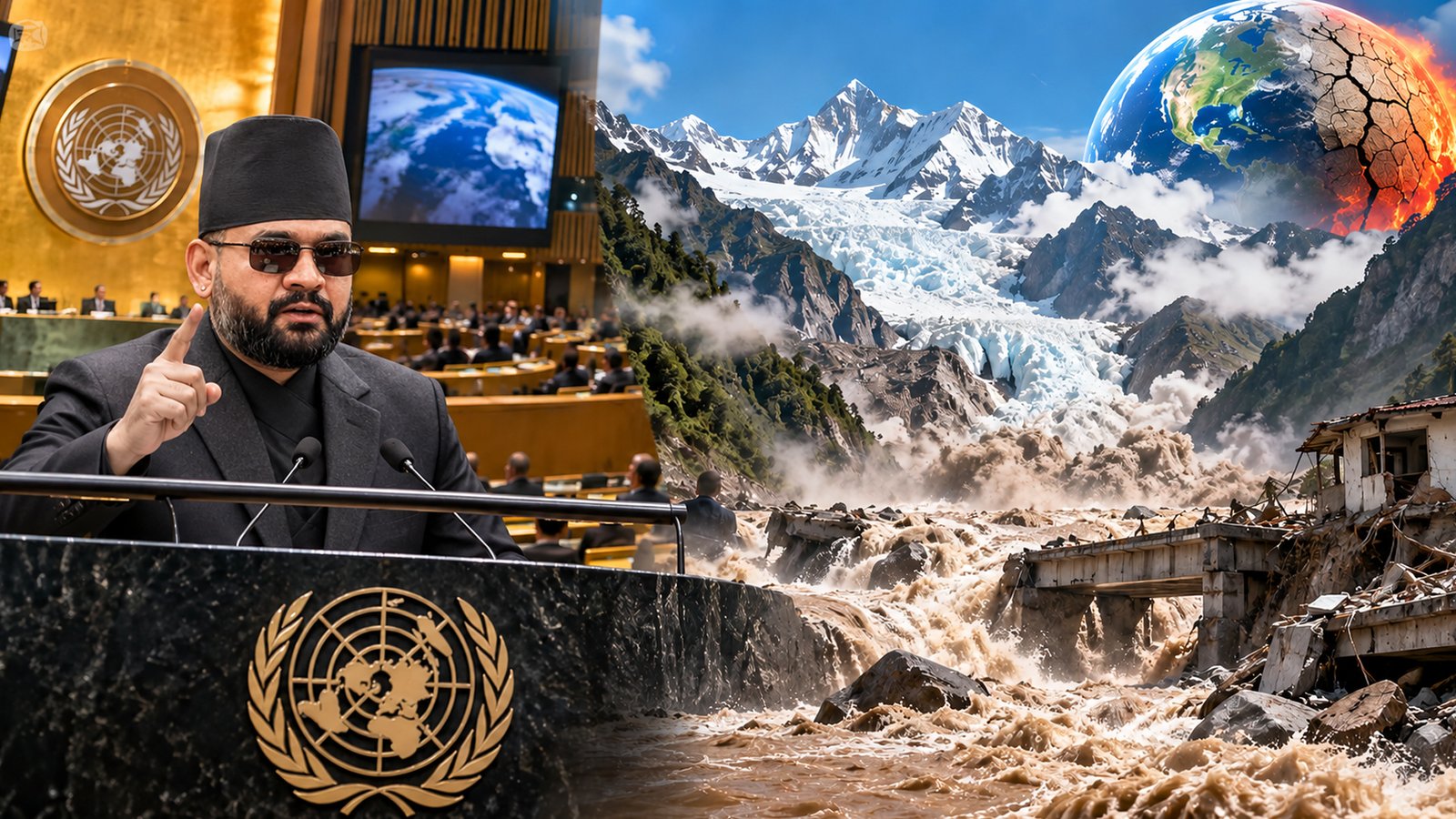
Nepal Prime Minister Balendra Shah has used his address to the United Nations General Assembly to warn that the country’s deadly floods are a sign of the growing risks posed by climate change. Describing the disaster as “a warning to the world”, Shah urged countries to act faster on climate resilience, disaster preparedness and financial support for vulnerable nations.
The warning came four weeks after catastrophic flash floods struck Nepal’s mountain communities on August 26. At least 1,400 people have been confirmed dead, while more than 6,000 remained missing according to figures cited by Shah. The floods swept through roads, bridges, homes, schools and livelihoods, disrupting development in several parts of the Himalayan nation.
Shah told the UN that the disaster was not simply a local tragedy. He questioned whether world leaders had heard earlier warnings about the impact of a warming planet and criticised the slow pace at which governments have translated climate science into action.
The floods have also drawn attention to the changing risks facing the Himalayas. Researchers have linked the disaster to a combination of long-term warming, glacier retreat, permafrost thaw and geological instability. The combination can increase the risks of glacier collapse, landslides, flash floods and other cascading disasters in mountain regions.
Nepal has contributed less than 0.1% of global greenhouse gas emissions, yet it faces significant exposure to climate-related disasters. Shah said the country was paying a heavy price for a crisis it had contributed little to creating.
“Our glaciers are retreating, our mountain slopes are becoming unstable, our rivers are becoming less predictable,” Shah said, warning that repeated disasters could erase years of development.
The economic cost is also substantial. Nepal’s preliminary assessment puts the physical recovery and reconstruction requirement at around 10% of its gross domestic product. The government has said the disaster caused extensive damage to transport infrastructure, power facilities, homes and local livelihoods.
Shah argued that poorer countries should not have to take on large amounts of debt every time a climate disaster destroys critical infrastructure. He called for greater access to grant-based climate finance and said existing international funding mechanisms remain difficult for vulnerable countries to access.
Nepal has sought $20 million from the UN’s Loss and Damage Fund, while the World Bank has made up to $170 million in emergency financing available for the country’s recovery. The United States has also announced $31 million in additional flood recovery assistance, taking its total support to $36 million.
The disaster has also strengthened Nepal’s call for closer cooperation with its neighbours. Shah proposed a Himalayan Climate Resilience Mechanism involving Nepal, India and China. The proposed framework would focus on sharing satellite information, monitoring dangerous glacial lakes, strengthening early-warning systems and coordinating emergency responses across borders.
Such cooperation is particularly important because rivers, glaciers and mountain systems do not follow national boundaries. The August floods affected areas near the Nepal-China border, while floodwaters travelled downstream towards India.
Nepal’s proposal comes as scientists and governments increasingly focus on the climate risks facing the Hindu Kush Himalaya. The region provides water, agriculture and livelihoods to a vast population across South Asia, making changes in its glaciers and rivers a concern well beyond Nepal.
Shah also linked climate change with the country’s wider development challenges. Nepal has invested heavily in hydropower and other infrastructure, but extreme weather can damage the same systems needed to support economic growth. Around 99% of Nepal’s electricity comes from hydropower, according to figures cited in reports on his UN address.
The prime minister called for a shift from emergency response to long-term climate preparedness. That includes stronger infrastructure, improved early-warning systems, climate adaptation, insurance and greater investment in resilience.
Nepal has also sought to frame the disaster as an issue of climate justice. Shah invoked the principle of common but differentiated responsibilities, arguing that countries with larger historical contributions to greenhouse gas emissions and greater financial capacity should do more to support vulnerable nations.
The message from Kathmandu is that climate change is no longer a distant environmental issue. In Nepal, its effects are being felt through unstable mountain slopes, retreating glaciers, unpredictable rivers and increasingly costly disasters.
The flood recovery will take years, but Nepal is using the disaster to push for a broader international response. Shah’s UN appeal has placed climate finance, Himalayan cooperation and disaster preparedness at the centre of the country’s international agenda.
The immediate challenge is rebuilding communities and infrastructure damaged by the floods. The larger challenge is preparing Nepal and other vulnerable countries for a future in which climate-related disasters could become more frequent and severe.