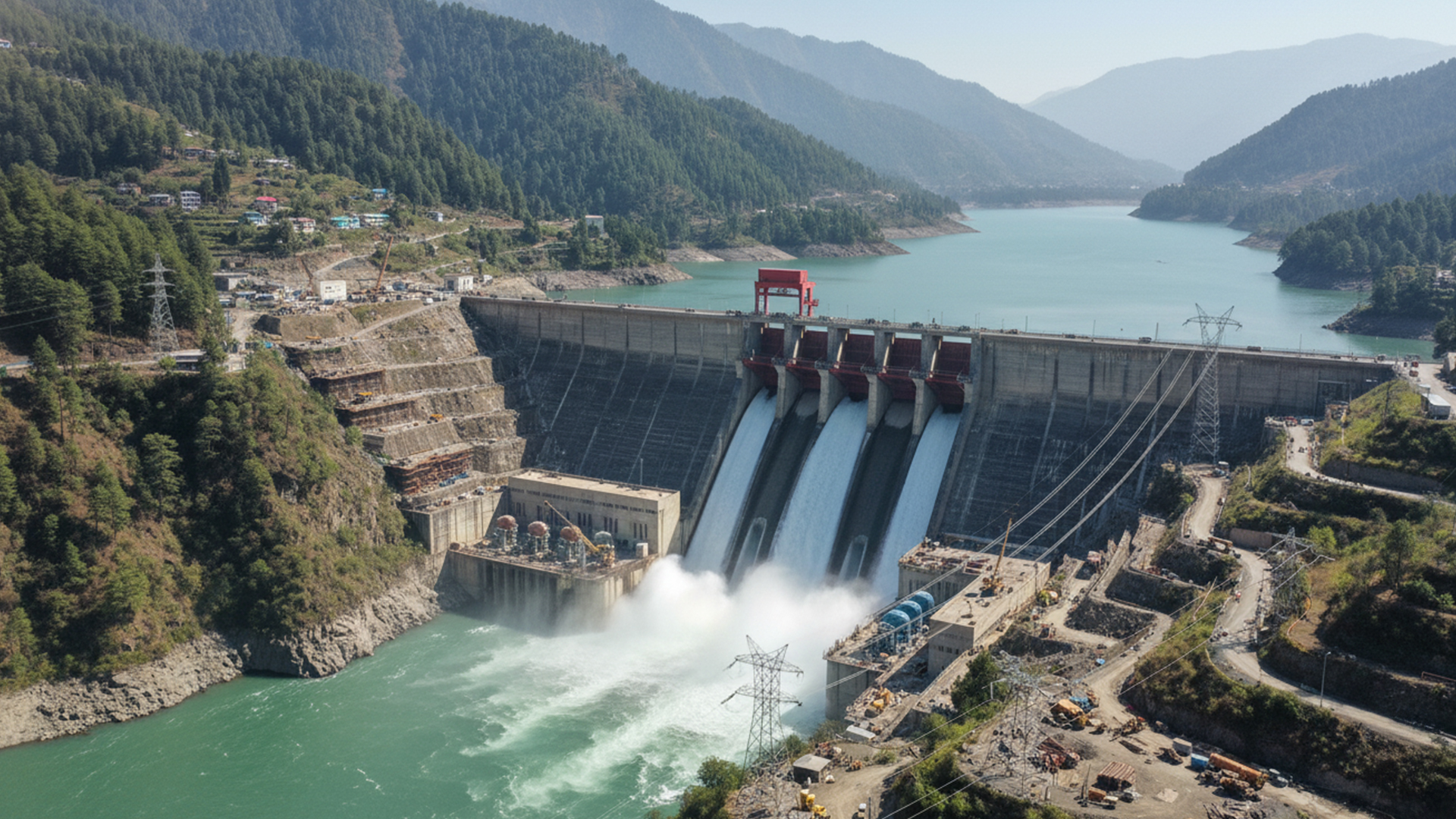
The Indian government has recommended environmental clearance for the Sawalkote Hydroelectric Project, a 1,856 MW run-of-the-river facility located on the Chenab River in Jammu and Kashmir’s Ramban district. This significant development follows the suspension of the Indus Waters Treaty (IWT) with Pakistan in April 2025, allowing India to proceed with the project without the constraints previously imposed by the treaty.
Strategic and Energy Implications
The Sawalkote project, first proposed in 1984, has faced numerous delays over the decades. Its revival is part of India’s broader strategy to assert its rights over the western rivers under the IWT and to enhance energy infrastructure in the region. The Environmental Appraisal Committee (EAC) of the Ministry of Environment, Forest and Climate Change has recommended the project’s clearance, noting that it will not require fresh cumulative impact or carrying-capacity studies, which are typically mandated for large-scale projects.
The project is expected to generate about 1,856 MW of power, contributing significantly to India’s renewable energy capacity.
It will be developed in two stages: Stage I will involve the construction of six units of 225 MW each and one unit of 56 MW, totalling 1,406 MW; Stage II will add two units of 225 MW each, bringing the total to 1,856 MW. The total investment for the project is estimated at ₹31,380 crore.
The Sawalkote project is designed as a run-of-the-river scheme, which minimizes environmental impact by not requiring large reservoirs. However, it will involve the construction of a 192.5-meter-high concrete gravity dam, an upstream water channel, an underground powerhouse, and a tailrace system to return water to the Chenab River. The project will cover an area of 1,401 hectares across Ramban, Reasi, and Udhampur districts.
The revival of the Sawalkote Hydroelectric Project marks a significant step in India’s efforts to develop its hydropower potential and assert its rights over the western rivers. As the project moves forward, it will be closely monitored for its environmental impact and its role in the region’s energy landscape.