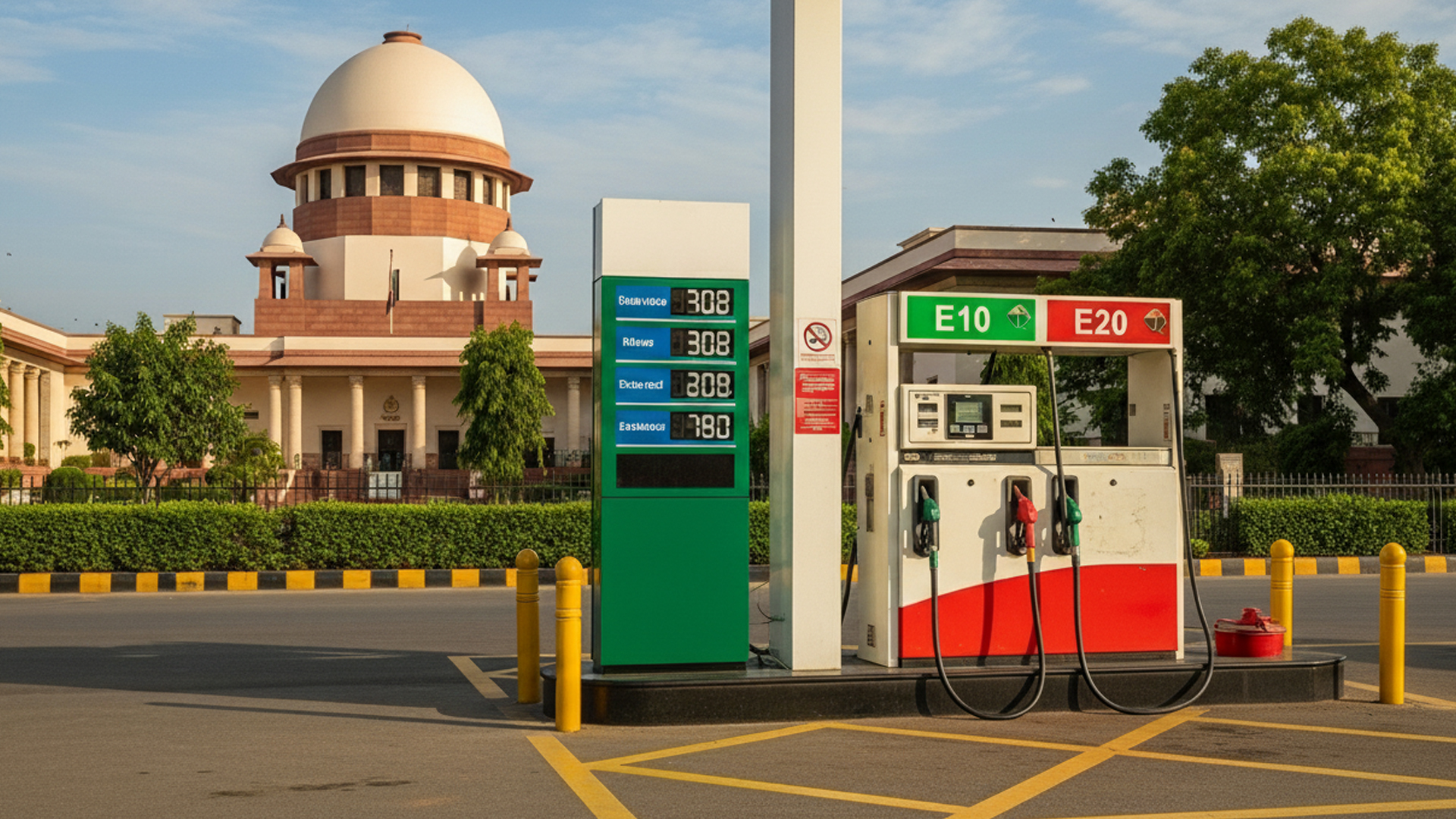
The Supreme Court on Monday, September 1, 2025, dismissed a public interest petition challenging India’s nationwide rollout of 20% ethanol-blended petrol (E20), which alleged that millions of motorists were being compelled to use fuel incompatible with their vehicles without the option of ethanol-free petrol.
A Bench comprising Chief Justice of India B.R. Gavai and Justice K. Vinod Chandran rejected the petition after the Union government defended the policy as one that boosts the income of sugarcane farmers and conserves foreign exchange. Attorney-General R. Venkataramani, appearing for the government, argued that the petitioner, a foreign resident, was a “name-lender” acting on behalf of a lobby, and questioned whether individuals outside India should dictate the country’s fuel policy. He emphasized that E20 rollout serves national interests by supporting farmers and reducing import dependence.
E20 petrol has been gradually introduced since 2023, following earlier blends such as E5 and E10, which were considered safer for older vehicles. However, only cars and two-wheelers manufactured after April 2023 are certified E20-compatible, and earlier ethanol-free options have largely been phased out at the country’s 90,000 fuel stations.
The petitioner, represented by senior advocate Shadan Farasat, clarified that the challenge was not to ethanol blending itself, but to the absence of an ethanol-free option for pre-2023 vehicles. The petition cited a 2021 NITI Aayog report, “Roadmap for Ethanol Blending in India 2020-25,” which acknowledged that blending ethanol up to 20% could reduce fuel efficiency by 6–7% in four-wheelers and 3–4% in two-wheelers. It argued that E20 use in non-compliant vehicles could lead to engine corrosion, premature wear and tear, and loss of manufacturer and insurance coverage, causing potential financial and mechanical harm to consumers.
The petition also highlighted the lack of public awareness and proper labelling at petrol pumps. It claimed that, unlike in the U.S. and E.U., where ethanol-free petrol is widely available and ethanol content is clearly displayed, Indian consumers are sold ethanol-blended fuel without disclosure of composition, limiting informed choice. Accordingly, the petitioner sought mandatory labelling of ethanol content at all dispensing units and a nationwide study on mechanical degradation and efficiency loss in non-compliant vehicles.
In response, the Ministry of Petroleum and Natural Gas cited NITI Aayog’s study, asserting that E20 petrol offers better acceleration and ride quality, in addition to economic benefits for farmers. The government maintained that the policy aligns with broader national goals of energy security and reducing reliance on imported fuels.
The Supreme Court’s dismissal effectively allows the ongoing E20 rollout to continue without requiring ethanol-free alternatives for older vehicles, leaving the government’s policy intact. While the decision is a win for India’s ethanol program and sugarcane farmers, it raises questions about consumer choice, public awareness, and potential vehicle compatibility issues as the country transitions to higher ethanol blends.
As India moves toward wider adoption of ethanol-blended fuels, balancing environmental and economic objectives with consumer protection will remain a key challenge, particularly for owners of vehicles not designed to handle higher ethanol content.