While PM Modi’s call to conserve fuel, reduce imports, and avoid buying gold might reflect a genuine economic concern as geopolitical tensions stay high, austerity cannot begin with ordinary citizens while ministers travel in sprawling convoys, bureaucracies remain addicted to physical meetings, and the state continues to function with visible excess. If a sacrifice is necessary, the government must demonstrate it first.
The first rule of asking the people to sacrifice is simple: the leaders must sacrifice first.
That is why Prime Minister Narendra Modi’s recent appeal to Indians to reduce fuel consumption, avoid buying gold for a year, cut edible oil use, and conserve foreign exchange has produced such an uneasy reaction.
The instinct behind the appeal is understandable. India remains dangerously dependent on imports for its energy needs. A conflict in West Asia can still shake the Indian economy thousands of kilometres away. Oil prices still have the power to disrupt inflation, weaken the rupee, strain government finances, and squeeze household budgets.
India imports nearly 60 percent of its crude oil requirements. Every spike in global oil prices widens the country’s vulnerability. Gold imports too remain substantial. There is no serious economist who would deny that excessive import dependence creates strategic weakness.
But there is another truth here that Delhi must confront. Citizens are far more willing to accept austerity when they can see their rulers practising it themselves.
And that is where this appeal begins to collapse.
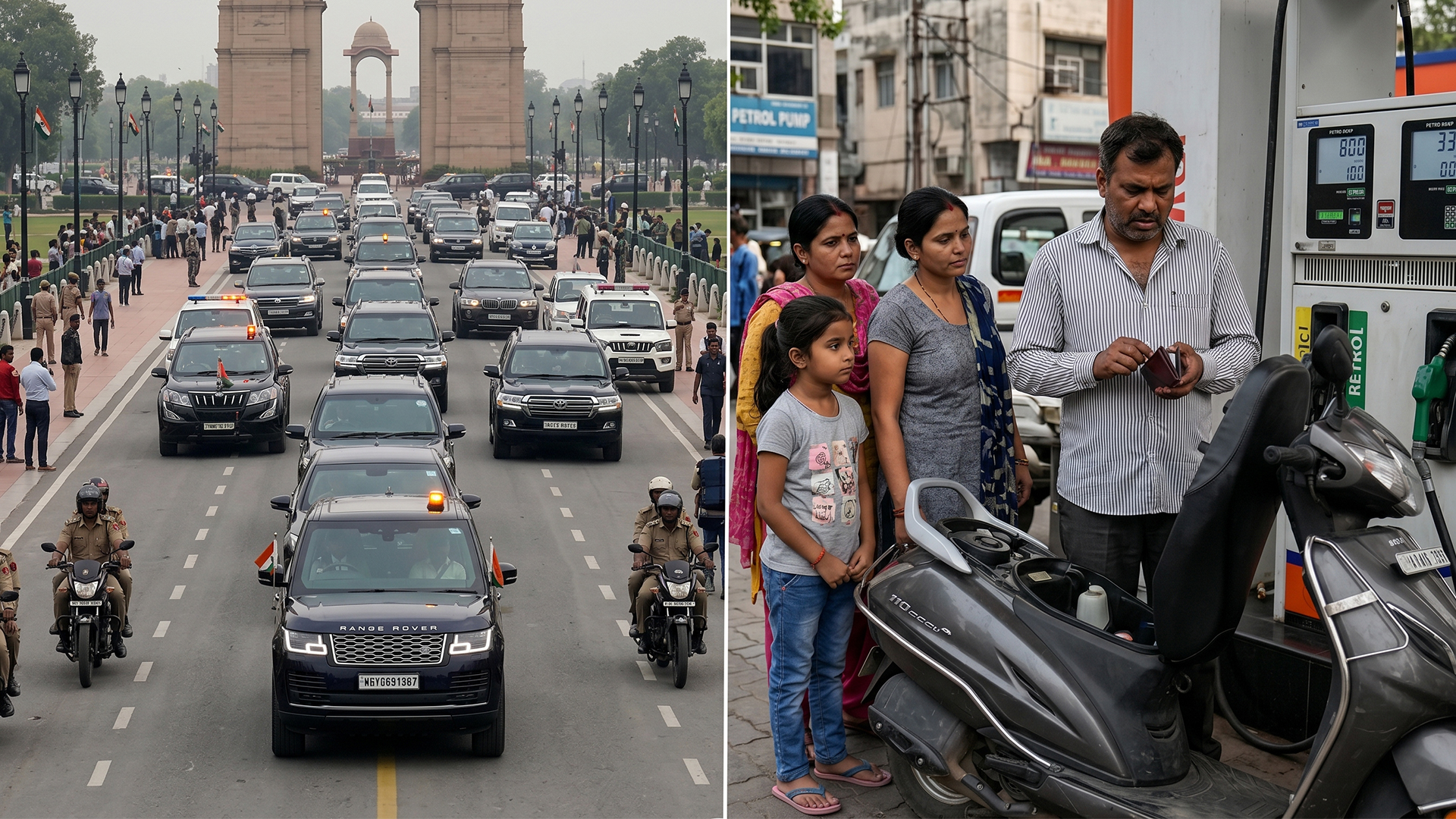
Because, while ordinary Indians are being advised not to buy gold, reduce travel, and consume less fuel, the political and bureaucratic machinery of the Indian state continues to function with astonishing extravagance. Endless convoys, cavalcades of SUVs, unnecessary official flights, conferences in luxury hotels, bureaucratic delegations abroad, physically conducted meetings that could easily happen online, and a governmental culture that still behaves as if fuel were infinite and time had no cost.
One cannot ask a middle-class family in Coimbatore to postpone buying jewellery for a daughter’s wedding while ministers move in convoys that resemble military operations.
One cannot ask citizens to conserve fuel while government systems themselves are structured around waste.
And one certainly cannot ask people to reduce travel while the state continues to treat physical movement as a default administrative reflex rather than an exception.
This is not merely about optics. It is about moral legitimacy.
The problem with Delhi’s instinctive response to every crisis is that sacrifice is almost always expected from citizens first. Governments issue advisories. Citizens are told to tighten their belts. Families are asked to postpone consumption. But the state itself rarely undergoes any visible behavioural transformation. The debate also raises broader questions about public policy, political accountability and how governments balance national priorities with the burden placed on citizens, themes explored further in our opinion and analysis coverage.
Yet India today possesses technological and infrastructural capabilities that make such a transformation entirely possible.
If fuel conservation is truly a national priority, then the government should begin with its own ecosystem.
Start with ministerial convoys.
Outside of genuine security threats, there is no reason why dozens of vehicles must accompany every political movement. Convoys should be reduced drastically. Pool vehicles should become mandatory wherever possible. Ministers attending the same event should travel together. Government officials in cities should increasingly use electric vehicles for local movement.
Then move to official travel.
For one year, all non-essential foreign travel by ministers, bureaucrats, and public sector executives should be suspended. Not “reviewed”.
Suspended. Trade negotiations, strategic diplomacy, and security-related visits are understandable. But “study tours”, conferences, seminars, and ceremonial delegations can wait.
The same applies domestically.
India now possesses one of the fastest-growing modern rail networks in the world. Vande Bharat trains already connect major urban and economic centres across the country. Why should ministers and senior officials routinely take short-haul flights between cities that are comfortably connected by premium rail? If ordinary citizens are expected to sacrifice convenience for national interest, the political class can do the same.
And then there is the most obvious reform of all: virtual governance.
The COVID years demonstrated that enormous portions of the Indian state can function remotely. Cabinet consultations, inter-ministerial reviews, departmental meetings, consultations with district collectors, investor interactions, and policy discussions can all happen online. Yet the bureaucracy has steadily drifted back to old habits because the Indian administrative system remains deeply addicted to physical presence.
Why?
Why should thousands of officials fly or drive across India every week merely to sit inside conference rooms and listen to PowerPoint presentations that could easily be conducted digitally?
If fuel conservation is genuinely urgent, the government should immediately impose a “virtual-first” administrative framework. Any physical meeting must justify why it cannot occur online.
The judiciary, too, cannot remain outside this conversation.
India already has significant video-conferencing infrastructure across courts and prisons. During the pandemic, millions of hearings were conducted virtually. Procedural hearings, adjournments, documentation matters, and preliminary arguments can continue online in vast numbers of cases.
Indeed, one of the greatest ironies of modern India is this: a villager can conduct a UPI transaction in seconds with someone 2,000 kilometres away, but litigants still travel physically for hearings that last three minutes and end in adjournments.
Why should that continue during a national fuel-conservation effort?
Every district — indeed every large village cluster — can have digitally connected courtroom facilities. Lawyers and litigants could appear remotely for routine proceedings. The reduction in fuel consumption, travel burden, congestion, and productivity loss would be enormous.
The same logic applies to education.
No, nobody is suggesting that India permanently abandon physical classrooms. But hybrid systems already exist. Teacher training, administrative meetings, guest lectures, and certain categories of instruction can temporarily move online if conserving fuel and foreign exchange is genuinely a national priority.
What makes all this particularly frustrating is that none of these ideas is revolutionary. In fact, the Modi government itself once understood this principle very well.
Back in 2014, the Centre issued austerity instructions discouraging conferences in luxury hotels, restricting unnecessary travel, reducing expenditure, and encouraging video conferencing.
Somewhere along the way, that instinct faded. The state reverted to spectacle. And spectacle is expensive.
There is also a deeper problem with the appeal to stop buying gold.
It reveals a certain disconnect between policymaking elites and the cultural realities of Indian society.
Gold in India is not merely for consumption. It is savings, security, inheritance, social dignity, and cultural tradition rolled into one. A substantial portion of Indian gold purchases is linked to weddings — events that occur once in a lifetime for most families. People do not wake up on random Tuesdays and impulsively purchase half a kilogram of gold because the mood strikes them.
For millions of families, gold is accumulated slowly over the years. To casually ask Indians to suspend such purchases for a year, therefore, sounds tone-deaf, especially when the same state continues spending freely on ceremonial excesses.
If the government truly wishes to reduce gold imports, then the answer lies not in moral appeals but in creating financial instruments that Indian families trust equally. Indians buy gold because it is tangible, culturally accepted, inflation-resistant, and psychologically reassuring. Unless alternative savings vehicles provide comparable trust and accessibility, sermons will achieve little.
And there is another uncomfortable reality here.
The burden of austerity in India is almost always asymmetrical. A billionaire delaying the purchase of a luxury watch is not a sacrifice. A middle-class family postponing wedding jewellery, cancelling travel, or cutting household consumption is a sacrifice. The state must recognise that distinction.
This is why symbolism matters enormously in moments like these.
Imagine the impact if the Prime Minister announced the following: No non-essential foreign travel by ministers for one year.
Mandatory virtual meetings across ministries, wherever feasible. Mandatory reduction in convoy sizes.
Rail-first travel for ministers and senior bureaucrats on designated routes.
A freeze on conferences in luxury hotels. A government-wide EV transition plan.
Suddenly, the national appeal would feel credible.
Because citizens do not object to sacrifice when they believe it is shared fairly.
India has repeatedly demonstrated extraordinary collective discipline during crises. Citizens tolerated shortages during wars. They accepted hardships during the pandemic. They adapted to economic disruptions repeatedly over decades. But public cooperation depends fundamentally on trust. And trust is built when power visibly restrains itself first.
That is the lesson Delhi still struggles to understand.
The state cannot continue operating as though austerity is for citizens while comfort remains reserved for the government.
If India genuinely faces an economic moment serious enough to justify appeals against buying gold and consuming fuel, then the political and bureaucratic establishment must become the first laboratory of restraint. Not the last.
Also Read: Centre tweaks fuel export duties from May 16