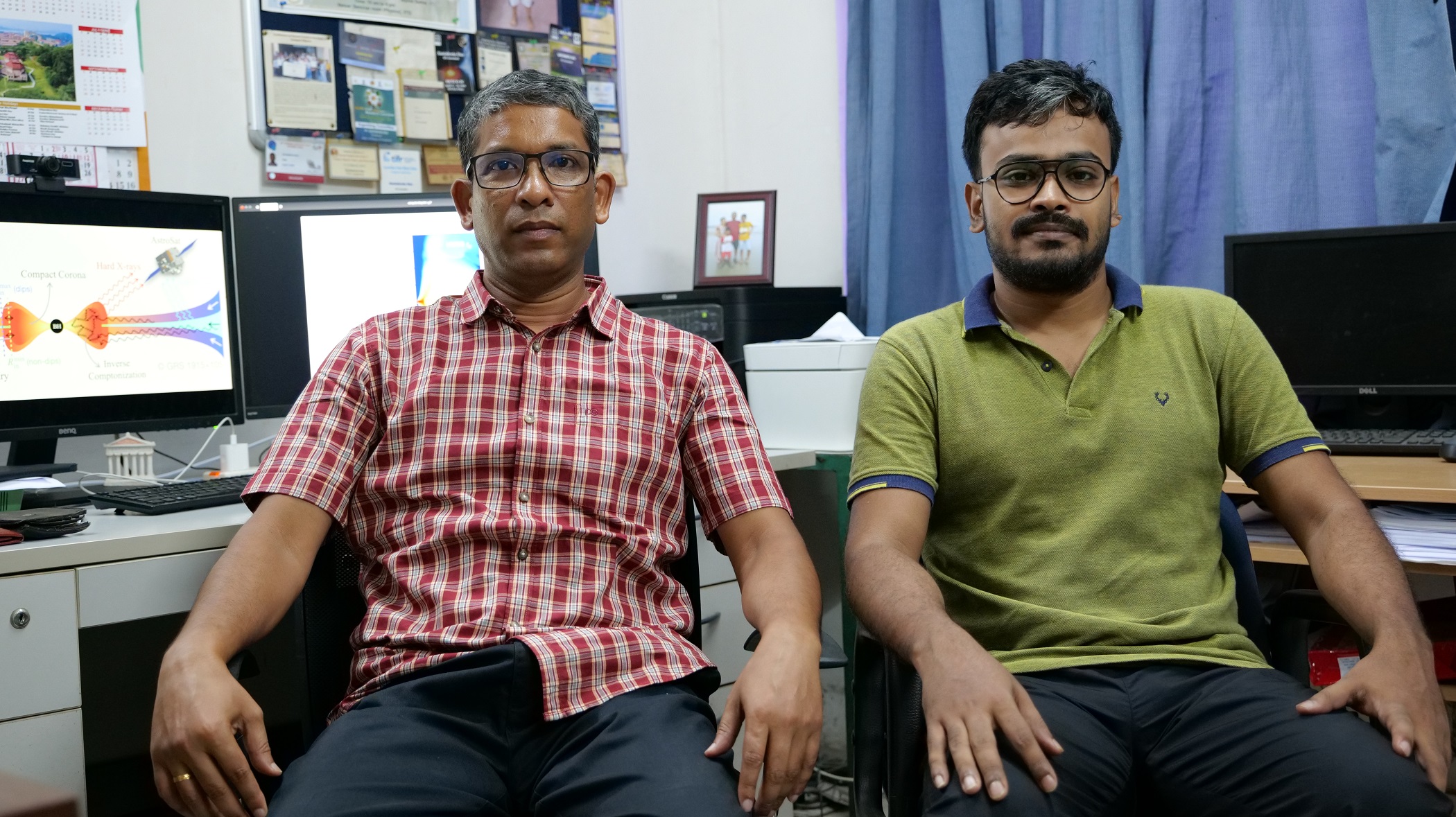
Guwahati: Black holes are often imagined as silent cosmic giants, swallowing everything in their path. But scientists from IIT Guwahati, ISRO’s U. R. Rao Satellite Centre (URSC), and the University of Haifa, Israel, have found that one such black hole, located about 28,000 light-years away, sends out an unusual message, flickering X-ray signals that act like a heartbeat in space.
The team used India’s space observatory AstroSat to study GRS 1915+105, a black hole already famous for its energetic activity. They observed that its X-ray brightness shifted between bright and dim phases, each lasting a few hundred seconds. Remarkably, during the bright phases, the black hole flickered nearly 70 times per second, while the flickering completely vanished in the dimmer phases.
“We have found the first evidence of rapid X-ray flickering, repeating nearly 70 times per second, during high-brightness phases. Interestingly, these fast flickers disappear during the low-brightness phases. This was possible only because of AstroSat’s powerful observational capability,” explained Prof. Santabrata Das, Department of Physics, IIT Guwahati.
A Breathing Corona
The researchers traced the flickers to the corona, a region of superheated plasma that surrounds the black hole. Far from being fixed, the corona was found to be dynamic. When the black hole shines brighter, the corona becomes more compact and hotter, giving rise to rapid flickers. In dim phases, it expands and cools, silencing them.
“Our study provides direct evidence for the origin of X-ray flickering. We have shown that this behaviour is linked to modulations in the corona surrounding the black hole,” said Dr. Anuj Nandi, URSC, ISRO.
The Bigger Picture
This discovery sheds light on how black holes feed, grow, and release energy. By tracking these signals, scientists gain insights into the extreme gravitational and thermal conditions near a black hole’s edge. Such findings also deepen our understanding of how black holes may influence the galaxies around them.
The study, published in the Monthly Notices of the Royal Astronomical Society, was co-authored by Prof. Das and research scholar Mr. Seshadri Majumder of IIT Guwahati, Dr. Nandi of ISRO, and Dr. Sreehari Harikesh of the University of Haifa.
The flickering heartbeat of GRS 1915+105 is a reminder that black holes are not silent voids but dynamic, evolving systems, offering us a rare window into the mysteries of the universe.
Also Read: INDIA Bloc Mulls Impeachment Motion Against Chief Election Commissioner Amid Voter Roll Row