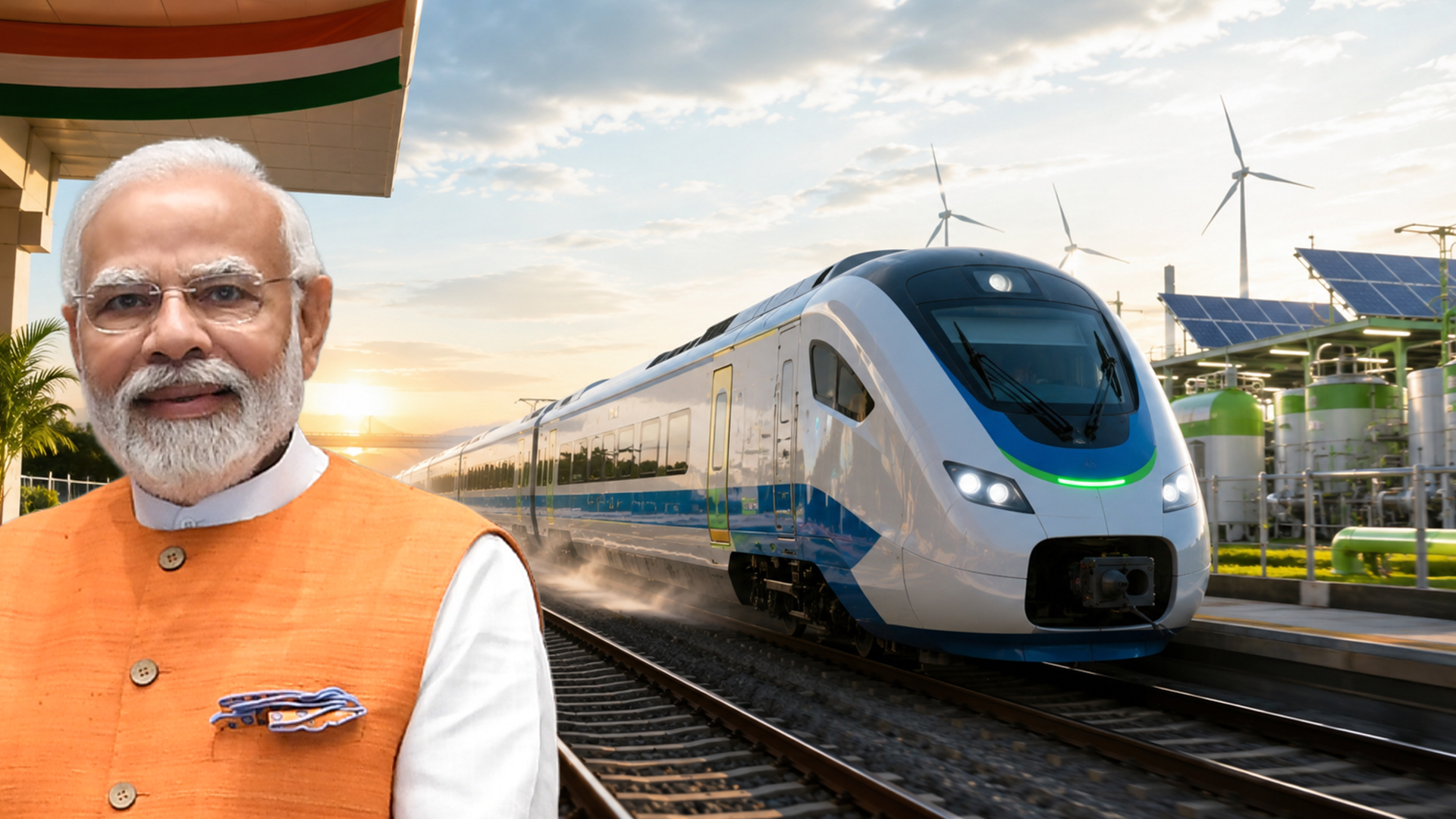
Prime Minister Narendra Modi on Friday flagged off India’s first hydrogen train from Jind in Haryana, marking a major milestone in the country’s push for green mobility and sustainable public transport. The launch makes India one of the few countries in the world to introduce hydrogen-powered passenger rail services, reinforcing its commitment to cleaner and more innovative transport solutions.
The hydrogen train will run on the 89-km Jind-Sonipat route, a non-electrified railway section in Haryana. Powered by hydrogen fuel cells instead of diesel, the train produces electricity through a chemical reaction between hydrogen and oxygen, with water vapour as its only direct emission. The technology is expected to significantly reduce carbon emissions while providing a cleaner alternative for routes where electrification is not feasible.
Designed and developed with indigenous technology under the Make in India initiative, the project reflects Indian Railways’ growing focus on clean energy and self-reliance. The train consists of two hydrogen-powered coaches and eight passenger coaches, with capacity to carry around 2,600 passengers. A dedicated hydrogen production, storage and refuelling facility has also been established at Jind to support regular operations.
Calling the launch a landmark achievement, Prime Minister Modi said the hydrogen train represents India’s growing technological capabilities and determination to build a modern, environment-friendly transport network. He said innovation and sustainability will play a central role in shaping the country’s future infrastructure.
Alongside the train launch, the Prime Minister inaugurated and laid the foundation stone for development projects worth about ₹14,700 crore across Haryana. The projects cover sectors including railways, roads, healthcare, education and urban development, and are aimed at improving connectivity, boosting economic activity and enhancing public services across the state.
The hydrogen-powered train is expected to serve as a pilot project for Indian Railways as it explores cleaner alternatives to diesel locomotives. Railway officials believe the operational experience gained from the Jind-Sonipat route will help determine the feasibility of introducing similar trains on other non-electrified routes across the country.
Hydrogen-powered trains are increasingly being seen as an effective solution for reducing emissions in rail transport. By adopting the technology, India joins a select group of nations that are investing in hydrogen-based railway systems as part of the global transition towards clean energy and low-carbon transportation.
Beyond its technological significance, the project is expected to benefit passengers by offering a quieter and more environmentally friendly travel experience. It also highlights India’s broader efforts to modernise its railway network while supporting long-term climate goals through sustainable infrastructure and green transport initiatives.