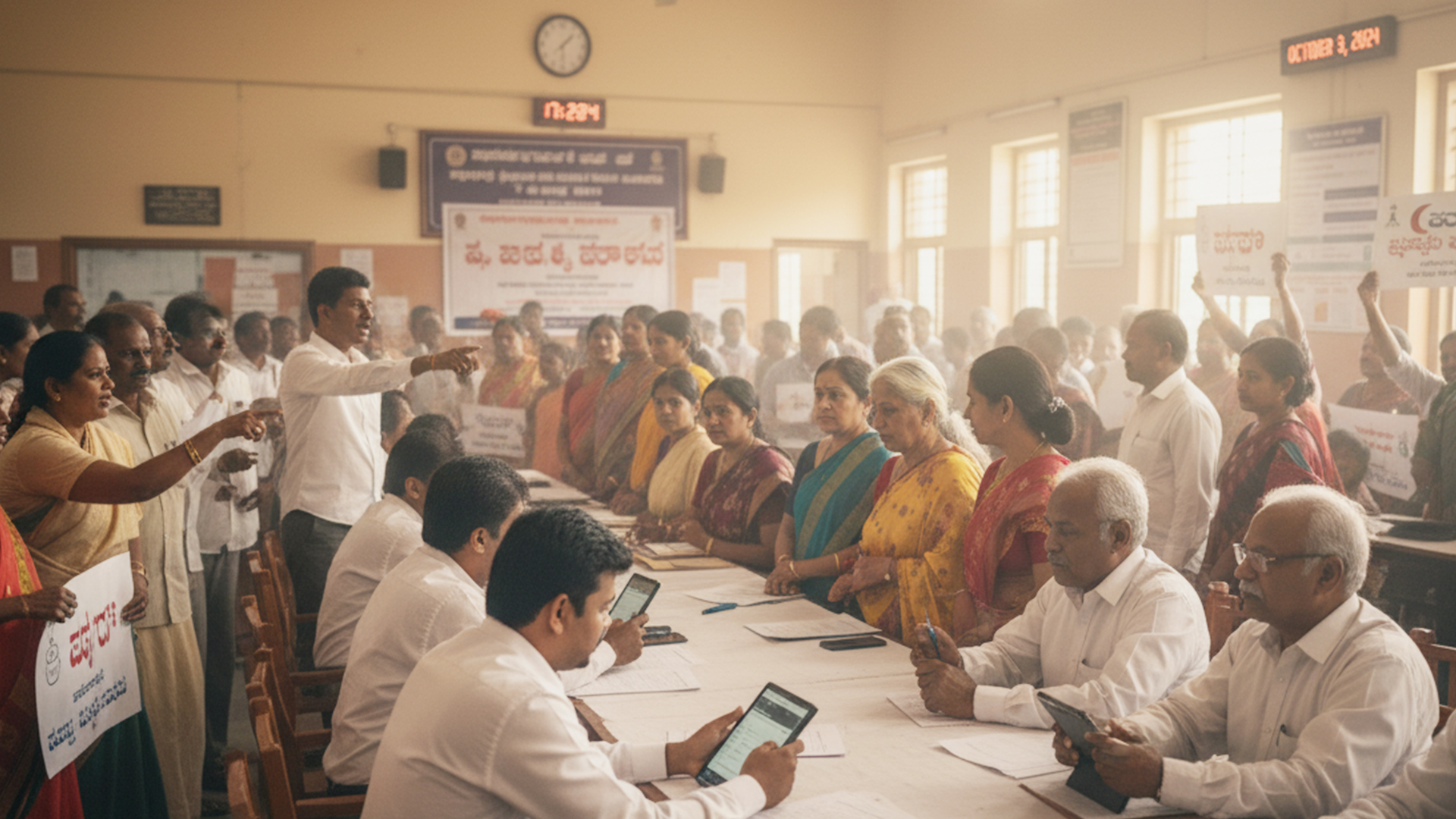
Karnataka has launched its much-anticipated socio-educational survey, commonly known as the caste census, aiming to collect detailed data on the state’s social, economic, educational, and caste composition. The survey started today and will continue until October 7, covering roughly 7 crore people across 2 crore households.
Conducted by the Karnataka State Commission for Backward Classes, this survey follows a similar effort in 2015 that was discontinued due to concerns about its methodology. Around 1.75 lakh enumerators, primarily government school teachers, have been mobilized for the task. The government has allocated an estimated ₹420 crore for the exercise.
Enumerators will use a 60-question app featuring Aadhaar integration, face recognition, and geo-tagging of households through electricity meter numbers. Each household will be assigned a Unique Household ID (UHID) to ensure accurate verification and avoid duplication. Ration card and Aadhaar details will be linked to mobile numbers during data collection. A helpline and online option are also available for those unable to participate in person.
The survey has sparked debate over caste and religious identity. To avoid controversy, the government has masked certain caste names with Christian prefixes, such as “Kuruba Christian” and “Brahmin Christian,” in the app’s dropdown menus. However, individuals can still self-identify freely. Following objections, 57 Christian-caste categories were removed from the official list.
Political opposition, particularly from the BJP, has criticized the survey, accusing the ruling Congress government of creating divisions within Hindu communities. Some Congress members have also expressed concerns, arguing that caste identities should not apply to those who have converted to other religions.
Various community groups, including Vokkaligas, Veerashaiva-Lingayats, Kurubas, Muslims, and Brahmins, are deliberating on how their members should respond. Vokkaliga leaders have advised followers to identify as Hindu and list “Vokkaliga” as their caste, minimizing sub-caste mentions.
Critics have also questioned the short timeframe, comparing it to Telangana’s caste survey, which took 65 days to cover only half the population. Calls for extending the survey duration or conducting it in phases have been made to ensure accuracy.
The Karnataka government defends the survey, citing the need to update the backward classes list and improve policy-making and welfare delivery. The survey is carried out under Section 11(1) of the Karnataka State Commission for Backward Classes Act, 1995, which requires a review every ten years.
Results from the survey are expected to impact reservation policies and social justice initiatives across Karnataka.
Also Read: Thousands Mourn Assam’s Icon Zubeen Garg at Guwahati Farewell