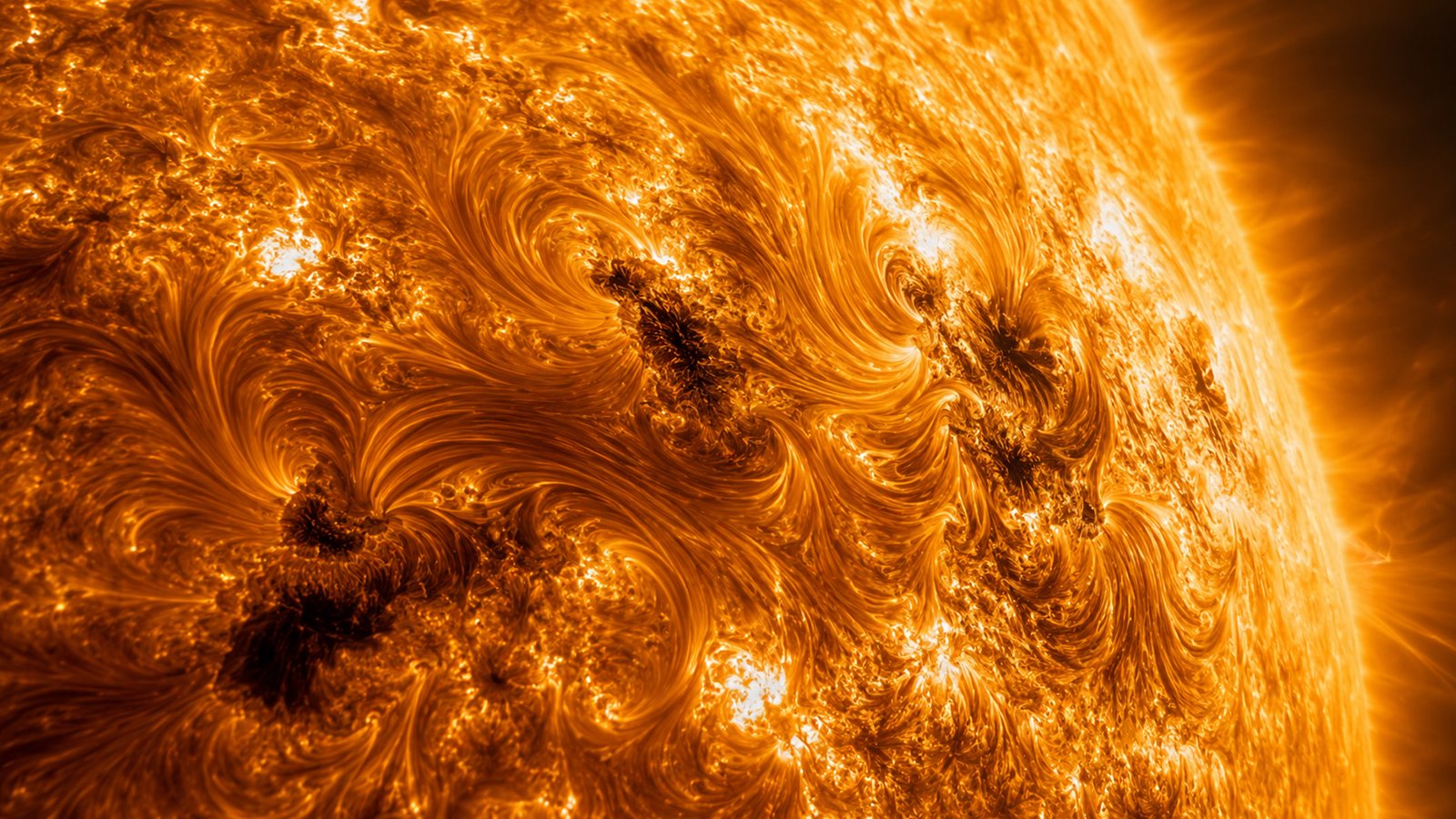
Scientists have captured an unprecedented view of the Sun’s restless surface, revealing tiny whirlpools of superheated plasma that had remained hidden from earlier observations.
The discovery, made with the US National Science Foundation’s Daniel K. Inouye Solar Telescope in Hawaii, provides the first direct evidence of a long-predicted phenomenon called Kelvin-Helmholtz instability (KHI) on the Sun’s visible surface. The findings were published in Nature on August 5.
The images show the Sun’s photosphere, the layer we see as its visible surface, behaving in a far more dynamic way than previously understood. At the boundaries of strong magnetic regions, hot plasma appears to form rapidly changing, wave-like vortices.
For scientists, these are not simply striking patterns. They could offer important clues about how the Sun moves energy and magnetic fields through its atmosphere.
Kelvin-Helmholtz instability is a familiar process in fluid dynamics. It develops when two neighbouring layers of fluid or gas move at different speeds. The difference creates shear, causing small disturbances along the boundary to grow into waves and eventually swirling vortices.
The same physics can be seen in phenomena on Earth, including patterns in clouds and oceans. Similar instabilities have also been observed in planetary magnetospheres and other astrophysical environments.
Until now, however, scientists had not been able to clearly observe the process occurring on the Sun’s photosphere at such a small scale.
The new observations change that.
Using the Inouye Solar Telescope, researchers examined an active region close to a sunspot. The telescope was able to resolve structures as small as about 19 kilometres across, roughly the width of a large city — while also tracking their rapid evolution.
The observed vortices ranged from around 19 kilometres to about 170 kilometres in size. The structures appeared at the edges of magnetic flux concentrations, where moving solar plasma interacts with strong magnetic fields.
The researchers identified 47 vortices in the observations, with characteristic spacing of roughly 65 kilometres. Their apparent motion ranged from about 0.67 to 3 kilometres per second.
The Sun may look calm from Earth, but its surface is constantly boiling with motion. Hot plasma rises, cools and sinks again in a process known as convection. These movements also carry magnetic fields with them.
Near concentrated magnetic regions, however, the magnetic field can interfere with the movement of plasma. This creates sharp differences in flow speed along boundaries — precisely the conditions required for Kelvin-Helmholtz instability to develop.
As the plasma begins to swirl, it can bend and distort magnetic field lines. Researchers believe this process may contribute to magnetic flux braiding, in which magnetic fields become increasingly tangled and store energy.
That stored magnetic energy is central to some of the Sun’s most powerful events, including solar flares and coronal mass ejections (CMEs). Such eruptions can send huge amounts of charged particles and radiation into space, producing space weather that can affect satellites, radio communications, navigation systems and power infrastructure on Earth.
The newly observed vortices therefore provide scientists with a closer look at one of the small-scale processes that may influence much larger solar events.
The researchers did not rely only on the telescope images. They also compared their observations with high-resolution computer simulations of the Sun’s magnetised plasma.
The simulations reproduced vortex-like structures remarkably similar to those seen by the Inouye telescope. This agreement strengthened the conclusion that the observed patterns are indeed Kelvin-Helmholtz instabilities rather than unrelated fluctuations in the solar atmosphere.
The process also appears to mix magnetised and non-magnetised plasma efficiently. According to the researchers, Kelvin-Helmholtz instabilities can transport mass, energy, momentum and magnetic flux, making them potentially important to the way the Sun’s magnetic atmosphere evolves.
One of the biggest puzzles in solar physics is why the Sun’s outer atmosphere, or corona, is dramatically hotter than its visible surface. The photosphere has a temperature of roughly 5,500°C, while parts of the corona reach millions of degrees.
Scientists have long suspected that small-scale magnetic and plasma processes play a role in transferring energy upwards. The newly observed instabilities could provide another piece of that puzzle, although researchers stress that the discovery does not by itself solve the coronal-heating mystery.
The importance of the discovery goes beyond the Sun. Kelvin-Helmholtz instability is a universal physical process, so studying it in such extraordinary detail could also improve scientists’ understanding of magnetic activity in other stars and astrophysical plasmas.
The breakthrough was made possible by the 4-metre Inouye Solar Telescope, the world’s largest and most powerful solar telescope. Its enormous mirror allows scientists to collect enough light to study extremely fine structures while measuring the Sun’s magnetic fields with exceptional precision.
For decades, these tiny solar whirlpools existed mainly in theory and computer models. Now, scientists can watch them unfold on the real Sun.
And that may be the most important part of the discovery: by seeing the Sun at this unprecedented scale, researchers are beginning to connect the smallest movements of plasma and magnetic fields with the enormous bursts of energy that make our star so active.