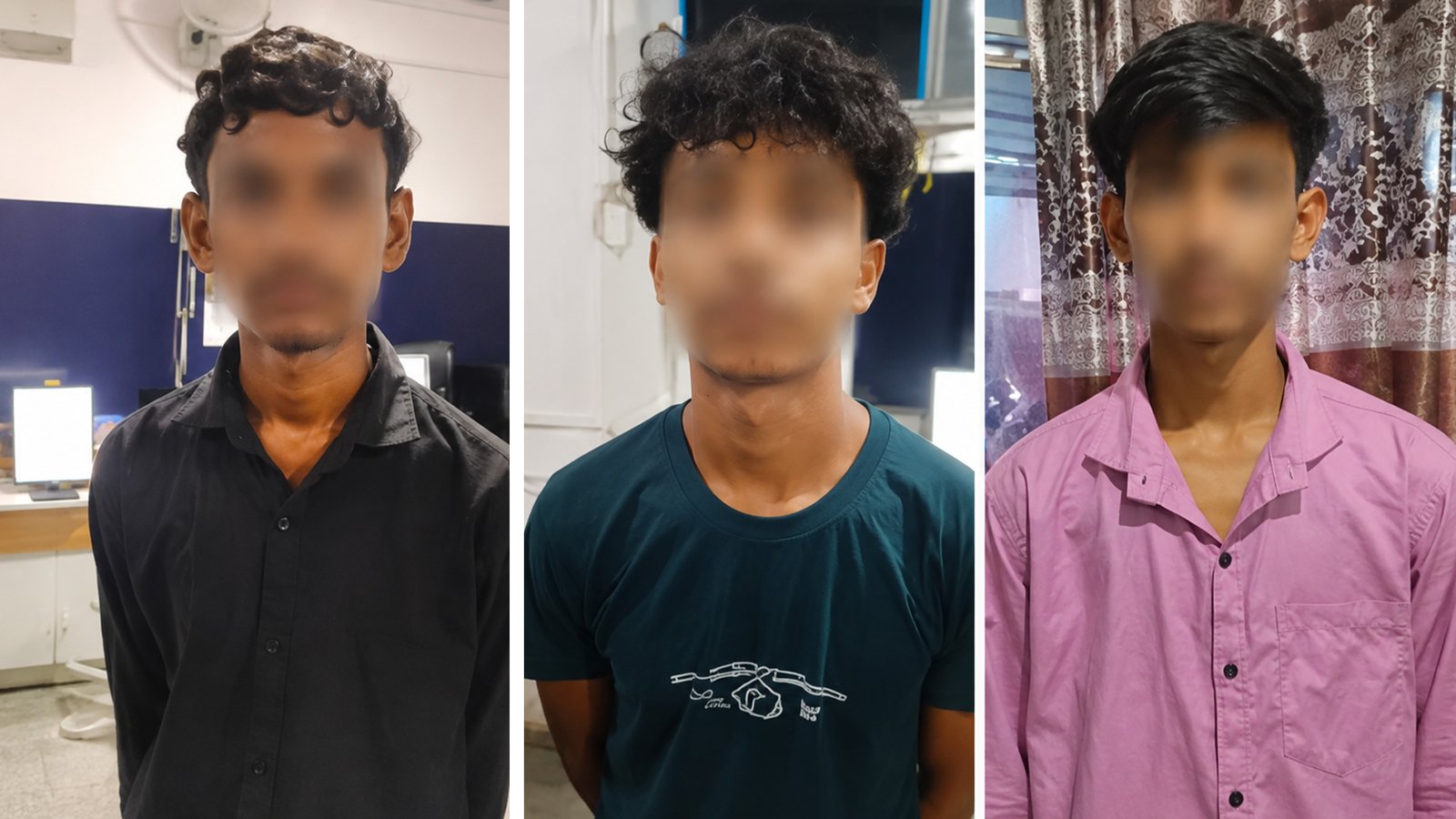
Three teenagers have been arrested in Assam’s Hailakandi district in connection with the alleged rape and murder of a teenage girl, in a case that has shocked the local community and prompted demands for swift justice.
The victim, whose age has been reported as 15 and 16 in different accounts, was found dead at her home in the Aloichora area under Katlicherra police station on Saturday night. Police initially detained five youths for questioning before arresting three of them. The accused are between 17 and 19 years old.
Assam Police have formed a Special Investigation Team (SIT) to investigate the case. Forensic experts have also examined the crime scene as investigators work to establish exactly what happened inside the house and identify the sequence of events leading to the girl’s death.
According to police, the incident occurred at around 11 pm on Saturday in the Aloichora area. The girl’s family had gone to a nearby relative’s house for a feast. The teenager was also present at the gathering but reportedly returned home after an argument with a cousin.
Her mother said the family planned to take food to her later. When relatives returned home roughly an hour afterwards, they found the girl dead. The discovery triggered an immediate police investigation and anger among residents.
Police officials said the girl’s body had suffered severe injuries. Investigators are examining evidence from the scene and awaiting the post-mortem findings to establish the precise cause and circumstances of death. The allegations of sexual assault are part of the criminal case registered against the accused.
Authorities have invoked serious provisions of the Bharatiya Nyaya Sanhita (BNS) and the Protection of Children from Sexual Offences (POCSO) Act. The charges currently include Section 65(1) of the BNS concerning rape of a girl below 16, Section 103(1) relating to murder, and Section 6 of the POCSO Act concerning aggravated penetrative sexual assault. Police have said additional sections could be added as the investigation progresses.
One of the arrested accused is around 17-and-a-half years old. Hailakandi Senior Superintendent of Police Amitabh Sinha said the police have approached the court seeking that the juvenile be tried as an adult because of the alleged brutality of the crime. The issue will now be decided through the legal process applicable to juveniles accused of serious offences.
The other two arrested accused are older teenagers. Police have produced all three before the court, though officials have not disclosed further details about the proceedings, citing the sensitive nature of the case.
Investigators are also examining the possible involvement of others. Police said mobile phones belonging to several people have been seized and that their owners are being questioned. Officials have not ruled out further arrests as the investigation continues.
The case has caused considerable anger in Hailakandi, with local residents demanding strict punishment for those found responsible. The incident has also raised concerns about the safety of children and young women, particularly in communities where families expect homes to remain safe spaces.
The victim’s family has called for the strongest possible punishment. Her mother, speaking about the condition in which her daughter was found, expressed shock and grief and demanded justice. The family has urged authorities to ensure that the investigation is not delayed and that anyone responsible is held accountable.
The police, meanwhile, are trying to separate established facts from allegations as the investigation develops. The post-mortem examination and forensic evidence are expected to play an important role in determining the circumstances surrounding the teenager’s death. Statements from witnesses and analysis of seized mobile phones could also help investigators reconstruct the events of that night.
The formation of the SIT is intended to bring together different aspects of the investigation, including forensic examination, witness questioning and the collection of digital evidence. Police have indicated that the probe remains active and that the current charges may be expanded if further evidence emerges.
The case has also drawn attention because all three accused are themselves teenagers or young adults, with one below 18. The police request to treat the 17-year-old as an adult highlights the difficult legal questions that can arise when juveniles are accused of particularly serious offences. Under India’s juvenile justice framework, such cases require a separate assessment before an older juvenile can potentially face proceedings as an adult.
As the SIT investigation continues, authorities face pressure from the victim’s family and the local community to ensure a thorough and transparent probe. The immediate priority is to establish the full sequence of events, determine the role of each accused and ensure that the teenager’s family receives justice through due process.