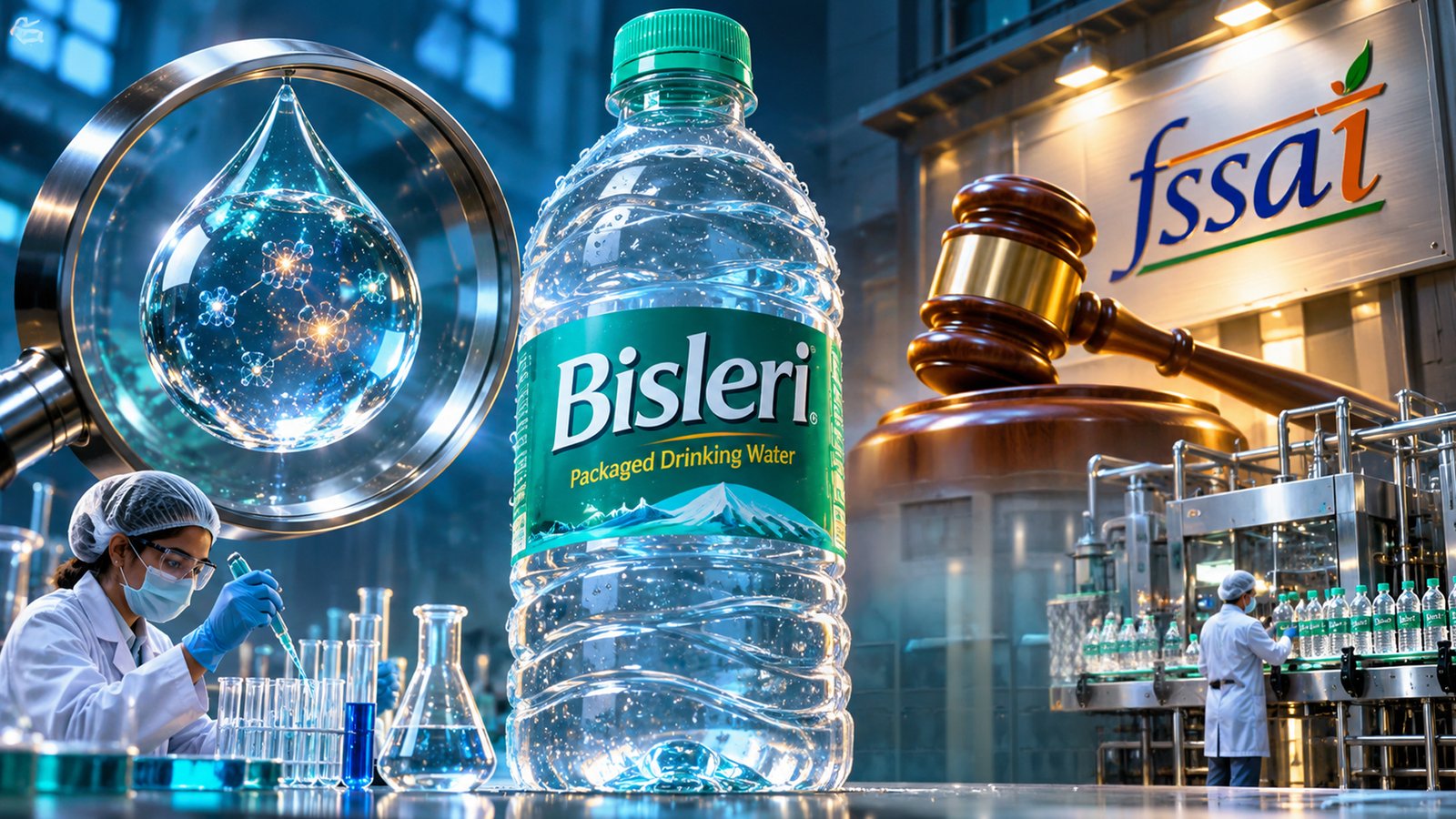
Bisleri International has defended the safety of its packaged drinking water after the Food Safety and Standards Authority of India (FSSAI) sanctioned prosecution against the company over a sample declared unsafe during laboratory testing. Disputing the findings, the company said independent tests found bromate levels within permissible limits and claimed it had not received any formal notice regarding the prosecution.
The clarification came on November 23, a day after FSSAI announced that it had sanctioned prosecution against Bisleri under the Food Safety and Standards Act, 2006. The regulatory action followed laboratory findings that a sample of the company’s packaged drinking water did not meet prescribed safety standards, with tests flagging bromate and polynuclear aromatic hydrocarbons (PAHs).
Bisleri said the case relates to a single batch manufactured in September 2025 at its Goa facility. According to the company, FSSAI collected six samples from the manufacturing unit on September 30, 2025. Initial laboratory testing found that five samples complied with the applicable standards, while the sixth recorded bromate levels of 12 micrograms per litre, against the permissible limit of 10 micrograms per litre.
Bromate is a chemical compound that can form during certain water treatment and disinfection processes. Its presence in drinking water is regulated because prolonged exposure to elevated levels can pose health risks. Food safety standards prescribe limits to ensure that packaged drinking water remains safe for consumers.
Following the initial findings, Bisleri said it exercised its right to appeal on November 22, 2025. The sample was subsequently sent to a referral food laboratory for further examination. While the referral laboratory found bromate levels within the prescribed limit, it separately detected polynuclear aromatic hydrocarbons, commonly known as PAHs, in the sample. Based on these findings, the laboratory declared the sample unsafe.
PAHs are a group of chemical compounds that can enter the environment through industrial processes and the incomplete burning of organic materials. Some compounds in this group are classified as carcinogenic, making their presence in food and drinking water a matter of regulatory concern.
Bisleri said the differing laboratory findings prompted it to seek further clarification. The company arranged for the same sample to be tested independently at another FSSAI-approved laboratory. According to its statement, this examination also found bromate levels within the prescribed safety limit.
The company said it submitted the independent laboratory results to FSSAI’s Western Regional Office through a formal letter dated February 2, 2026. However, it claimed that there had been no further communication from the regulator after the submission and that it had understood the matter to be closed.
Bisleri also maintained that it had not received any official communication regarding the prosecution, either through email or in hard copy. It added that it had been unable to locate the reported notice on the FSSAI website.
Reiterating its position, the company said consumer safety remained its priority and that its manufacturing operations followed multiple quality-control procedures. Bisleri said its production process involved more than 90 quality checks across 10 stages to maintain product standards and ensure compliance with food safety requirements. It added that it would cooperate with FSSAI and address the matter through the appropriate regulatory process.
The development has also brought wider attention to quality monitoring in India’s packaged drinking water industry. According to reports, FSSAI is planning to expand its testing beyond the sample collected from Bisleri’s Goa facility. The proposed exercise is expected to cover additional Bisleri samples as well as products manufactured by other packaged drinking water companies.
The move could lead to closer scrutiny of the sector, where consumer confidence depends on consistent quality standards, transparent manufacturing practices and effective regulatory oversight.
The government has also indicated that the batches linked to the unsafe sample were recalled and that subsequent tests did not identify further water quality concerns. Bisleri’s February communication to the regulator reportedly stated that no product from the affected batch remained in the market by that time.
The distinction is important because the regulatory action relates to a specific sample collected from the Goa facility in 2025. The findings do not, by themselves, establish that every Bisleri product or batch currently available in the market is unsafe.
This raises the importance of regular testing and strict compliance with drinking water standards. It also highlights the need for clear communication between manufacturers and regulators when laboratory results differ.
Bisleri remains one of India’s best-known packaged drinking water brands, and the prosecution move represents a significant development for the company. While it has stood by its claim that its products are safe, the regulator’s findings have raised questions that will need to be addressed through the legal process.
The prosecution sanction is not a final judicial finding of guilt. The outcome will depend on the proceedings and the evidence placed before the appropriate authority. Further clarification from FSSAI and the company’s response to the regulatory action will be closely watched by the packaged drinking water industry.