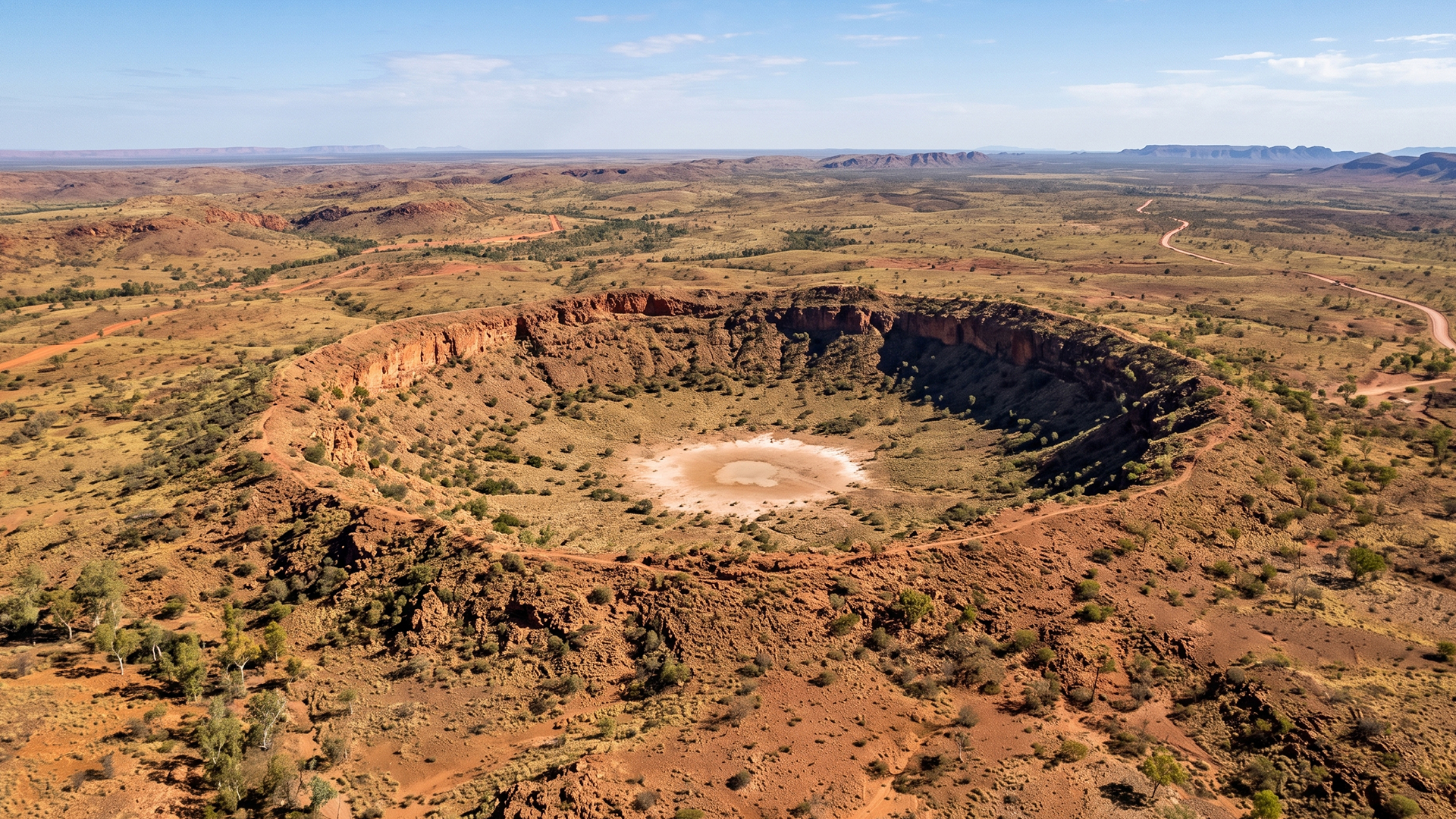
A massive crater discovered in the remote Pilbara region of Western Australia could become the oldest known asteroid impact site on Earth, according to a new study. If confirmed, the impact would have occurred about 3.47 billion years ago, pushing back Earth’s known impact history by more than a billion years.
The research, led by scientists from Curtin University, suggests that a giant asteroid slammed into the planet during its early history, leaving behind geological evidence that has survived for billions of years. Researchers identified distinctive rock formations known as shatter cones, which are created only by the immense pressure generated during meteorite impacts.
The team believes the asteroid may have been travelling at tens of thousands of kilometres per hour, releasing enormous amounts of energy on impact. Such collisions were common during the early formation of the solar system and may have played an important role in shaping Earth’s surface and influencing the conditions that eventually supported life. The discovery adds to our understanding of asteroids and the early solar system, offering clues about the violent collisions that shaped planets billions of years ago.
If the findings are verified, the Australian crater would replace the Vredefort Crater in South Africa, estimated to be around 2.02 billion years old, as the oldest recognised impact structure on Earth.
However, not all scientists are convinced. Several experts have urged caution, saying more evidence is needed before the site can be officially recognised as an ancient impact crater. Some geologists argue that additional mapping, rock analysis and independent verification are necessary because Earth’s oldest rocks have undergone billions of years of deformation and erosion, making it difficult to interpret their origins.
Despite the debate, researchers say the discovery opens an exciting window into Earth’s distant past. Studying ancient impact sites can help scientists understand how early asteroid collisions influenced the planet’s geology, atmosphere and even the emergence of life.
Also Read: King Charles discloses £30 million tax bill