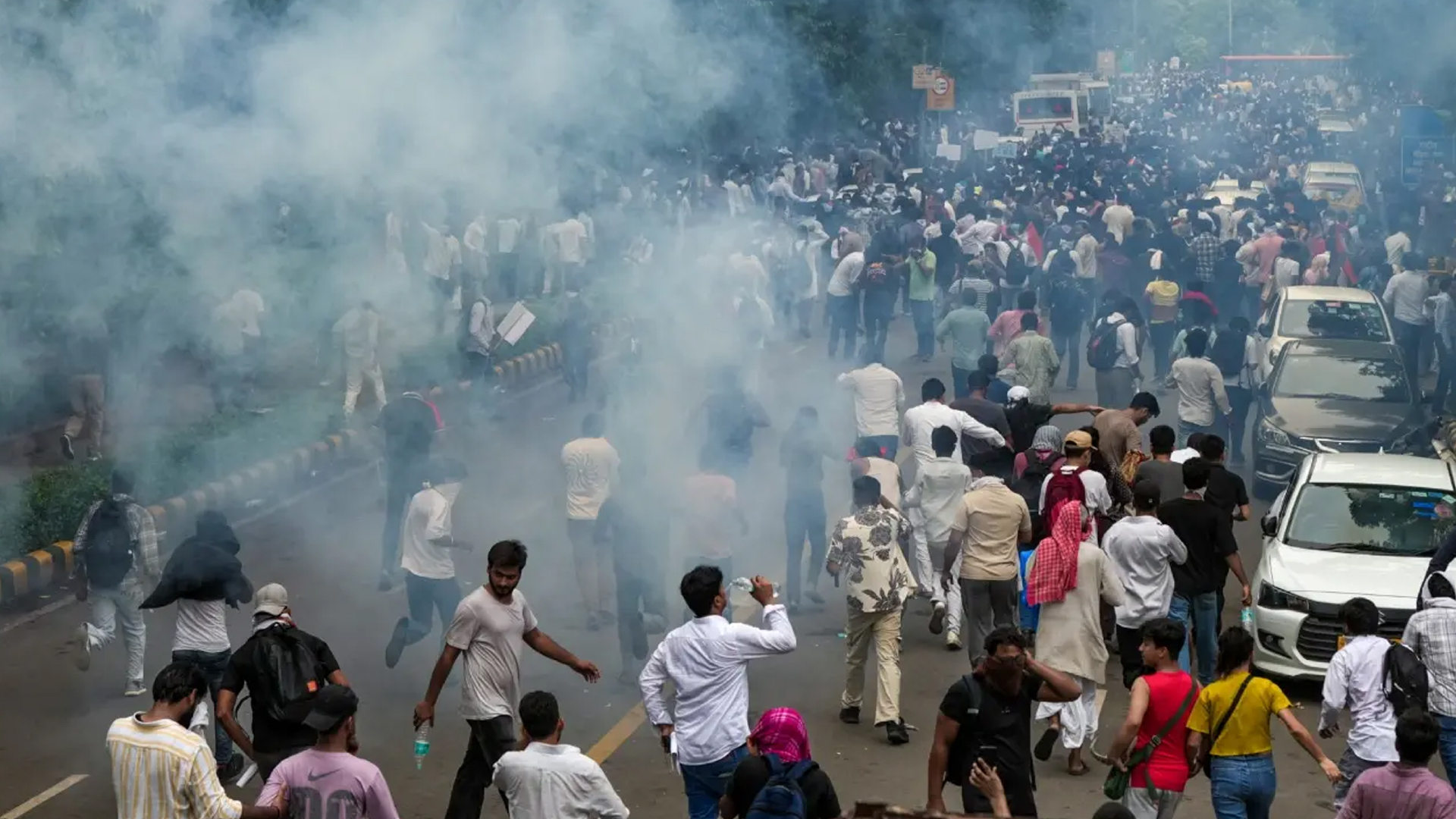
New Delhi remained on edge on Thursday after fresh clashes erupted between police and protesters at Jantar Mantar, where thousands of students have been demonstrating under the banner of the Cockroach Janta Party (CJP). The protest, which began over alleged examination paper leaks, has now grown into a nationwide movement demanding the resignation of Union Education Minister Dharmendra Pradhan and sweeping reforms in India’s examination system.
The latest violence broke out late Wednesday night when a section of protesters attempted to move beyond the designated protest area. Police stopped the march using barricades, leading to a confrontation that quickly escalated. Tear gas shells were fired to disperse the crowd, while videos circulating on social media showed chaotic scenes of protesters running through smoke-filled streets and police trying to restore order.
Delhi Police said several senior officers sustained injuries after protesters allegedly hurled stones and pushed against security barricades. Authorities claimed that the demonstration turned violent after repeated warnings to maintain peace were ignored. Police also said they were forced to use minimum force to prevent protesters from entering high-security areas near Parliament.
However, CJP leaders rejected the police version, accusing security personnel of using excessive force against peaceful demonstrators. They alleged that many students were injured in the crackdown and insisted that the movement would continue despite the clashes.
The protest site at Jantar Mantar remained heavily guarded on Thursday, with hundreds of police personnel deployed across the area. Barricades were reinforced, traffic diversions were imposed around central Delhi, and entry into sensitive government zones was closely monitored.
The CJP movement has rapidly transformed into one of India’s largest youth-led protests in recent years. What began as outrage over repeated examination paper leaks has evolved into a broader campaign highlighting concerns over transparency in recruitment examinations, delays in government job appointments and the future of millions of aspirants.
Students participating in the protest say years of hard work have been undermined by repeated examination irregularities. Many travelled from different parts of the country to join the agitation, carrying placards demanding a fair examination system and accountability from the government.
For several aspirants, the protest is deeply personal. Many have spent years preparing for competitive examinations while making financial and personal sacrifices. Some left stable jobs to pursue government careers, while others exhausted family savings on coaching classes. They argue that repeated paper leaks have robbed deserving candidates of equal opportunities.
Volunteers at the protest site continued to distribute food, drinking water and medical assistance as demonstrators remained camped at Jantar Mantar despite the tense atmosphere. Several parents also joined the protest, expressing concern over the uncertainty faced by students preparing for competitive examinations.
The agitation has also drawn support from environmental activist Sonam Wangchuk, who is observing a hunger strike in solidarity with the protesting students. Wangchuk has appealed to the government to engage in dialogue and address students’ concerns instead of relying on police action. His participation has brought wider public attention to the movement and attracted support from civil society groups.
The issue has also dominated the ongoing Monsoon Session of Parliament. Opposition parties have repeatedly raised the matter in both Houses, accusing the Centre of failing to protect the integrity of India’s examination system. They have demanded a detailed discussion on examination reforms and called for the Education Minister’s resignation.
The government, however, has defended its actions, saying it is committed to ensuring fair and transparent examinations. Prime Minister Narendra Modi recently described preventing paper leaks as a “national responsibility” and assured strict action against those involved in examination fraud. The Centre has also indicated that stronger legal measures and faster investigations are being considered to curb future leaks.
Despite these assurances, CJP leaders say their core demands remain unchanged. They want accountability at the highest level, stronger safeguards to prevent examination malpractice and comprehensive reforms that restore confidence among students and job aspirants.
Political observers believe the protest has evolved beyond a single examination controversy. It now reflects growing frustration among young people over employment opportunities, delayed recruitment processes and repeated allegations of irregularities in competitive examinations.
As security remained tight around Jantar Mantar, protesters vowed to continue their sit-in until their demands are met. With fresh clashes, rising political pressure and increasing public support, the CJP movement has emerged as one of the country’s most significant youth protests, placing the spotlight firmly on examination reforms and the future of millions of aspiring students.
Also Read: Pakistan seeks $10 bn US economic support package