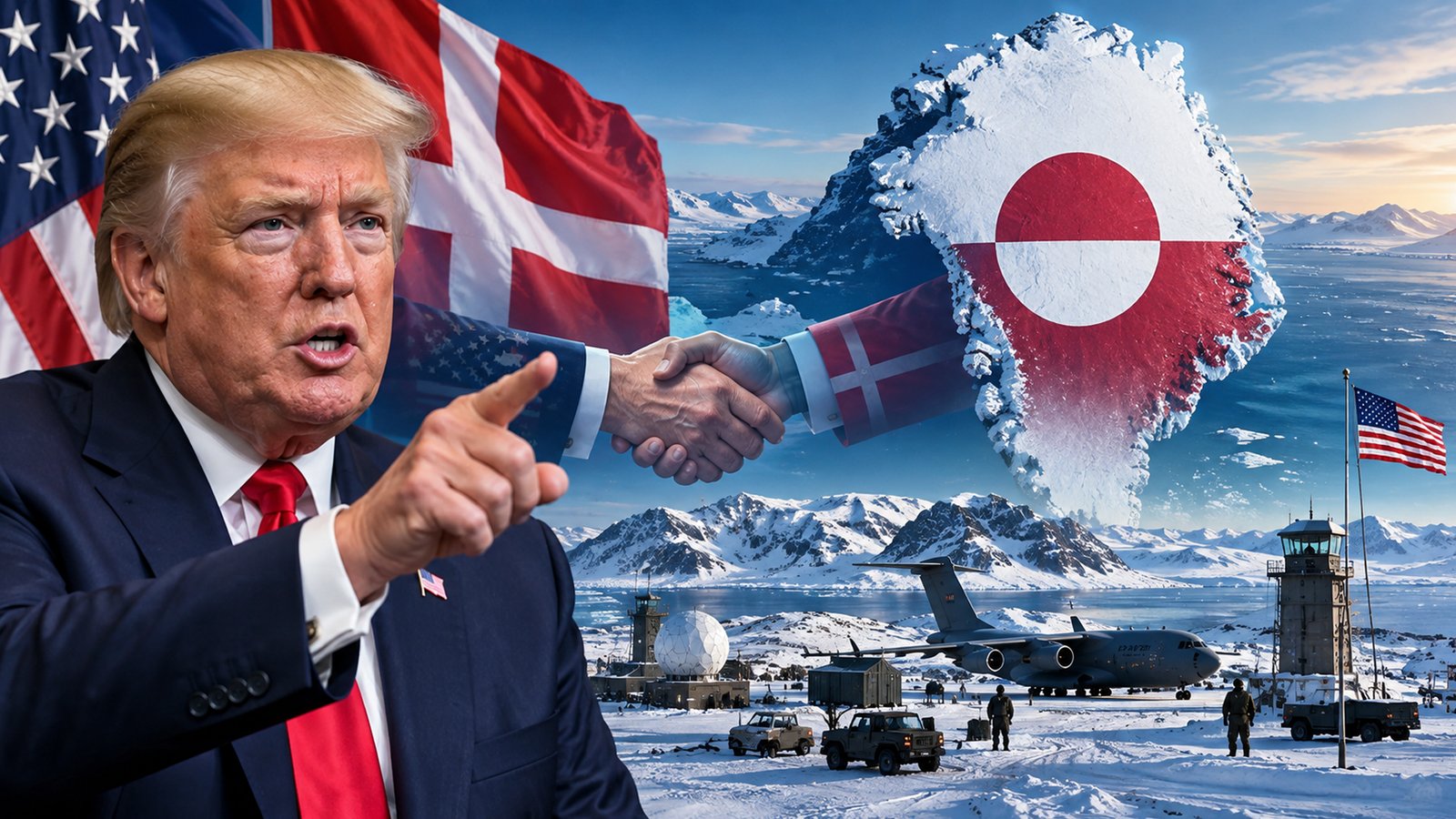
The United States has reached a security agreement with Denmark and Greenland that will significantly expand Washington’s military role on the strategically important Arctic island.
US President Donald Trump announced the agreement on Friday, saying it gives the United States permanent control over Greenland’s security and other defence needs. The deal does not transfer Greenland to the US, however. The island will remain part of the Kingdom of Denmark and retain its existing self-government.
The agreement follows months of tension after Trump repeatedly called for the United States to acquire Greenland. His comments had created concern in Denmark and Greenland and raised wider questions within NATO about US relations with its European allies.
The latest arrangement instead focuses on military cooperation. Washington will receive expanded access to Greenland for defence purposes and plans to increase its military presence there. Trump said the US would begin work on developing a larger military presence on the island.
The exact size and location of any additional US facilities have not yet been disclosed. The full text of the agreement has also not been made public.
The United States already has a military facility in Greenland. Pituffik Space Base, formerly known as Thule Air Base, is used for missile warning, missile defence and space surveillance. US military access to Greenland also dates back to a 1951 defence agreement with Denmark.
The new deal is intended to expand that existing arrangement and give Washington longer-term security rights in the Arctic territory.
A major part of the agreement is aimed at preventing US strategic rivals from establishing a presence in Greenland. Trump said adversaries would not be allowed to establish military bases, maintain military forces or make sensitive investments on the island without US approval.
The arrangement is particularly significant because of growing competition in the Arctic. Russia has maintained a major military presence in the region, while China has increased its economic and strategic interest in the Arctic. Greenland’s location gives it importance for surveillance, defence and control of routes between North America and Europe.
The island is also believed to have significant mineral resources, adding an economic dimension to its strategic importance. Access to critical minerals and control over infrastructure such as ports, telecommunications networks and undersea cables have become increasingly important in Arctic security discussions.
Denmark and Greenland have stressed that the agreement does not change their sovereignty. Danish Prime Minister Mette Frederiksen said the arrangement recognises the sovereignty and territorial integrity of the Kingdom of Denmark as well as Greenlanders’ right to self-determination.
Greenland‘s Prime Minister Jens-Frederik Nielsen said the agreement strengthens the security of Greenland, Denmark, the United States and the wider Western alliance.
The distinction is important because Greenland has its own government and parliament but remains within the Danish kingdom. Greenland has also maintained a long-term ambition of greater independence from Denmark.
According to US officials, the security arrangement is designed to remain in place even if Greenland eventually becomes independent. That provision addresses a longstanding concern in Washington that a future change in Greenland’s political status could affect existing US military rights.
Trump has presented the agreement as a solution to the security concerns that drove his earlier push to acquire Greenland. Secretary of State Marco Rubio said the agreement addresses US national security concerns and keeps Greenland within the strategic defence area of North America.
The agreement is also being viewed as a way to ease a dispute that had strained relations between Washington and Copenhagen. Denmark is a NATO member, and Trump’s earlier demands for control of Greenland had caused unease among European allies.
The new arrangement gives the US greater military access without changing Greenland’s formal political status. That allows Denmark and Greenland to retain sovereignty while Washington secures a stronger long-term defence position in the Arctic.
The agreement is expected to be formally signed in New York next week during the United Nations General Assembly. It will then have to go through the necessary parliamentary procedures before coming into force, according to Danish and Greenlandic officials.
Questions remain over how quickly the US military presence will expand and whether new bases will actually be built. Details of future American facilities, investment restrictions and the precise limits of US authority are expected to become clearer once the agreement is formally published.
The Greenland deal therefore marks a shift in the dispute. Instead of transferring the territory to the United States, the agreement gives Washington a broader and potentially permanent security role while leaving Greenland under Danish sovereignty.
Its implementation could have wider implications for Arctic security, NATO cooperation and the growing strategic competition between the US, Russia and China in the region.