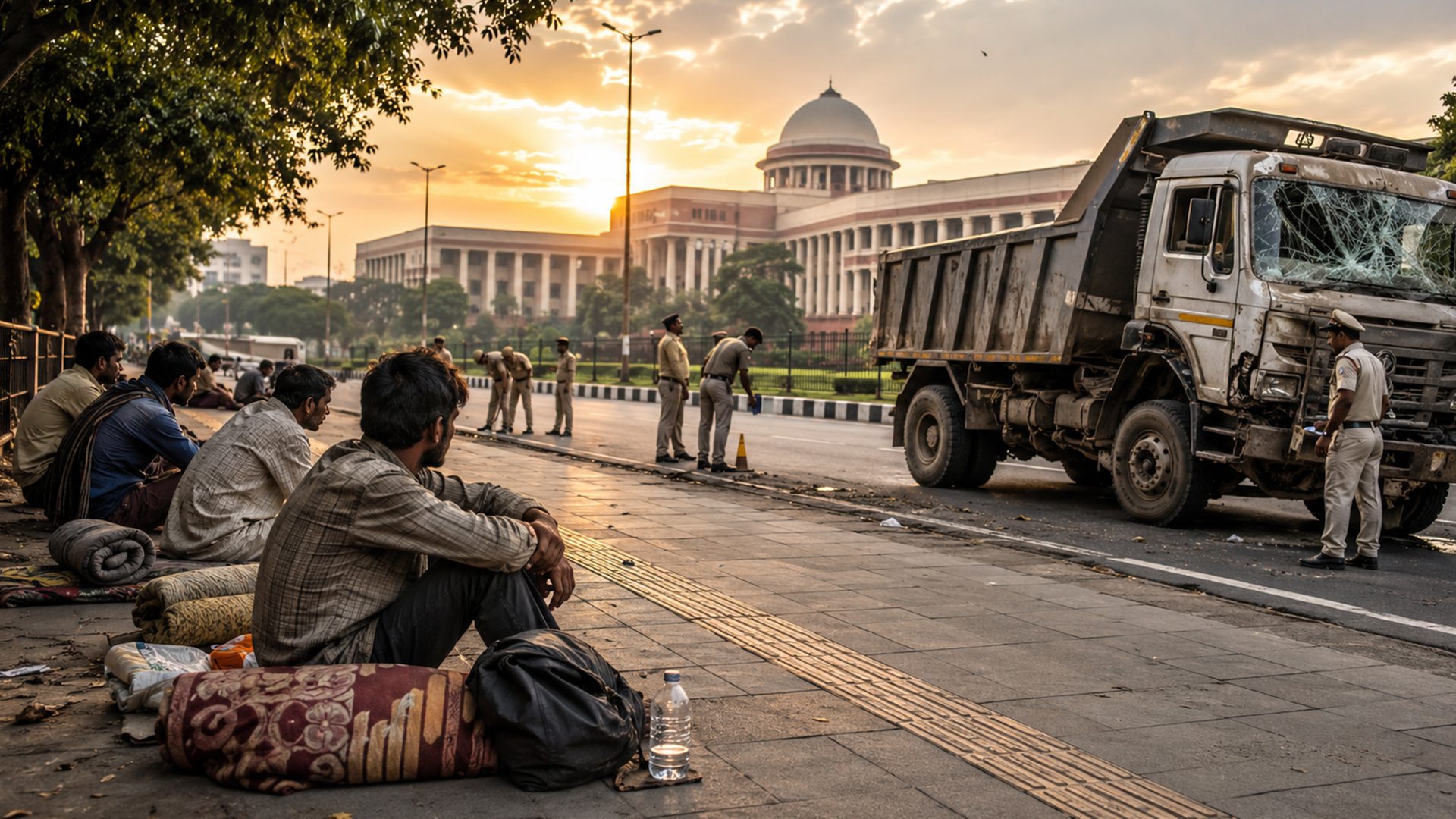
The Supreme Court has observed that a person sleeping on a pavement cannot be blamed for a road accident caused by a negligent driver, making it clear that such circumstances do not reduce the driver’s responsibility. The remarks came while the court granted bail to a man convicted in a fatal hit-and-run case involving people sleeping on a footpath in Delhi.
A Bench of Justices Ujjal Bhuyan and Vinod Chandran made the observation while hearing the bail plea of the convict, who had challenged his conviction after being found guilty by a trial court. While allowing the appeal to be heard, the court suspended the sentence and granted him bail, noting that the case raised issues that deserved detailed examination.
The case dates back to July 9, 2016, when a speeding car allegedly mounted a pavement in Delhi’s Kashmere Gate area and ran over several people who were asleep on the footpath. The crash killed one person and left others injured, triggering widespread outrage over road safety and reckless driving.
The trial court later convicted the accused under provisions related to causing death by negligence and sentenced him to imprisonment. The Delhi High Court upheld the conviction, after which the accused approached the Supreme Court seeking relief.
During the hearing, the defence argued that the victims were sleeping on the pavement, which was not meant for that purpose. It contended that this amounted to contributory negligence, suggesting that the victims had also contributed to the circumstances that led to the accident.
The Supreme Court, however, was not convinced by this argument.
The Bench observed that sleeping on a pavement may not be lawful, but it does not lessen the negligence of a driver who loses control of a vehicle and drives onto the footpath. The judges remarked that even if the victims were occupying the pavement, such conduct did not reduce the legal responsibility of the driver for the accident.
The court’s observation reinforces an important legal principle that motorists are expected to exercise reasonable care while driving and remain responsible for maintaining control of their vehicles. A vehicle leaving the road and entering a pedestrian area generally points to negligence unless exceptional circumstances are established.
At the same time, the Supreme Court clarified that its remarks were only prima facie observations made while deciding the bail application. The court said the legal issues surrounding the conviction would be examined in detail when the appeal is heard on merits.
The Bench suspended the sentence during the pendency of the appeal, allowing the convict to be released on bail subject to conditions imposed by the court. The appeal against the conviction will now be heard in due course.
Legal experts say the observation is significant because it distinguishes between the conduct of accident victims and the primary duty of motorists. While sleeping on a footpath may violate civic rules, it does not automatically transfer or reduce liability when a driver is found to have driven negligently.
The ruling has also reignited discussions on road safety, driver accountability and the living conditions of homeless people who often sleep on pavements due to the lack of shelter. Across many Indian cities, pavements become makeshift sleeping spaces for migrant workers, daily wage earners and homeless families despite the risks posed by traffic.
Road safety advocates argue that drivers have a heightened duty of care, particularly in urban areas where pedestrians, cyclists and vulnerable road users share limited public spaces. They say motorists must remain alert and ensure that their vehicles stay within designated carriageways.
The case also highlights the importance of balancing legal accountability with social realities. Although pavements are intended for pedestrians and not for sleeping, the court’s observation suggests that a driver’s obligation to avoid causing harm remains unchanged even when victims are using public spaces in an unauthorised manner.
The Supreme Court’s remarks are expected to be closely watched by legal experts and road safety campaigners, as they underline the principle that negligent driving cannot be excused merely because victims were present at an unexpected location.
With the appeal now pending before the apex court, a final ruling on the conviction will come after a detailed examination of the evidence and legal arguments. Until then, the court’s observations serve as a reminder that every driver carries a fundamental responsibility to operate vehicles safely and prevent avoidable accidents, particularly where human lives are at risk.
The case once again brings attention to India’s continuing challenge of improving road safety, strengthening driver responsibility, and protecting vulnerable people who often live or sleep in public spaces. As the legal proceedings continue, the Supreme Court’s observations are likely to shape future debates on motor accident liability, negligent driving, and the extent of a driver’s duty of care under Indian law.