India’s long-standing push for a permanent seat on the United Nations Security Council received fresh support from four Central European countries on Monday.
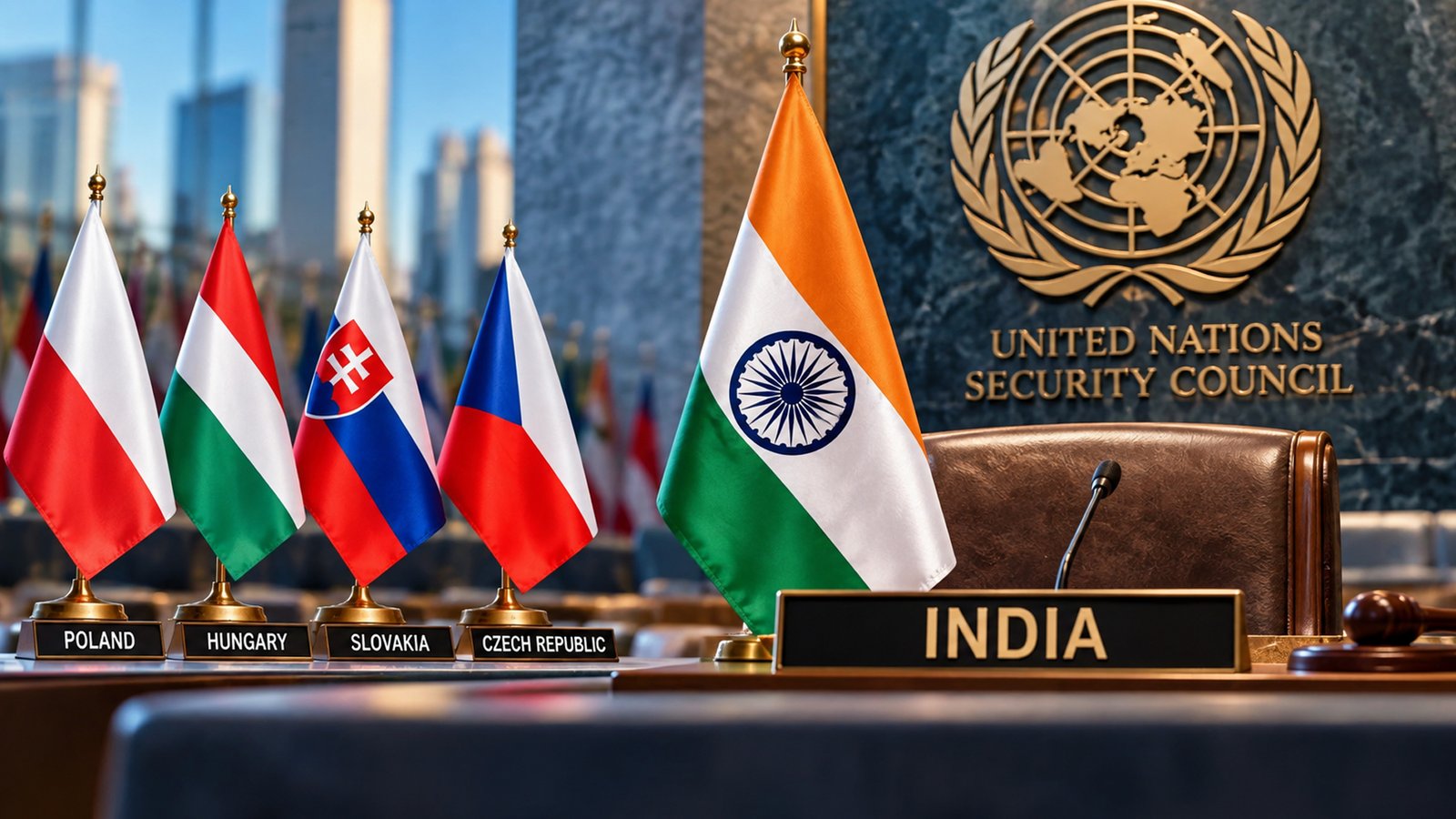
Hungary, Poland, Slovakia and the Czech Republic, which together form the Visegrád Group, backed India’s demand during the first V4-India foreign ministers’ meeting held on the sidelines of the 81st United Nations General Assembly in New York.
Slovak Foreign Minister Juraj Blanár said the four countries agreed that India should have a permanent place on the UN Security Council. He described India as a major country of the Global South and an emerging power in the Indo-Pacific.
The support comes as India continues to press for reform of the UN Security Council, arguing that its present structure does not adequately reflect the political and economic realities of the world today.
External Affairs Minister S Jaishankar attended the meeting with senior representatives from the four V4 countries. He described the gathering as a new and significant occasion for India’s engagement with the Central European grouping.
The meeting was not limited to the UNSC issue. India and the V4 countries also agreed to strengthen cooperation in areas including technology, innovation, defence, space, connectivity, research, education and people-to-people ties. The countries agreed to hold regular meetings of their foreign ministers and establish an annual business forum.
Jaishankar said India has strong relations with all four V4 nations and that the new format could provide another platform for expanding those ties.
The ministers also discussed major international developments, including the Ukraine conflict and developments in the Gulf. The discussions came as countries attending the UN General Assembly faced a wide range of security and geopolitical challenges.
The Visegrád Group was formed in 1991 and consists of the Czech Republic, Hungary, Poland and Slovakia. The grouping provides a platform for cooperation on political, economic, security and other issues.
The collective backing from the four countries adds to the international support India has received for its permanent membership campaign. France, the United Kingdom, the United States and Russia have also expressed support for India’s inclusion in an expanded Security Council, although countries differ over how the Council itself should be reformed.
The UN Security Council currently has 15 members. Five are permanent members — China, France, Russia, the United Kingdom and the United States — and the remaining 10 are elected for two-year terms. The five permanent members also have veto power over substantive Council decisions.
India argues that the current arrangement reflects the global order of 1945 rather than the world of today. When the United Nations was established, much of Asia and Africa was still under colonial rule. Since then, countries such as India have gained greater economic, diplomatic and strategic importance.
India has served eight times as an elected member of the Security Council, most recently in 2021 and 2022. New Delhi has argued that its large population, growing economy, contribution to UN peacekeeping and role in international affairs strengthen its case for a permanent position.
India is also part of the G4 grouping with Brazil, Germany and Japan. The four countries support each other’s bids for permanent membership and have jointly pushed for changes to the structure of the Security Council.
However, gaining a permanent seat requires much more than support from individual countries. Any change to the UN Charter requires approval through the organisation’s established amendment process, including ratification by the permanent members.
There are also differences among countries over the size of an expanded Security Council, regional representation and whether any new permanent members should receive veto powers. These issues remain part of the broader negotiations on UN Security Council reform.
For India, the V4 endorsement therefore represents another diplomatic statement of support rather than an immediate change to the composition of the Security Council.
The timing is significant because the endorsement came during the UN General Assembly, where India has continued to make the case for a more representative multilateral system.
The first V4-India meeting also gives New Delhi a new channel for closer engagement with four European countries. Regular foreign ministers’ meetings and an annual business forum are expected to keep the relationship active beyond the current UNGA session.
As India continues its campaign for a permanent UNSC seat, the latest support from Hungary, Poland, Slovakia and the Czech Republic adds another group of countries to the conversation around Security Council reform. The broader debate, however, will depend on negotiations among UN member states over how the Council should change and how new members would be represented.