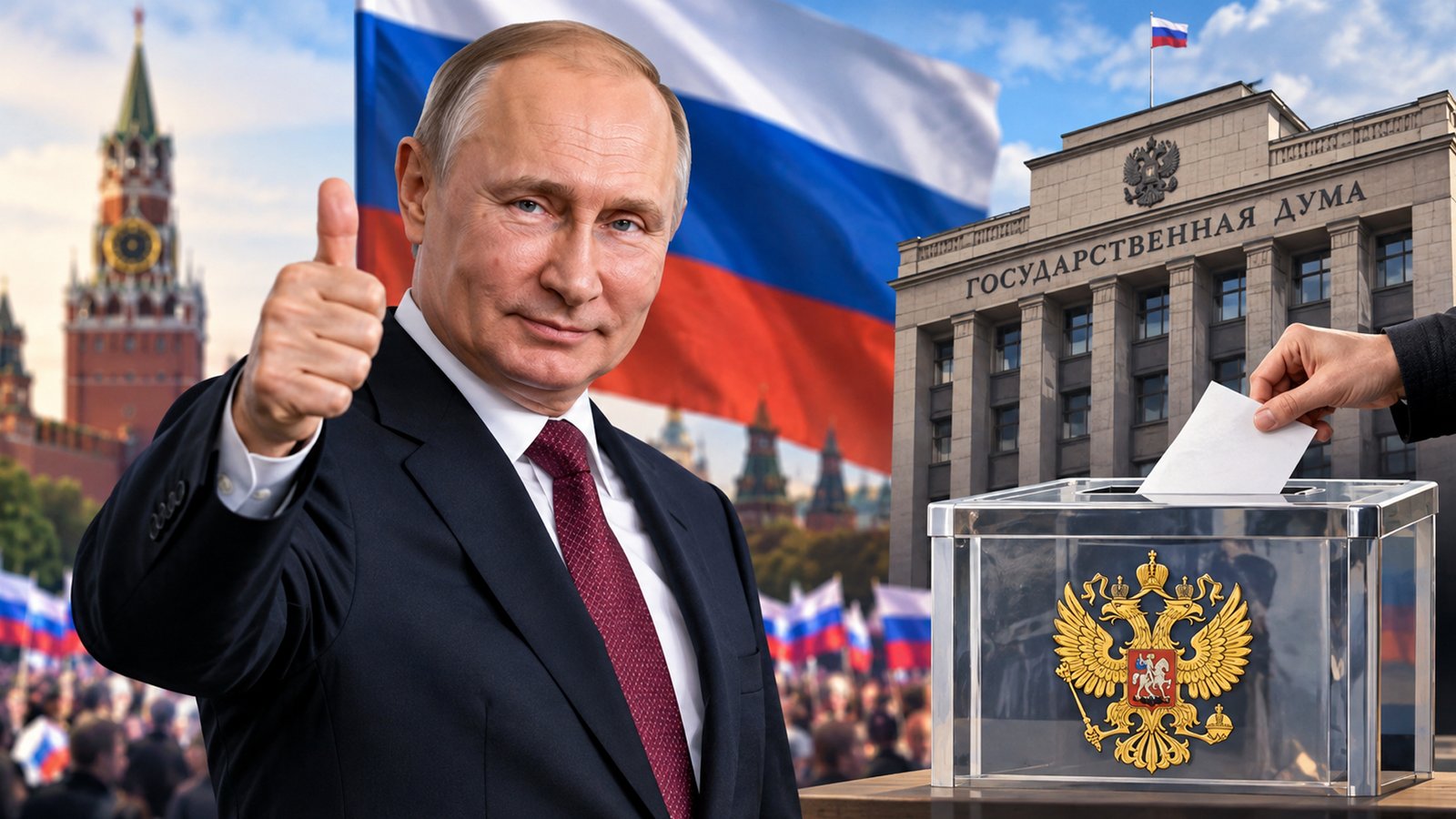
President Vladimir Putin’s ruling United Russia party has secured a record majority in Russia’s parliamentary election, strengthening the Kremlin’s control over the country’s political system as the war in Ukraine continues.
Preliminary results released by Russia’s Central Election Commission showed United Russia winning 355 of the 450 seats in the State Duma, the lower house of parliament. The party received about 57.8% of the vote, according to results covering more than 95% of ballots. The final results are expected later this week.
The result gives United Russia an even larger majority than it held after the previous parliamentary election in 2021. Its earlier record was 343 seats in 2016. The new figure also gives the party a constitutional supermajority, allowing it to pass legislation and constitutional amendments without relying on other parliamentary groups.
The three-day election, held from September 18 to 20, was the first parliamentary vote in Russia since Putin launched the full-scale invasion of Ukraine in February 2022. The Kremlin presented the election as an opportunity for Russians to demonstrate support for the country and its military campaign.
Putin’s government has described the result as evidence of national unity. Kremlin spokesman Dmitry Peskov said the vote showed a high level of support for the president and the leadership.
The election, however, took place in a tightly controlled political environment. Opposition groups and independent election observers have questioned the fairness of the process, while several anti-war politicians were prevented from contesting or were forced to leave Russia.
The Yabloko party, the only registered political party openly critical of the war, was removed from the federal ballot by Russia’s Supreme Court before the election. None of its candidates won a seat in the national parliament, although the party secured a small foothold in the regional parliament in Novgorod after crossing the required threshold.
Other parties entering the State Duma included the Communist Party, which won 40 seats, the nationalist Liberal Democratic Party of Russia with 25 seats and New People with 20 seats. These parties have generally supported the Kremlin on major issues, although they have sometimes criticised specific government policies.
Turnout was reported at around 59.3%, according to the Central Election Commission. Authorities used both traditional polling and electronic voting in many regions. Critics have questioned the use of electronic voting and raised allegations of pressure on voters and irregularities. Russian officials have rejected accusations of widespread manipulation.
The election also included voting in four Ukrainian regions — Donetsk, Luhansk, Kherson and Zaporizhzhia — that Russia claims to have annexed. Ukraine and many other countries reject those claims, and Kyiv has described voting organised by Russia in those areas as illegal. Voting was also held in Crimea, which Moscow annexed in 2014.
The parliamentary vote unfolded against the backdrop of continued Russian military operations in Ukraine and a series of Ukrainian drone attacks inside Russia.
On the final day of voting, Russian authorities reported hundreds of Ukrainian drones being intercepted, including a large attack targeting the Moscow region. Moscow officials said the strikes damaged infrastructure, including an oil refinery. Ukrainian attacks have increasingly targeted Russian energy facilities and other infrastructure linked to the war effort.
The timing of the attacks added another layer to an election already closely linked to the war. Moscow accused Ukraine of trying to disrupt the vote, while Ukraine has continued to argue that strikes against Russian military and energy infrastructure are part of its effort to weaken Russia’s war capacity.
The election result is significant for Putin because the larger United Russia majority provides the Kremlin with a stronger parliamentary base at a time when the war has entered its fifth year. Analysts cited by Time said the result could give the government greater political space to introduce legislation connected to military recruitment, defence spending and the wider wartime economy.
At the same time, the result does not necessarily provide a clear measure of public opinion on the war. With major anti-war political forces excluded from the federal ballot, voters had limited opportunities to express opposition through national parliamentary candidates. Analysts have therefore cautioned against treating the result as a straightforward referendum on the Ukraine conflict.
The election also brings more attention to the growing role of war veterans in Russian politics. Reports indicate that dozens of veterans of the Ukraine war are expected to enter the new Duma, reflecting the Kremlin’s effort to integrate military figures into political institutions.
United Russia will continue to dominate the State Duma. The bigger question is how that parliamentary strength will be used as Russia balances its continuing war in Ukraine with economic pressures, military demands and growing attention to the country’s political future.
The final results will determine the precise composition of the new parliament, but the preliminary figures already point to another Duma firmly aligned with the Kremlin.